
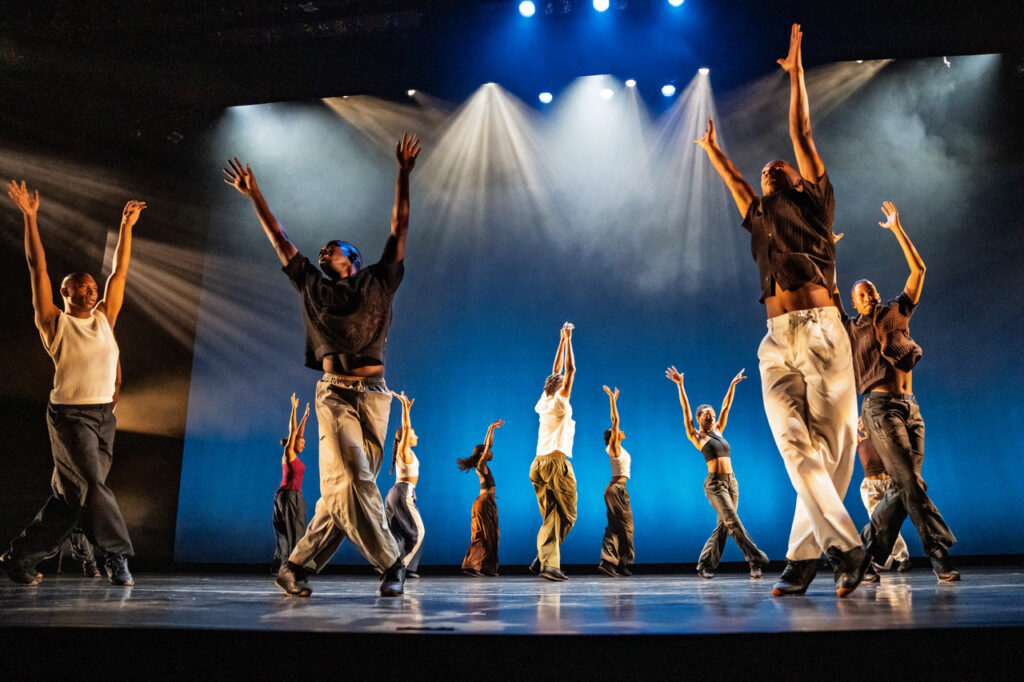
The Philadelphia Dance Company, known as Philadanco!, was created to provide opportunity. The Philadelphia School of Dance Arts was opened by Joan Myers Brown in the 1960’s to provide opportunities for Black dancers to receive exceptional training. Ten years later, Philadanco! was founded to provide a stage for these dancers to perform, since opportunities in the 1970’s were scarce and far between. Rather than wait for the dance world to change, Brown became the force for that change and in 1988, along with the Philadanco! staff, the first International Conference on Black Dance Companies was launched which eventually led to the formation of The International Association of Blacks in Dance (IABD).
Philadanco! had performed at the Tilles Center in NY in 2013, and I had remembered being impressed. Little did I know what this company signified. When I saw that they were coming to New York, I made sure to get my ticket and I was fortunate that Thursday July 30th also happened to be the Curtain Chat! at the Joyce Theater following the show.
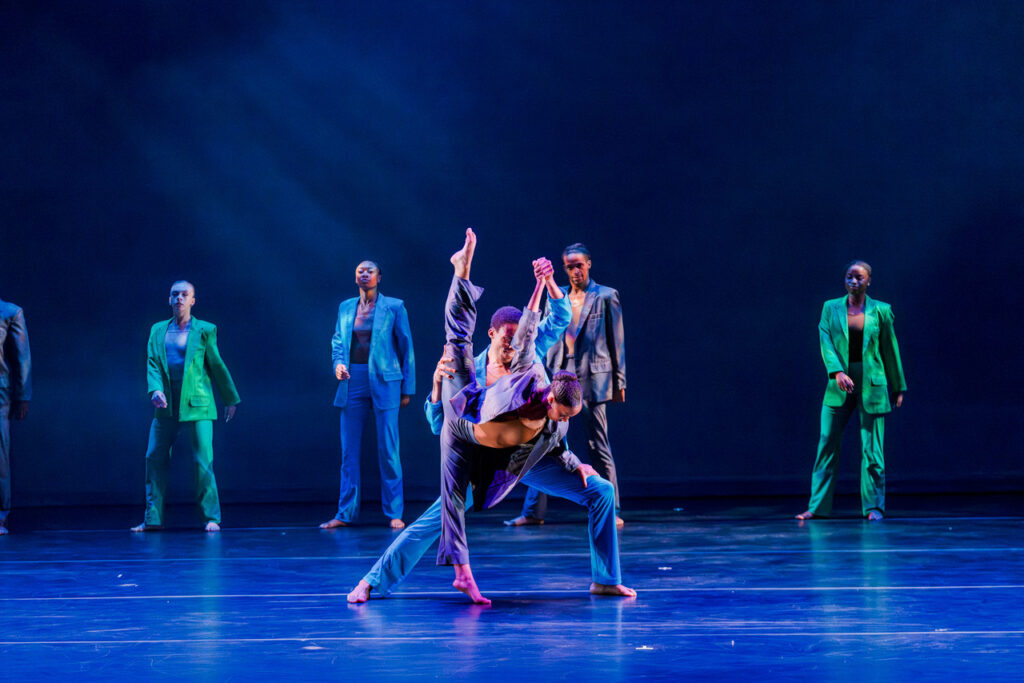
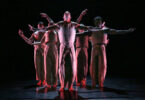
Without Witness (2021), choreographed by Thang Dao, opened the show in its New York premiere. Dancers wore skin toned leotards with a blazer and slacks in either bright green, bright blue, or grey. The dancers traveled in various locations on stage in the formation of a triangle, briefly releasing a dancer or two as they performed separately from their flock. Their placement was so precise, one wondered how this formation stayed intact, as the dancers returned to their positions effortlessly.
The music was a compilation of works by Ezio Bosso, Les Sins, Shye Ben Tzur, and Johnny Greenwood. Beginning with string music from Ezio Bosso… it was staccato, dramatic, and brought a drive to the movement. The dancers performed numerous undulations with their torsos, very much like a wave, and these undulations were so fluid… they weren’t forced in the least.
The dance continued to include two separate and distinct sections, identified by the music selection and costumes. It had shifted to an electronic song by Les Sins, and then to a song collaboration of Shye Ben Tzur and Johnny Greenwood fusing electronic beats, percussion, and voice…quite a contrast to that of Ezio Bosso! It brought on a very exciting energy. The dancers in these two segments were lined up across the stage from left to right, performing various gestures in unison.
This work was originally choreographed right out of the pandemic era and given the title Roked, which in Hebrew is the masculine singular verb of “dancing.” Since then, Thang Dao made several edits and additions along with company dancers, and renamed the work Without Witness to represent, as he put it, “living and dancing so freely without the eyes of spectators.” I was left with a feeling that there was more to be done…an additional section that had yet to be discovered. It seems apropos considering this was a revision from the original. From my perspective, the work is still in progress. And maybe that is just how one is supposed to feel, because one should never stop dancing. To stop, would mean to no longer live!
The opening and closing pieces, Without Witness (2021) and Enemy Behind the Gates (2002) were both contemporary dance pieces that resembled one another, while the two sandwiched in between demonstrated two different styles. To Philly, Love Rennie (2026) choreographed by Rennie Harris and Promise Me You Won’t Call (2025) by Tommie-Waheed Evans will both be featured again in Philadelphia this December as part of a larger project that collaborates with Philadelphia International Records… a program appropriately named “For the Love of Philly!” The show will highlight Philadelphia’s major contributions in music, dance, and culture as its influences moved beyond Philly and to an international audience.
To Philly, Love, Rennie included a mashup of songs from The Sound of Philadelphia, The O’Jays, and Harold Melvin & the Blue Notes. Kenneth Gamble and Leon A. Huff were two producers and songwriters known for creating the Philadelphia soul/Philly Sound music genre that started in the 1970’s. It was a sound I was not accustomed to. The discussion panel that followed the performance clearly grew up with these songs. I found myself struggling to connect to the music as dancers moved on and off stage, however, suddenly there was a break from the constant movement…there was a repose. The music seemed to slow down, or the dancers made it seem so. Dancing in sync, a group filled the stage, and the choreography mimicked the music notes. It created a visual representation that allowed me to appreciate, connect, and find an understanding as the music proceeded.
The movement had a Hip Hop and street dance flare. I felt as if I was at a dance club. It was not showy or full of tricks…it was a bunch of people in street clothes having fun. As I watched, I thought….how lucky are they: Dance on stage, have fun, and get paid for it! The dancers zipped on and off in pairs, trios, and quadruplets. It was fun and energetic, but I know that it demanded a great amount of stamina, and meant much more than what met the eye. As stated in the program, the dance “…is an artistic celebration of the diverse fabric that defines Philadelphia, illuminating its struggles, triumphs, and the unwavering spirit of its people.” I loved that the bows became a part of the piece. The music continued. The dancers performed a choreographed movement and then took a bow. They pursued this one group at a time. This ending was perfect!
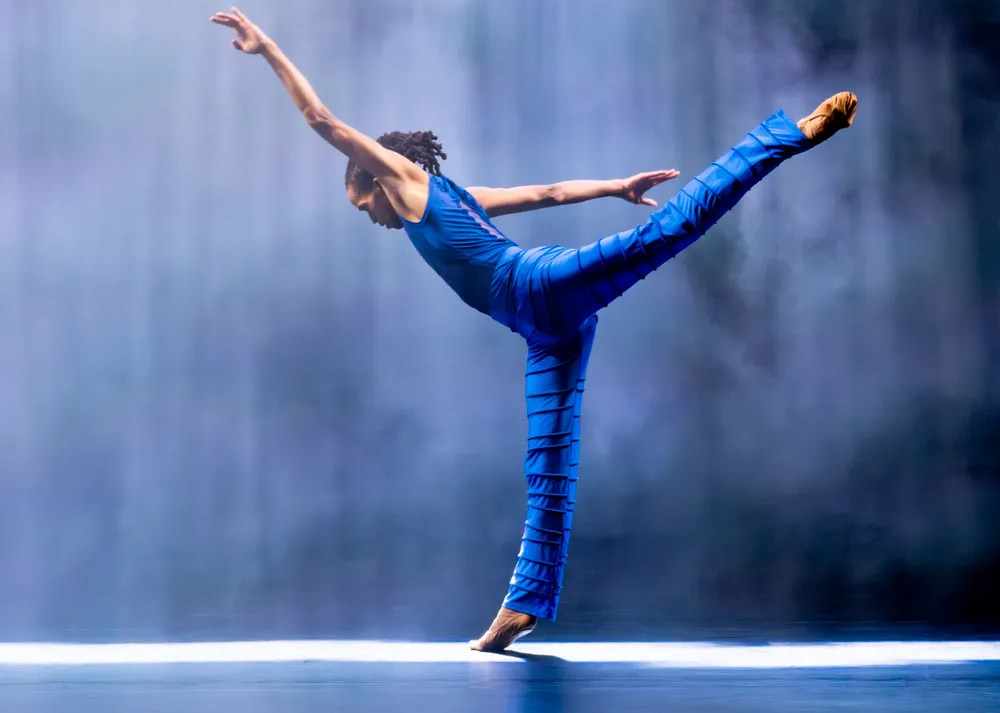
The show continued with Promise Me You Won’t Call (2025) choreographed by Tommie-Waheed Evans, in collaboration with company dancers. It gave the ambience of a love story as partners moved on and off the stage. The lights presented as a curtain, as if telling a love story…. a love story on stage and off, a past love versus a present, a love that’s still felt, but lost. One could say that the audience was immersed in the experience of how Evans was processing and reminiscing about a love that took its course.
The dancers were appropriately dressed in blue, as if to represent the sadness that comes with any heart break. Smoke fogged up the stage. Dancers were sliding from one side to the next as they entered, ready to tell their story. The choreography highlighted the companies’ signature strengths with beautiful partnerwork, lifts, leg extensions, and turns.
The music was a compilation of songs by Patti LaBelle as well as Harold Melvin & The Blue Notes featuring Teddy Pendergrass. All of a sudden the song “Somewhere over the Rainbow” came on, and the dancers moved like a group of blue birds flying together.
The lighting was absolutely fantastic! The lighting designer, Nick Kolin, set the lights for the first three dances, and the third was a masterpiece! The lights created a curtain that shifted forward, just like one might see a rain shower pass in the distance… However, this time it was coming towards the audience. The lights created the landscape of the piece.
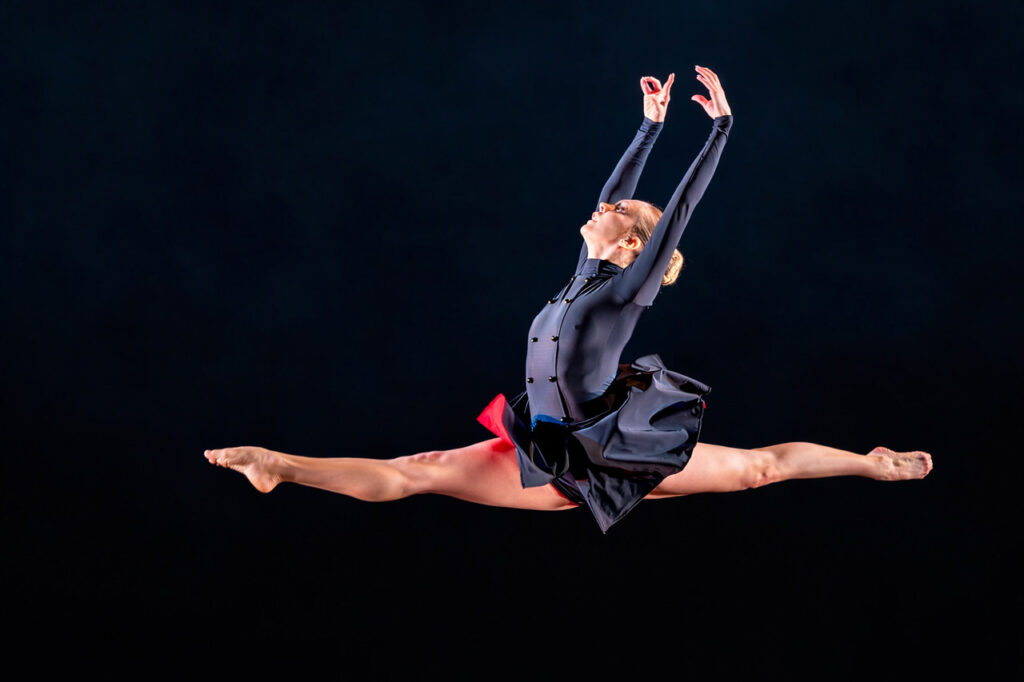
Lighting designer William H. Grant, III, enhanced the work of the last choreographer of the night Christopher Huggins, Enemy Behind The Gates (2002). The moment engrained in my thoughts, was the image of white lights layered down the stage in a gradient V. Another was the image created by a layer of color, red or dark magenta, laying along the stage like a river that just draped across, just below the dancers waistline. The men and women were dressed all in black, long sleeves, skin tight leotards with double-breasted black fabric buttons that flared out into skirts. The men wore black leggings while the women were bare legged. A hint of red or magenta fabric glimmered on the underside of their skirts.
Above the dancers was a white haze….this was significant considering the piece was created in response to 9/11. It was dramatic and powerful. The work was militaristic and choreographed to the music of Steve Reich who pioneered the minimalist music movement. The music was characterized as repetitious and hypnotic. The theme transformed gradually after multiple repetitions. The dancers performed with so much unison. It was such an iconic Philadanco! piece… it was the perfect one to close the show!
Should one be in New York City September 24th and 25th, Philadanco! will be performing Heirborne (my mama ain’t ever touched the sky, but she gave me wings) at NY City Center’s Fall for Dance Festival, along with the Boston Ballet and Robbie Fairchild’s Players. For the Love of Philly will be at the Perelman Theater at the Kimmel Center in Philadelphia December 4th and 5th, 2026. It will be a celebration of Philadelphia’s culture and history through dance and music…one of the best ways to visit, explore and connect with a city unknown! G&S
Leave a Comment