
Flipping through the thick pages of a beautiful playbill, carefully crafted with crisp colored photographs and advertisements, I see a list of dancers, a historical depiction of the journey, life, art, social significance and collaboration…a list of composers, sculptural artists and designers…with careful consideration a playbill was created like no other, one that I had yearned for all year. With attention to detail and the kind of care one would take to celebrate and honor the legacy of Martha Graham, it was the Centennial Celebration of the Martha Graham Dance Company. I was delighted!
I spent the last year and a half reconnecting with my first love, modern dance. What is modern dance, contemporary dance, abstract movement? Dance, as in any art form, is always open to interpretation and perspective from the individual audience member. There are times when the dance might follow a story line, and other moments when one is merely watching movement unfold in an image…movement for movement’s sake…but it’s always an image fleeting. A sculpture in motion is the way I personally describe and enjoy dance. With dance compared to other art forms, the human being is experiencing the other, moving with emotion…so without thought, the body is responding…the dance evokes an emotional response. And the Martha Graham Dance Company does that so well!
Martha Graham is often referred to as the mother of modern dance, and her company is the oldest modern dance company of the United States. February 2025 was the first time I went to see the company live. It was at the Tilles Center on Long Island, NY. The company staged a sneak preview of Cortege, choreographed by Amadi “Baye” Washington and Sam “Asa” Pratt. It awakened and provoked something in me. It made me feel alive and present. It was this performance that inspired me to write and share the beauty of what I had witnessed and lived.
The key to a good work of art is how it inspires. As an audience member you can feel alive, rejuvenated, grounded, even whole. That’s how it felt watching Cortege, which I have now seen on three very different stages. Following the preview in February, I went to see the premiere in the intimate space of the Joyce Theater in April 2025, and recently at City Center, New York a year later. At the Joyce, I was able to see the facial expressions of the dancers in grief and torment. With a moment of lifts, and grand movement, I caught a glimpse of eyeballs bulging out of their sockets and mouths wide open as if screaming in agony. With every performance, I saw something new.
For the City Center performance, I hand-picked the program very carefully. Not only was I to see Cortege, but I was set to see Cave for the second time…two contemporary works sandwiched between two historical pieces. This is where I really started to grasp the similarities between the old and the new.
At City Center, the evening began with Night Journey choreographed by Graham (1947), continued with Cortege by Baye and Asa from 2025, followed by Lamentation (a solo by Graham (1930)), and ended with Cave choreographed Hofesh Shechter in collaboration with dancers in 2022. The program provided variation. The older pieces were created by a different generation for a different time and must be appreciated for their historical significance and what they share about the culture of the time. These dances were performed at a much slower pace, in contrast to newer dances of the fast-paced modern generation of technology and social media, highlighting the cultural shift. The program provided interest and variation.
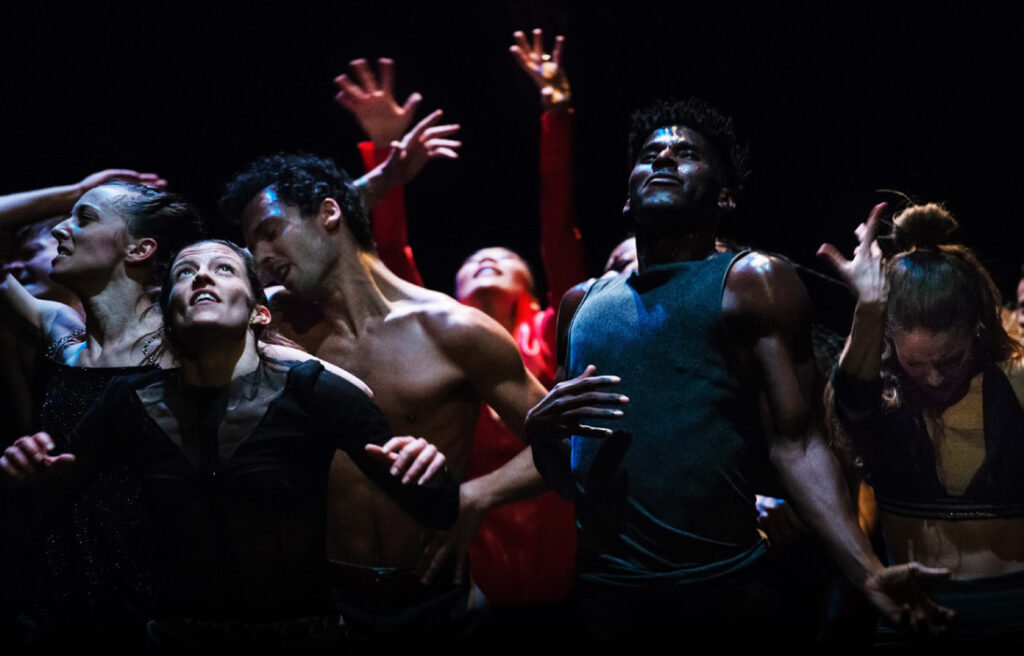
As traditional companies outsource their choreographers, the fear is that the new works will “muddy the water” stripping away the identity of the company and ending up with uniformity amongst all modern dance companies. While Baye & Asa; Asa come from a background of Hip Hop and African Dance, the work that they choreographed was created with the identity and legacy of Martha Graham in mind. Cortege is not based in Graham technique, but a modern dance work that shares glimpses of similarities to the company’s technique. The dancers are trained so heavily in Graham that their performance in any dance is informed by their movement and lends a quality that the company strives for. I find that Cortege shows qualities of Graham more closely than that of Cave. An homage to the works that Graham created in the mid 1940’s that circled around Greek mythology, Baye and Asa were inspired by Graham’s Cortege of Eagles, but choreographed Cortege through a different lens…. not one of individual characters but of a collective society…one that carries responsibility.
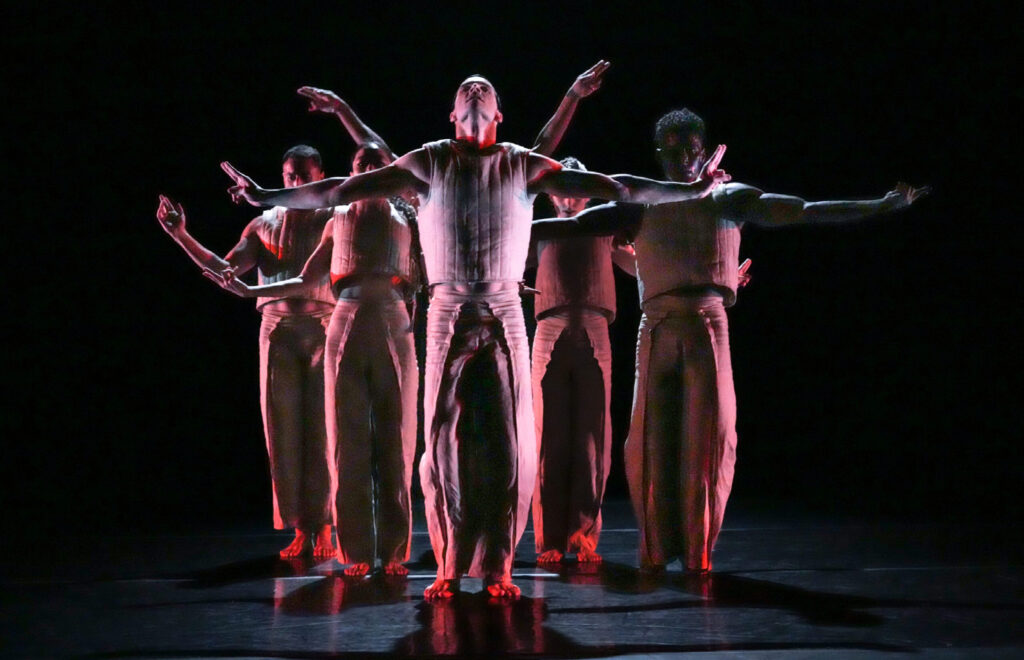
Cortege is so emotionally charged, it can only evoke a response in the audience. The dance is dramatic, powerful, violent, and demonstrates elements of war. There are moments where one can see the charging of enemy lines by how the dancers are positioned together on stage, stomping at times and then using the typical pitter patter of the feet that can be identified in other works by Graham. The fourth position spiral that is typically seen in the Graham floor exercises, can be seen in a lift mid-air. There’s a moment where the arms curve and cross one over the other behind the back and then over the head. It’s as though the arms are spiraling within the body vs. around the body as Graham did. The movement is much more fluid as the dancers travel to take up more space on stage but Baye and Asa do utilize the sharp staccato beat of the music to create bursts of stillness within the piece. They orchestrated poses with multiple dancers that are held in stillness, accented by various spotlights. The dancers moved as if being electrocuted, which is what draws so much emotion and violence.
The Graham legacy is not only seen within some of the movements but can also be seen by the choice of costume, music, and lighting. Just as Graham used props and structures on stage to enhance the dance, Cortege uses the dancers to create the image of the Trojan Horse. Rather than physical structures, the lighting is used with purpose to enhance and create focus. The music sounds reminiscent of the ticking of a clock…what does the clock signify? Time of death? Time to act? Time passing? Baye and Asa did a beautiful job of creating contrasts in time and space. The music created for the new work was also inspired by the original score of Eugene Lester that was made for Cortege of Eagles. The dancers wore vests to symbolize armor going into battle, but also as a burial covering. I associate the vest to the likeness of a strait jacket…trapped, contained, secure. A black cloth reveals the dancers once the curtain opens and then covers them at the end as one might cover those in a burial ground. The intensity of war is evident in the piece, and as guest choreographers it appears that Baye and Asa really collaborated with every artist, (Costume Designer Caleb Krieg, Lighting Designer Yi-Chung Chen, Music Composer Jack Grabow and the dancers) to make this piece truly a Martha Graham Dance Company piece.
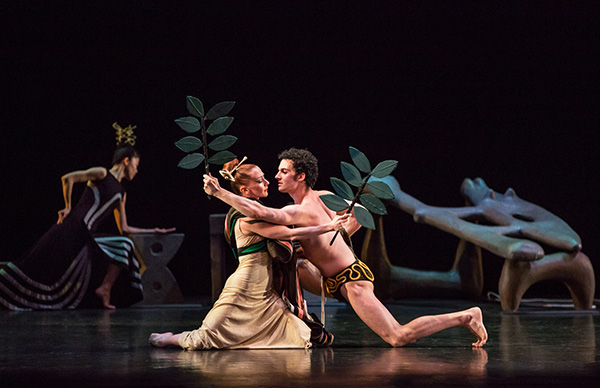
Finally N, ight Journey was the perfect opener to Cortege. The first historical, the second contemporary, the contrast allowing the viewer to analyze the differences, similarities, and find appreciation for both mythological pieces. It demonstrates how new choreographers can honor a legacy while still holding true to their identity. The dance speaks for itself. The next time the Martha Graham Dance Company is performing, look for Cortege, you won’t be disappointed. G&S
bayeandasa.com
All photos copyright and courtesy of Martha Graham Center of Contemporary Dance, Inc. marthagraham.org/graham100



Leave a Comment