
As we celebrate 250 years of our nation, we owe a great debt to the artistic vision of a group of mid-19th century painters who decided it was time to both claim and acclaim the natural beauty of our country. The Hudson River School—which thrived from the mid-1820s to around 1880—was America’s first true artistic fraternity, establishing a distinctly American style of painting that memorialized the nation’s untamed wilderness. Founded by Thomas Cole (1801–1848), the group portrayed the natural wonders of the USA as a spiritual, sublime force, which in turn helped promote national identity, early conservation efforts, and—for better or worse—the ideology of Manifest Destiny. Rather than imitating traditional European settings, the group helped create a national identity by painting our country’s unique landscape: first the Hudson River Valley, the Catskills and Adirondacks of upstate New York, and the panoramas of nearby New England; and then, the broad plains and spectacular mountains beyond the Mississippi River.
The term “Hudson River School” was coined by the New York Tribune art critic Clarence Cook and the landscape painter Homer Dodge Martin in the late 1870s because many of the first members initially painted their scenes en plein air in the Hudson Valley and its environs. In fact, “down river” in New York City became the de facto center of the group, with several artists having studios in the Tenth Street Studio Building in Greenwich Village. Further, some of the group’s leading exponents—Cole, Frederic Church (1826–1900), Jasper Cropsey (1823–1900), and Robert Weir (1803–1889)—had homes along or near the River that would become historic house museums by the 20th century, including Olana State Historic Site (Frederic Church’s home) in Hudson, New York; the Thomas Cole National Historic Site in the town of Catskill; and the Newington-Cropsey Foundation’s historic house museum, art gallery, and research library in Hastings-on-Hudson, New York.
Known for their meticulous attention to detail, dramatic lighting, and idealized naturalism, the first generation of artists created works that would become the foundation for what is now called Luminism, a style of painting that emphasized the transformative, serene effects of light by using hidden brushstrokes and polished surfaces, often featuring glowing light in expansive skies and reflected in calm water. Additionally, the nearly photo-realistic attention to detail frequently idealized nature, juxtaposing both peaceful agricultural and rugged wilderness subject matter with the railroads and factories beginning to overtake many formerly pristine regions.
Of the first generation of Hudson River painters, Cole and his friend Asher Durand (1796–1886) are pivotal. Cole was deeply inspired by the brilliant colors of the American landscape and focused on dramatic, often allegorical landscapes of the Hudson Valley and Catskills, highlighting the raw power of nature. Durand embraced a more realistic, detailed style of painting compared to Cole’s dramatic tone. Sometimes accompanied by Cole, he would go on sketching expeditions, spending summers creating pieces in the Catskills, Adirondacks, and eventually the White Mountains of New Hampshire. He later turned hundreds of these drawings and oil sketches into finished academy pieces that helped to define the Hudson River School “look.”
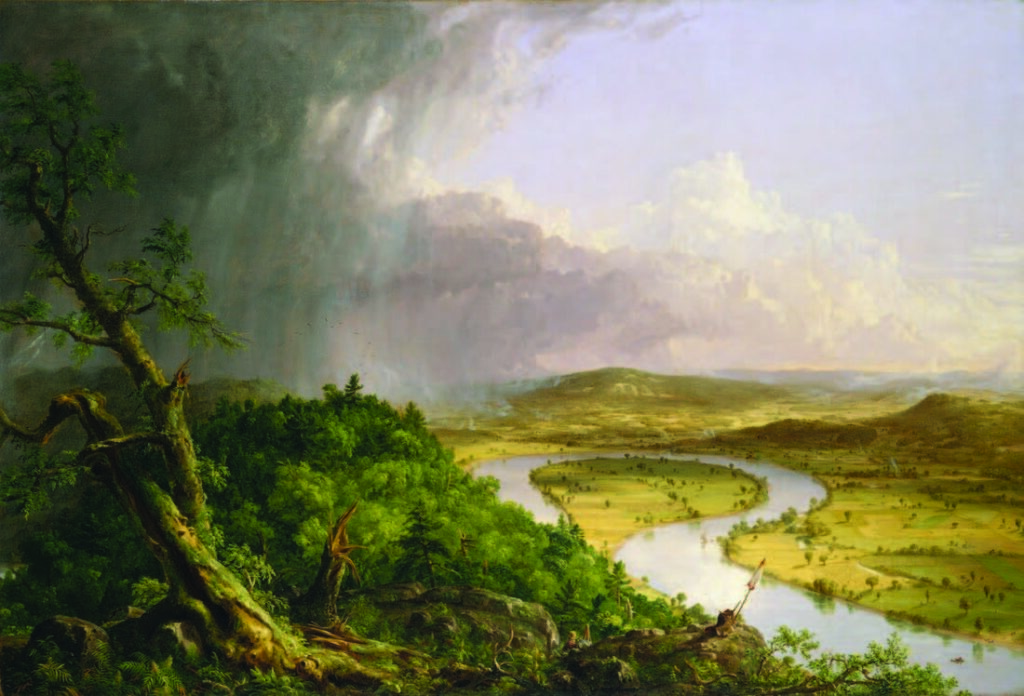
Through well-known works like Cole’s The Oxbow (1836) and Durand’s The Beeches (1845), we also recognize that they viewed the wilderness as a direct reflection of God. As a result of that belief, they embraced the environmental conservation of God’s world by fostering a sense of awe for the vast expanses of our country, both in the Hudson Valley and beyond. Ultimately, they saw their art as prophetic—a means to preserve the American landscape.
A second generation of Hudson River School artists emerged after Cole’s premature death in 1848; its members included Cole’s prize pupil Frederic Edwin Church as well as John Frederick Kensett (1816–1872) and Sanford Robinson Gifford (1823–1880)—all three of whom were among the founders of the Metropolitan Museum of Art in New York.
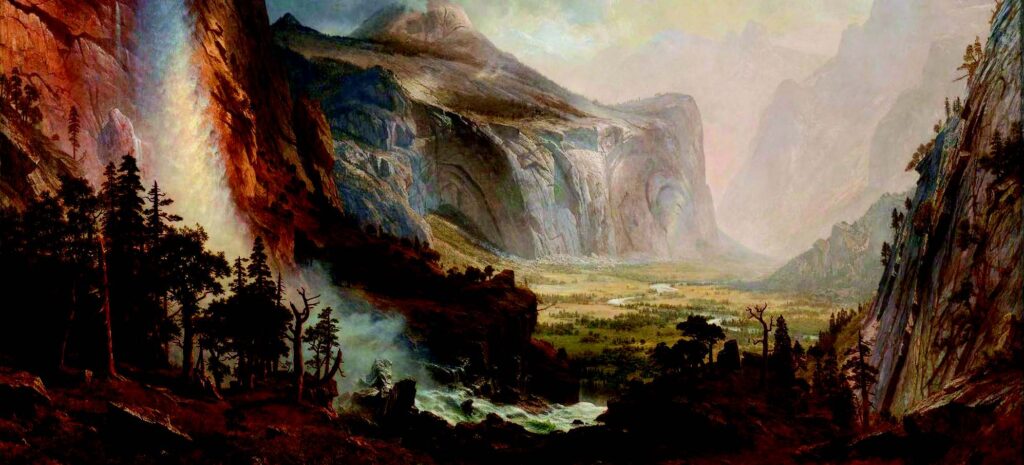
Most of the finest works of the second generation were painted between 1855 and 1875, and artists such as Church and Albert Bierstadt (1830–1902) became celebrities. Thousands of people would pay 25 cents or more per person to view paintings such as Niagara (Church, 1857) and The Domes of the Yosemite (Bierstadt, 1867). The epic size of these landscapes—often 10 or 12 feet by 14 to 15 feet—was unmatched in earlier American painting and absolutely reminded Americans of the vast, untamed, and magnificent wilderness areas in their country.
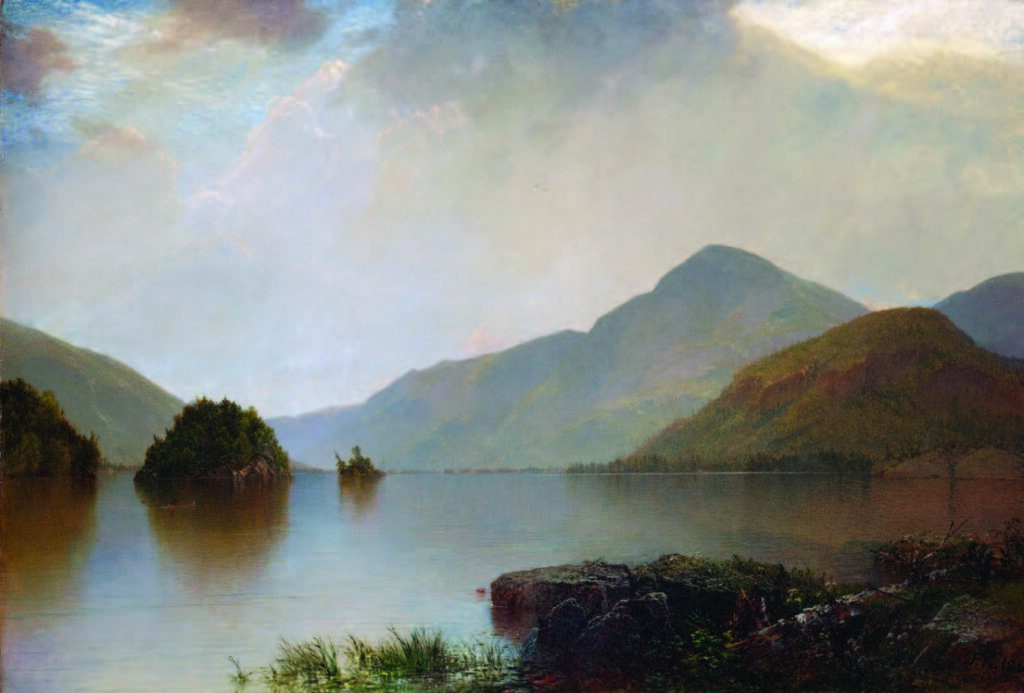
Another leading figure of the second generation was John Frederick Kensett (1816–1872) who became known for his quiet, atmospheric scenes of the Hudson River and the New England coast. His Lake George (a work from 1869 measuring over 5.5 feet wide and nearly 4 feet high) is a masterpiece of luminist landscape.
We must acknowledge that the School’s second generation also espoused the politically and morally freighted belief in Manifest Destiny. For example, many of the paintings of Bierstadt and Church presented sweeping panoramic landscapes depicting the seemingly endless expanses of the West that were meant to represent and foster the tenet that American expansion was divinely ordained. While many of the second-generation painters were sympathetic towards Indigenous people and their love of nature and spirituality (because it mirrored their own conservation-centric beliefs), they tacitly (or openly) condoned the western geographic and dogmatic expansion of the United States.
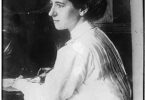
Several women also became associated with the School at a time when it was difficult for them to break into the male-dominated art scene. Three standouts from the period are Susie Barstow (1836–1923) who painted the scenery of the Catskills and the White Mountains; Julie Hart Beers (1835–1913), a rare professionally successful female artist of the era, who became well-known for her sketching expeditions; and Harriet Cany Peale (1799–1869), a student and later wife of the famous portrait artist Rembrandt Peale. Her masterful, moody landscapes such as Kaaterskill Clove (1858) epitomize the School’s celebration of America’s natural beauty.
So, while our nation was beginning to develop its voice in literature through writers like Nathaniel Hawthorne and James Fenimore Cooper and in music through composers such as Stephen Foster, Louis Moreau Gottschalk, and John Philip Sousa, it was also creating an environment that allowed the Hudson River School to flourish and paint its many glories. As the mid-19th century became dominated by the settlement of the West and the creation of national parks—not to mention the establishment of meticulously designed city parks—the Hudson River artists were there to proudly document it all. G&S

Leave a Comment