

Violet Oakley (1874-1961) was undeterred by constraints or stereotypes. Her love of art, she said, was “chronic and hereditary.” She grew up in a prosperous home in northern New Jersey. Both of her artist grandfathers were founding members of the National Academy of Design in New York. Three aunts who were painters of still life and portraits kept young Violet supplied with Old Master prints to copy. Despite her love of art and the enthusiastic support of her family, however, she would be fighting an uphill battle.
Opportunities for women, especially in the flourishing illustration arts, were fraught with limitations. They still faced exclusion from many fine-art schools, or at the least from foundational life drawing classes with nude models. Critics, including women, often couched their praise in terms that reflected clichéd views of “naturally feminine” styles and subjects. Many editors steered women to genteel depictions of home and children. Some excelled at and profited from such content. Others defied expectations and forged successful wider careers, despite male commentators’ laments that the illustration profession had fallen victim to “feminization.”
But not all reviewers agreed. In 1900, art critic Regina Armstrong published three articles titled “Representative Women Illustrators” in the literary magazine The Critic. Her essays encompassed book and magazine covers, fiction and non-fiction illustrations, posters and prints, and designs for murals and stained-glass windows. Armstrong highlighted the multi-talented “Miss Violet Oakley…(who) has performed noteworthy efforts in all these mediums of expression… (Her) fondness for color work has led her into the execution of designs for stained glass windows… which has carried her into an artistic alliance with architectural design.”
Armstrong’s articles alluded to several trends in American art and society. New color printing techniques brought illustrated books and magazines, and eye-catching advertisements and posters, to bookstores, libraries, kiosks, and city streets. The City Beautiful philosophy fostered civic pride and aesthetic quality, and motivated support for large-scale murals in public architecture. The Arts and Crafts movement, allied with the Gothic Revival in church decoration, led to calls for stained-glass windows in houses of worship and private homes. And while Tiffany Studios served the wealthy, smaller competitors produced more affordable windows.
When Oakley returned home in 1896 from her years of study in Paris, she enrolled at the Pennsylvania Academy of the Fine Arts in Philadelphia. A year later, when her father’s illness diminished the family’s income, she joined Howard Pyle’s illustration classes at Drexel Institute of Art, Science and Industry (now Drexel University), hoping to support herself as an illustrator. Within a year, she collaborated with classmate Jessie Willcox Smith on illustrations for an edition of Henry Wadsworth Longfellow’s Evangeline: A Tale of Acadie.
A decade of commissions followed from national magazines, including The Ladies’ Home Journal, Century Magazine, and Collier’s Weekly. Oakley and Willcox Smith, and their fellow illustrator Elizabeth Shippen Green, lived in a cooperative home and studio for several years, and they were founding members of the Plastic Club in Philadelphia, a professional organization for women artists.
Oakley soon branched out into murals and stained-glass. After an apprenticeship at the Church Glass and Decorating Company in New York, she designed murals, a mosaic, and five stained-glass windows for All Angels’ Church at 81st Street and West End Avenue in Manhattan (demolished 1979). The commission was the beginning of an international career and a volume of artistic work that one commentator described as “staggering.”
In 1903, Mary K. Gibson engaged Oakley to design two windows illustrating Shakespearean comedy and tragedy for Maybrook, the suburban Philadelphia mansion that she had inherited from her father, liquor distillery magnate Henry C. Gibson. Oakley produced detailed preparatory drawings and paintings for The Tempest and Hamlet in her studio. At the top of a major study for Hamlet, the line “The play’s the thing wherein I’ll catch the conscience of the king” appears in mediaeval lettering. That quote from Hamlet’s soliloquy reveals his plan for a performance intended to expose his father’s murderer.
In the foreground, Hamlet watches the characters during the play, and King Claudius’s reaction confirms his guilt. Terrified, he and Queen Gertrude flee as the courtier Polonius raises his hands in shock. The seated Ophelia stares ahead in dismay. Below, Elizabethan musicians play lutes, recalling the music that accompanied Shakespeare’s plays. Brilliant colors and exaggerated gestures enliven the fully-realized main figures.
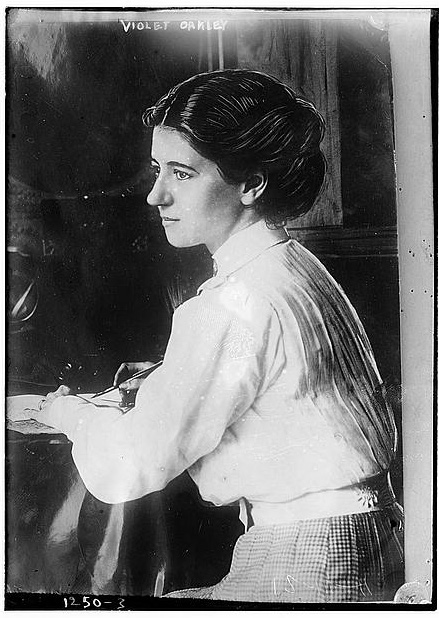
Oakley was already preparing for her next challenge: she had been chosen by architect Joseph M. Huston as the muralist for the Governor’s Reception Room in the new Pennsylvania State Capitol in Harrisburg. As Patricia Likos Ricci noted in her groundbreaking article “Violet Oakley: American Renaissance Woman” (The Pennsylvania Magazine of History and Biography, April 2002), Huston stated that he selected Oakley “purely because of the superior excellence of her work…and (as) an encouragement of women of the State.” The choice generated headlines such as “Woman Pioneer as Decorator of Great Capitol” and “Brilliant Young Woman Commissioned to Paint Mural Decoration.” In her 13 canvases, Oakley’s imagery reflected William Penn’s Quaker vision of a government anchored in nonviolence, equality, and freedom of thought. She completed the murals in 1906.
Over the next five years, Oakley produced several murals and stained-glass projects for schools, churches, and homes. She traveled to Europe and studied historic examples to perfect her skills. In 1911, when chief muralist of the Pennsylvania State Capitol Edwin Austen Abbey died unexpectedly, Oakley was commissioned to complete murals of various shapes and sizes in the Senate Chamber, where her paintings commemorated Penn’s hope for national and international unity. Hers are the only murals to depict the slave trade in a civic building before the 1930s. In the Supreme Court Chamber, her 16 panels represented the history of law and included an image of Penn as the Law Giver. All 43 Capitol murals were installed by 1927.
Oakley used scaffolding to paint on extra-large, heavyweight canvases in her studio and supervised their transport and installation. As Likos Ricci pointed out, such demands explain why “…no aspect of Violet Oakley’s career impressed her contemporaries more than the fact that she was a woman who could do a man’s job… Painting walls on scaffolding required physical agility and stamina that seemed beyond the capacity of the tightly corseted contemporary woman with her cumbersome ankle-length skirts.” Over the next decades, Oakley continued her diverse professional work. A committed pacifist, she made portraits of the delegates to the League of Nations and the United Nations, and documented the latter’s inaugural sessions.
After Oakley’s death in 1961, her life partner, artist Edith Emerson, oversaw the preservation of her art and papers. After Emerson’s death in 1981, contents of Oakley’s studio were distributed to museums and the Archives of American Art. Woodmere, an art museum and educational institution in Philadelphia, holds the largest collection of Oakley’s works and maintains an extensive website dedicated to the artist.
The Philadelphia Museum of Art’s exhibition “Workshop of the World: Arts and Crafts in Philadelphia,” has highlighted late nineteenth and early twentieth century artists who “sought to beautify everyday life through simple designs, hand craftsmanship, and pre-industrial models… and made a distinctive contribution to the artistic and social transformations of the era.” The exhibit runs through October 11, 2026. As a well-earned tribute, Violet Oakley’s work is on the catalogue’s cover. G&S
Mary F. Holahan ©2026



Leave a Comment