
On November 7, 1991, during one of my early trips to Russia, Mayor Anatoly Sobchak, standing on a pedestal in Palace Square behind the Hermitage Museum, in a speech that lasted more than an hour, celebrated the renaming of Leningrad back to Saint Petersburg. (The name of the city had been changed to “Leningrad” on January 26, 1924, five days after Lenin’s death.) Because of the celebrations, the Hermitage was closed for the day. The next day, however, I was able to visit with Sasha, a curator at the Hermitage whom I had met elsewhere. He had keys to various rooms that were closed to the public, mostly due to a shortage of staff and a lack of visitors; there were very few people inside.
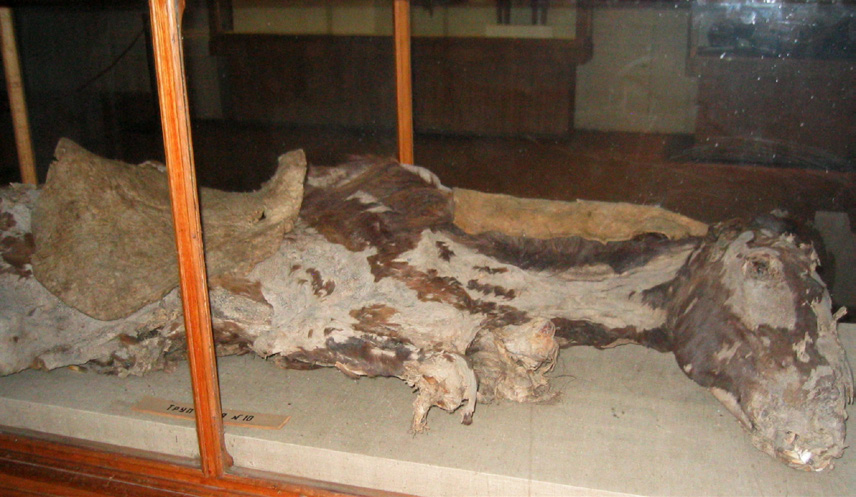
The Hermitage is perhaps the greatest museum in the world. It rivals the Louvre and the Met in many ways and exceeds them in others—most notably in the splendor of its buildings and historic furnishings. We viewed a portion of the vast array of paintings, including two Madonnas by da Vinci, 24 Rembrandts, and a marble sculpture by Michelangelo. (For context, the Rijksmuseum in Amsterdam holds 22 Rembrandts.) Sasha unlocked doors to the rarely visited silver and porcelain collections. He also brought me to a room housing the “frozen” treasures of the Pazyryk civilization, a Central Asian nomadic culture of the Altai Mountains, featuring a mummified horse. This particular room was rarely open to the public, and a mummified horse is a rare sight in a museum—or anywhere else, for that matter.
The Pazyryk culture was first discovered in 1865 by Vasily V. Radlov (also known as Wilhelm Radloff), a German-Russian linguist and ethnographer. Some of its kurgans were first excavated in 1929 by Russian archaeologists Sergei Rudenko and Mikhail Gryaznov. (Kurgans are ancient, mound-shaped burial tombs from the 6th to 3rd centuries BCE, often created for high-status individuals.) Scholars at a 2008 UNESCO conference emphasized the outstanding universal importance of the Altai region as the cradle of Central Asian nomadic civilizations. The area possesses an abundance of cultural and historical monuments from different epochs, with the Pazyryk Culture being uniquely significant. These artifacts testify to a flourishing culture that benefited from the many trade routes and merchant caravans passing through the area.
Fortunately, the Siberian permafrost did an excellent job of preserving these artifacts and human remains. While the treasures include precious metals, the highlights are the ancient carpets and fabrics that escaped decay due to the freezing conditions, alongside pottery, utilitarian objects, trade materials and mummies.
To me, these archaeological and anthropological finds testify to the incessant human creative impulse since time immemorial. They also reflect the assumptions made by endless societies regarding burial methods; each culture, including our own, maintains its own beliefs about what is necessary for the dead, though the rulers and the rich have always been entitled to upgrades. We have seen the wonders buried in Egyptian tombs, which were designed to provide the deceased with what they would need while “living” in the afterlife. Altaic cultures clearly held similar beliefs.
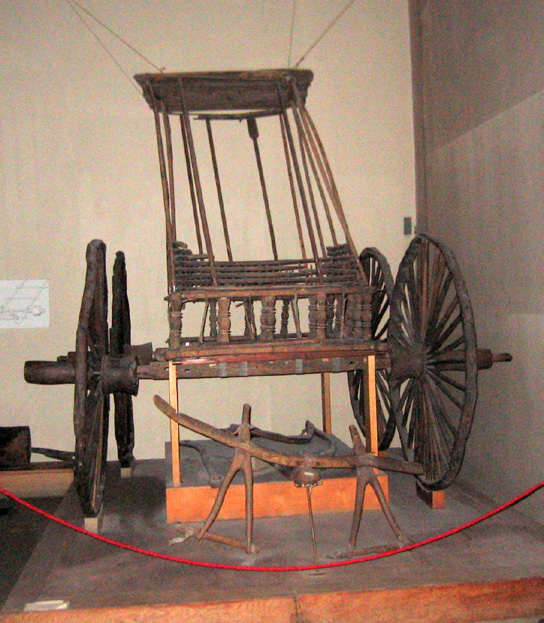
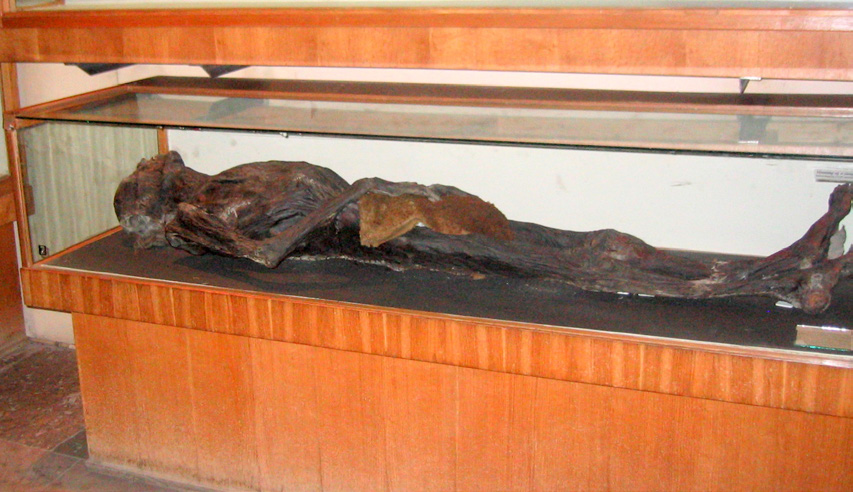
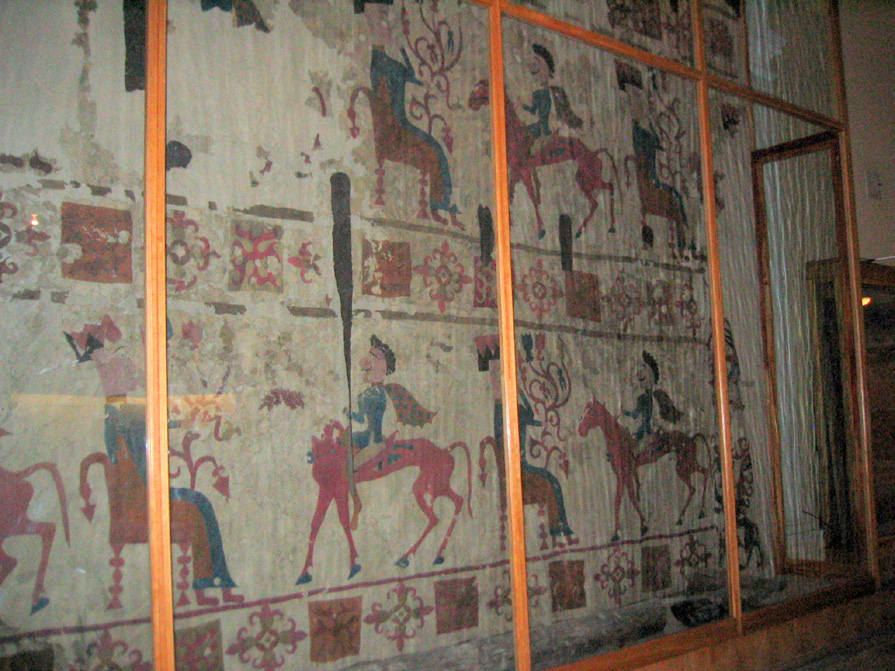
In addition to the mummified horse, the room contains a large cart the horse might have pulled, the mummy of a presumed potentate who was buried alongside them, and various other objects excavated from the same tomb. Hanging on the wall is a textile that depicts, multiple times, an itinerant potentate on horseback before the seated goddess Tabiti The ancient weaving techniques are stunning; it is estimated that it would take a woman carpet weaver at least a year and a half to complete such a piece. Following the initial discoveries, more Pazyryk kurgans were excavated between 1947 and 1949, followed by excavations of nearby burial sites from neighboring societies.
Interestingly, Sasha attributed these specific finds to Boris Borisovich Piotrovsky (1908–1990), a renowned orientalist and archaeologist who directed the Hermitage from 1964 to 1990. He was also the father of the current, long-time director, Mikhail Borisovich Piotrovsky, whom I worked with in subsequent years when publishing with the museum. It was the elder Piotrovsky who hid the massive collection of 19th and early 20th-century French paintings taken from Germany at the end of World War II (known in Russia as “The Great Patriotic War”). This cache was finally put on display in 1995 by Mikhail Borisovich under the title “Hidden Treasures Revealed.” (Mikhail claimed his father never told him about the hidden stash in the basement.) It has since become a permanent exhibit at the Hermitage, though some works were moved to the Pushkin Museum in Moscow for the benefit of Muscovites—a standard USSR policy for most of the 20th century. (Notably, some of the most important works in the National Gallery in Washington, D.C., including the only da Vinci in the United States, were purchased by Andrew W. Mellon in 1931 when the Soviets were selling art to raise money for the new regime.)
In reality, Boris Borisovich’s studies were primarily devoted to the ancient Near East and other archaeological cultures within the USSR, including the archaeology and history of the Armenian Highlands. Some of his findings are displayed in a completely different wing of the museum; Sasha had apparently confused the two collections.
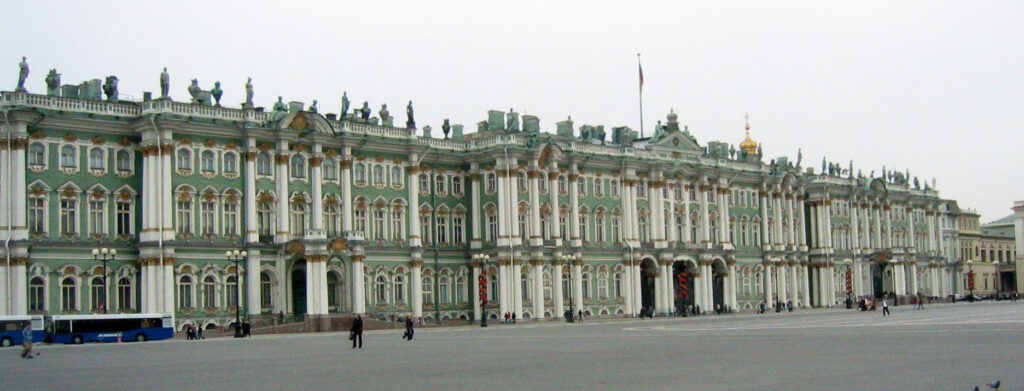
The State Hermitage Museum was founded in 1764 when Empress Catherine the Great acquired a collection of 225 paintings by Dutch and Flemish masters from a Berlin merchant (i.e., 95 years after the death of Rembrandt). Originally a private, exclusive collection housed in the Winter Palace, she named it the “Hermitage” to signify it was her private retreat. Today the Winter Palace sits at the heart of the museum, and the rooms where Catherine once entertained her paramours now house the Hermitage Library. Like the Louvre, the museum gradually expanded in the 20th and 21st centuries into adjacent buildings that formerly housed government ministries, growing into the enormous complex it is today.
My semi-annual meetings with the Hermitage librarian ended when I retired in 2002, though I was able to visit as a tourist twice since then. Although I saw the Rembrandts many times, I only managed to return to the mummified horse once. Because the museum is so vast, I still haven’t managed to see it all. Sadly, Vladimir Putin, in ‘times immoral,’ has put an end to my visits to Russia—one of which previously included a visit to his official residence on the edge of St. Petersburg, the Constantine Palace. He wasn’t home. G&S
Photos by Norman A. Ross

Leave a Comment