
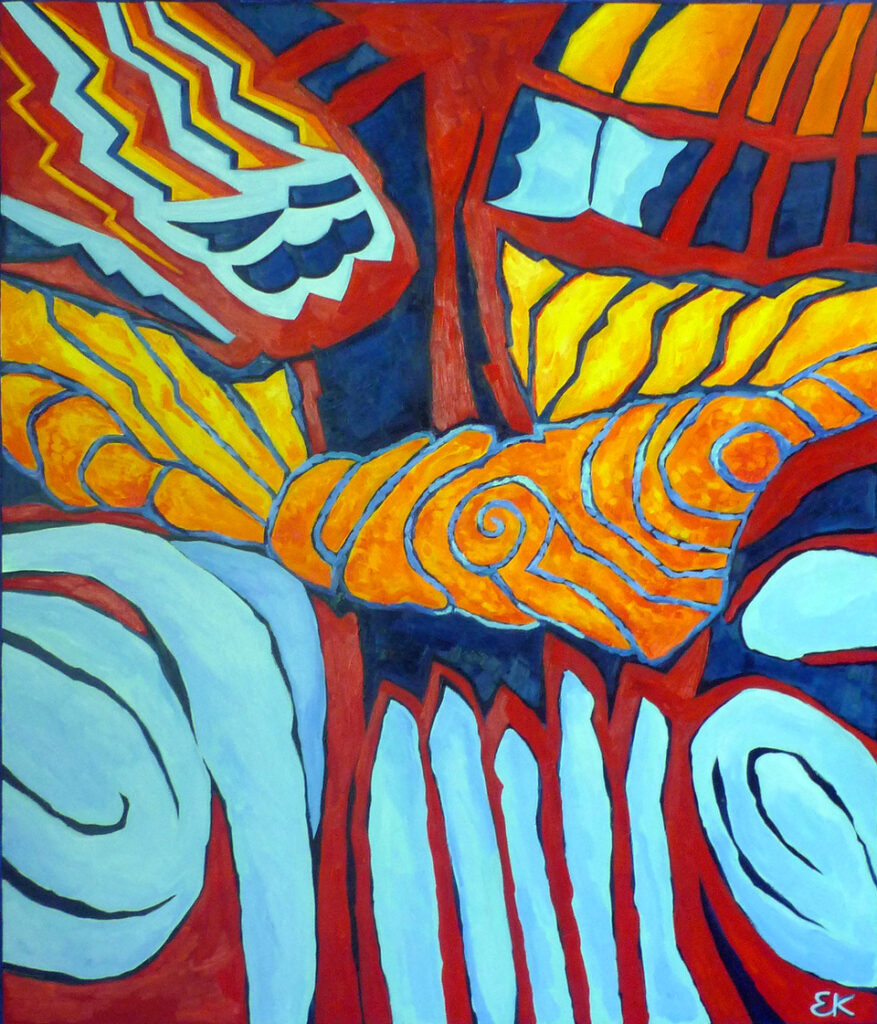
Elena Keller (b. 1951) has been painting for over half a century. Trained in academic tradition, she chose to take part in the Soviet nonconformist art movement.
A graduate of the Moscow State Academic Art College in Memory of 1905, also known as the 1905 School, Keller widely exhibited throughout Europe and the Americas. Her large oil paintings and collages have brightened museum expositions and collectors’ homes in the United States where the artist immigrated in the early 1990s. After having lived and worked in Washington, DC and New York, Keller moved to South Florida four years ago.
In her own words, “Being gifted or talented is only a point of departure, an excuse to try one’s hand at making art. This premise is an initial impulse that awakens a desire and motivates a person to create. Finding one’s voice and place in the artworld requires originality and participation in artistic dialogue. Early on, I realized that it is non-objective art that allows absolute freedom of self-expression. My path was that of exploration, relentless experimentation, and transformation of abstract visual language.” (Margaret Dikovitskaya, An Interview with Elena Keller, May 26, 2025).
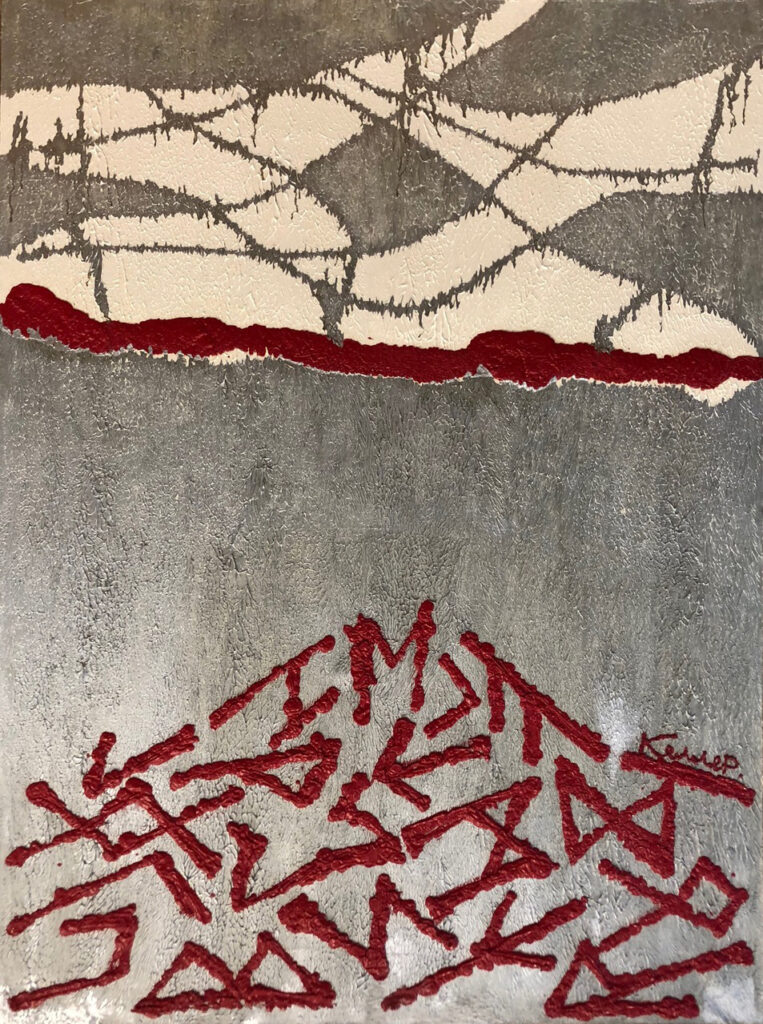
As a young artist, Keller answered the Russian avant-garde maestro Wassily Kandinsky’s call for a spiritual revolution in painting, which rises above material representation to express the soul’s vibrations and artist’s inner life through color (Kandinsky, Concerning the Spiritual in Art, 1911). Distancing herself from the figurative style of socialist realism helped launch Keller’s reputation in Finland, Germany, Italy, and the Netherlands where she closely followed contemporary art shows and visited artists’ studios. Participation in the group exhibition “Moscow-Washington” at The Carnegie Library of Washington, D.C. in 1991 was a turning point in Keller’s career.
The United States offered a wide range of creative opportunities and new audiences. Keller’s oeuvre includes several thousand paintings, collages, drawings, and prints. Her decades-long quest has resonated with the mission of this publication, to make the unknown known. Keller has been preoccupied with questions about “What makes art Art?” and “What happens at a moment when skillfulness become mastery, and a painting, taking on a spiritual meaning, transcends the boundaries of an art object?”
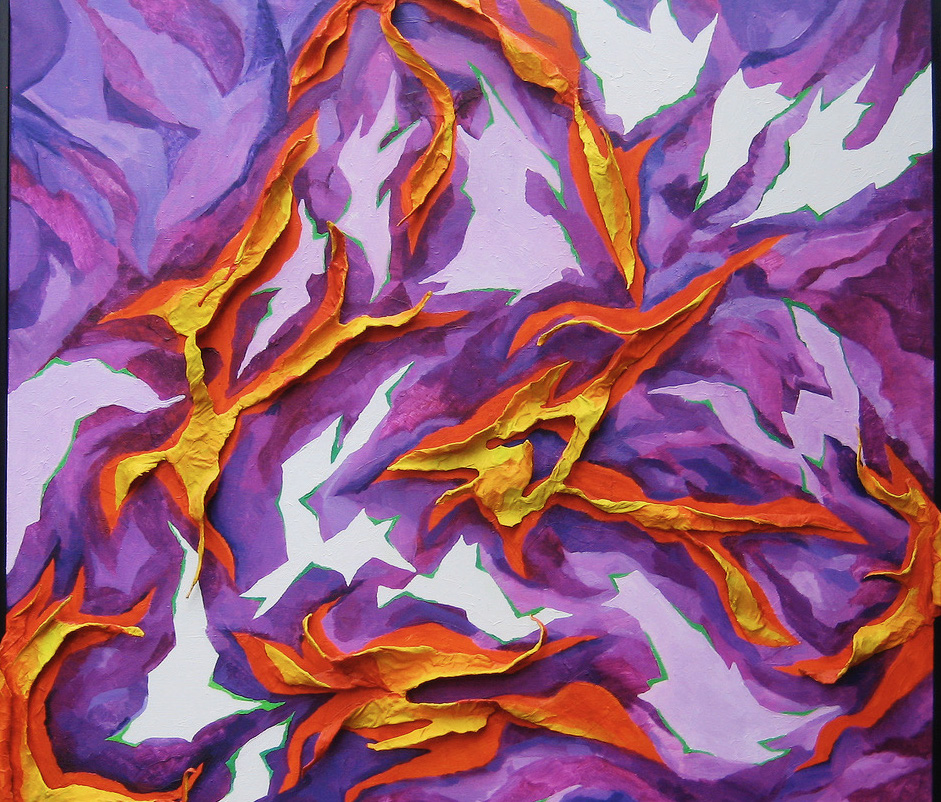
The solo and group exhibitions at New York venues, Connecticut galleries, and the Zimmerli Art Museum, Rutgers University (New Brunswick, New Jersey) revealed the mutual influence and advancement of new artistic directions between Keller and painters of the third-wave Abstract Expressionism, also known as Post-Painterly Abstraction. The Later-Stage AbEx artists and Keller focus on color as emotional and structural element. However, Keller does not rely on acrylic paint to create sculptural effects in her works.
A classically trained artist, she prefers to work with oils. To add volume, Keller uses pieces of textile often painted in contrasting colors. Stainless mesh provides support for highly textured oversized collage-paintings. While this technique can be attributed to Bernard Schultze who Keller met in Germany in the mid-1990s, inspiration for art where forms morph out of the picture plane comes from observing unusual geological formations during her travels in the Holy Land.
The artist explains, “I strive to come up with a plastic composition that possesses its own force structure, devoid of a logic of earthly relationships” (Margaret Dikovitskaya, An Interview with Elena Keller, May 26, 2025). Three-dimensional elements—spikes, irregular protrusions, and organic shapes—reach out into the viewer’s space to create an immersive, energetic atmosphere. As seen in Fire Dance (1997) these forms are used to break the boundary between the artwork and the spectator, inviting physical contact and emotional interaction.
Another difference is in versatility of the expanded palette. Works of Post-Painterly Abstraction are executed in high-key colors. Keller’s rhythmic compositions feature both high and low-key colors as well as local flat colors. Non-figurative language, monumental scale, and metaphysical vision of these artworks are complemented by a more intimate art of allegorical and proverbial storytelling. In Adam and Eve (2019), images of a contemporary couple in the biblical landscape present the scene as an atemporal event.
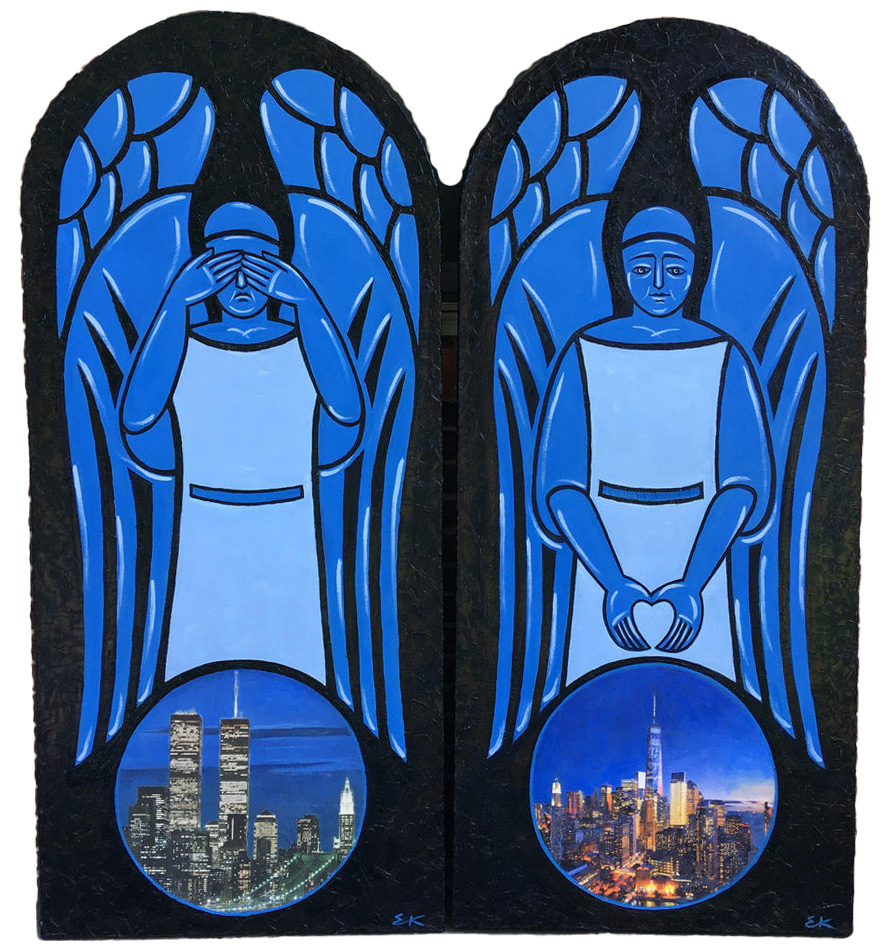
Human and celestial histories intersect in Two Angels (2018). On the left, a supernatural guardian in distress is mourning the future fate of the Twin Towers in Lower Manhattan. On the right, the new World Trade Center is lovingly protected by an angel rejoicing at the rebuilt complex.
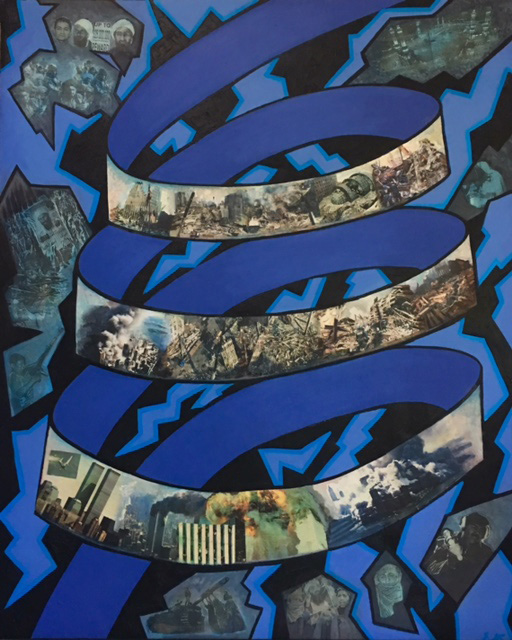
After visiting Keller at her New York studio, the director of the 9/11 Museum acquired September 11th, 2001—a large collage conceived and produced in the immediate aftermath of the 2001 terrorist attacks. It made a transatlantic journey when it was first shown at the 2003 retrospective organized by the State Russian Museum in St. Petersburg. This powerful work was on display at two group shows at Gregory Gallery in New York in 2006 and 2011.
Measuring 74″ x 61,” the composition features painted background and mechanically reproduced images—copies of the magazine and newspaper clippings—attached to the canvas. Arranged in successive order along a spiral, the view of the Twin Towers before the attack is followed by the images of destruction. No human atrocities are visualized. The angular lightning-shaped breaks in the dark background are associated with loud sound and ensuing chaos.
Images of perpetrators, the Islamic jihadists who vowed death to all Americans, included as they appeared in printed sources circulated at that time. The muted colors help focus viewer’s attention on the main element—the dynamic spiral that can be interpreted in several different ways, as a chronological timeline printed on telegraph tape, a thick smoke billowing after two hijacked planes crashed into the Twin Towers, or for Christians, as a path of Lucifer’s fall from heaven. The effect is twofold: using symbolic language of good and evil the artwork narrates the horrific events.
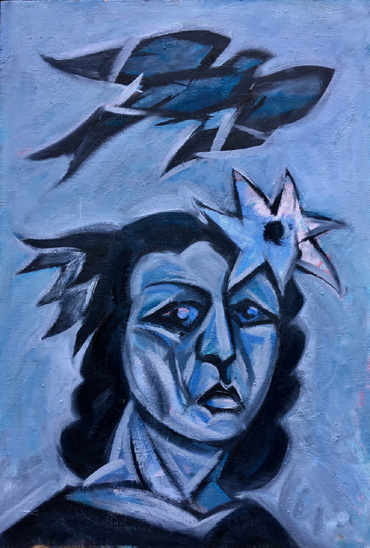
The Self-Portrait (2001) created at the time Keller was working on her iconic collage serves documentary function. A witness’s visual signature, it contains the message of tragedy and hope. G&S


Leave a Comment