
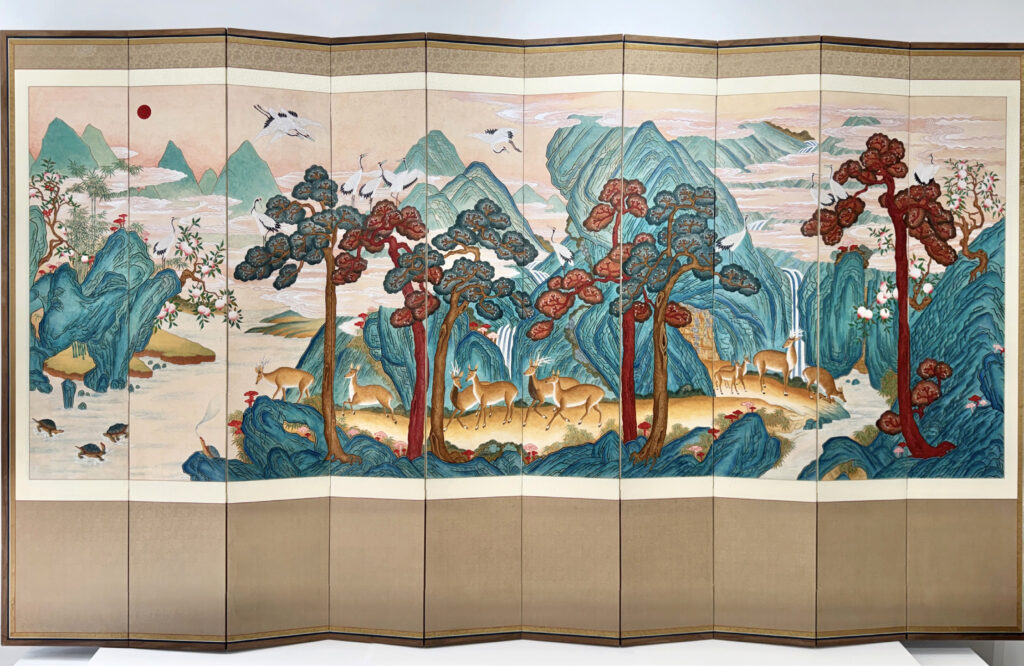
US Longevity,” at the Kate Oh Gallery seen in March, was a rarity in New York City: an opportunity to contemplate Minhwa, Korean Folk Art. Lining the gallery’s walls were bright, joyous works of art that express enduring Korean visions of eternal life.
Minhwa refers to popular painting or art of the people. Developed centuries ago, the style is rich in symbolism, conveying good wishes, and hopes for the future. Among the central themes are not only the desire for a good life, but for a long one. As gallerist, Kate Oh notes: “The enduring idea of longevity in this exhibition is a dialogue between tradition and identity.”
Ten artists—both Korean and Korean American—working in this exhibition of paintings and ceramics are women. The single male artist, Kim Jee Sun, works in ceramics. One standout created by the eponymous gallerist presents a panoramic depiction of the Ten Symbols of Longevity. Executed in mineral pigment painted on traditional Korean handmade paper, crafted from the fibrous inner bark of mulberry trees and wrapped on a wooden panel, the piece exemplifies both technical mastery and cultural continuity. Another Kate Oh work is a folding screen entitled Ten Longevity.
The Ten Symbols of Longevity comprise ten auspicious elements in Korean tradition: the sun, mountains, water, rocks, pine trees, clouds, turtles, cranes, deer, and the mushroom of immortality. Each symbolizes long life, vitality, and harmony with nature.
In a traditional lacquer painting on willow wood, Sun Hee Yang depicts a red-crowned crane, a bird known to live up to 40 years and to mate for life. The crane, often considered a messenger to heaven, may also be read symbolically here as a quiet hope for the reunification of North and South Korea. as cranes migrate between the two countries.
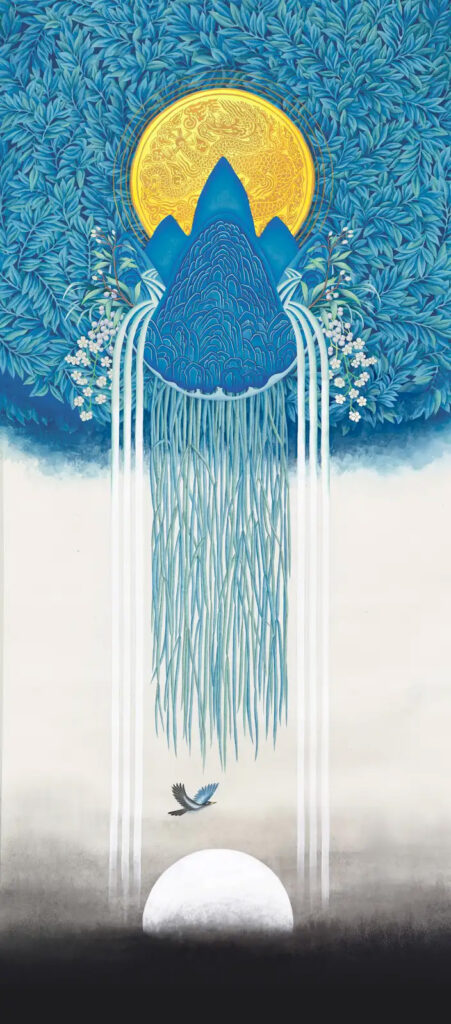
Song Yune Kyoung’s A Time for Glory (2025) is an arresting vertical composition dominated by a radiant golden sun against a decorative blue background. A barely visible moon at the base of the work appears to be greeting the sun. Celestial bodies—sun, moon, and clouds—are recurring motifs in Minhwa painting.
In addition to be being a prominent gallerist and Korean-American artist, Oh serves as a docent for the Highlights Tour at the Metropolitan Museum Art and teaches Korean Folk Traditions at Rutgers University. She recently led a Minhwa workshop at Princeton.
For her farewell uptown exhibition, Oh has chosen works of timeless beauty, each depicting one or more traditional symbols of Korean folk art. American folk art, by contrast, can be charming, quaint, historical, often memorializing a deceased child, portraying bald eagles or celebrating American holidays. Think Grandma Moses’s Catching the Thanksgiving Turkey.
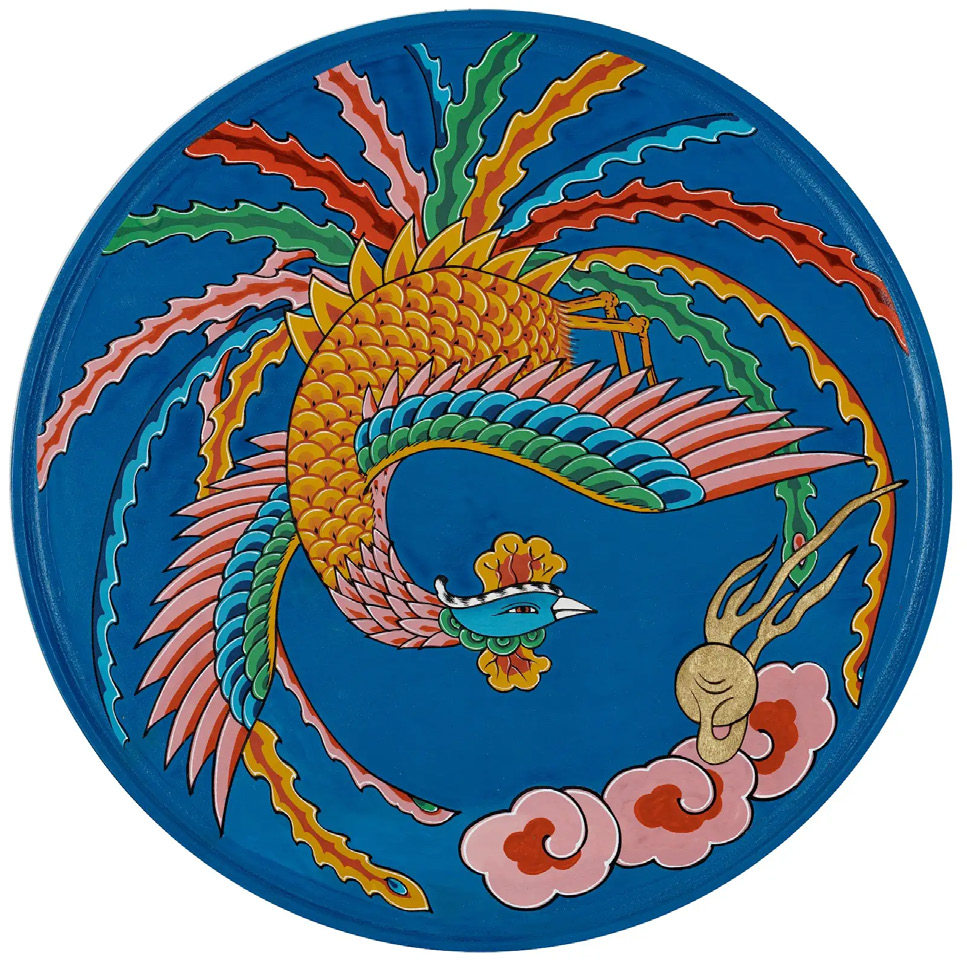
Conveying a strong sense of cultural identity, Korean folk art emphasizes a harmonious relationship with nature. The Ten Symbols of Longevity are not merely decorative, although they are visually captivating, but they are traditionally believed to have protective powers. Even the humble turtle, for instance, is thought to evoke wisdom and a long life.
The artists in this remarkable exhibition which introduces a new audience to contemporary Korean folk art are Kate Oh, Yang Ji Ae, Kim Se-Yong, Kim Ji Eun, Song Yune Kyoung, Lee Jee Sun, Moon Sook Jin, Kim Kyung Ae, Yoon Eunei and Lee Miyoung. G&S



Leave a Comment