
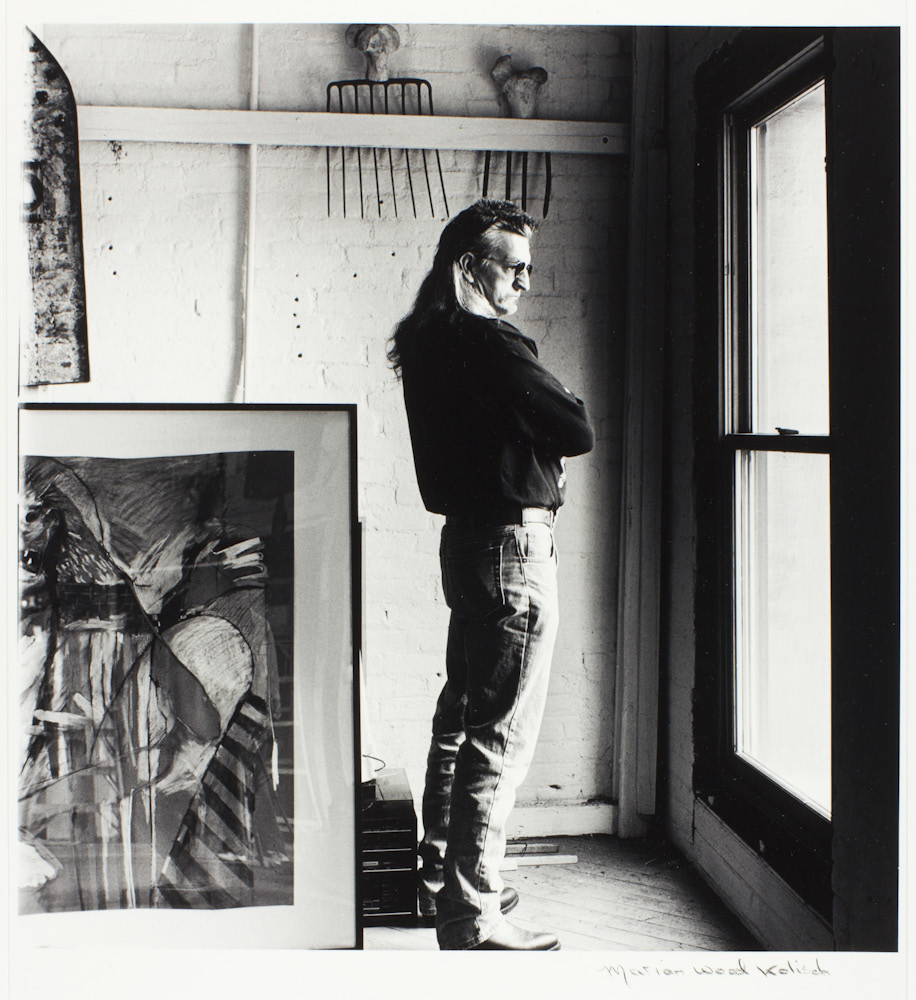
As part of its major 2025 renovation, the Portland Art Museum has redesigned and re-imagined its extensive Northwest Indian galleries, containing one of the most comprehensive and significant Native American collections in the United States. Caretaking more than 5,000 objects from over 200 tribal groups, the collection is the single-most visited aspect of the museum’s permanent holdings.
One of the prominent artists featured in that collection is Richard “Rick” Bartow (December 16, 1946-April 2, 2016) who was born (and died) in Newport, Oregon. There, he and his family—whose heritage was the Wiyot Tribe of Humboldt County, California—developed close ties with the local Siletz Indian community. Bartow became interested in art at an early age, ultimately studying at Western Oregon University. His extensive catalogue includes pastels, graphite and mixed media drawings, wood sculpture, acrylic paintings, drypoint etchings, monotypes, as well as ceramic works. His passion for art—especially that of Indigenous people—also extended to music, and Bartow became the lead singer and guitarist of his own band, Bartow and the Backseat Drivers.
After several small shows in the Newport area during the mid-1980s, Bartow began exhibiting in both Portland and New York City, eventually garnering national attention. Bartow’s large-scale carvings can be seen at the Smithsonian’s National Museum of the American Indian in Washington, D.C., and—besides the Portland Art Museum—his two-dimensional works are in the collections of several major institutions including the Brooklyn Museum; the Peabody Essex Museum in Salem, Massachusetts; and the Heard Museum in Phoenix, Arizona.
Bartow’s canvases and drawings are primarily autobiographical, generally focusing on three prime/primal areas: his personal life, both outward and psychological; his love of nature, especially animal life, which is rooted in the reverential beliefs of Native American peoples; and music, which comes from his work as a performing artist.
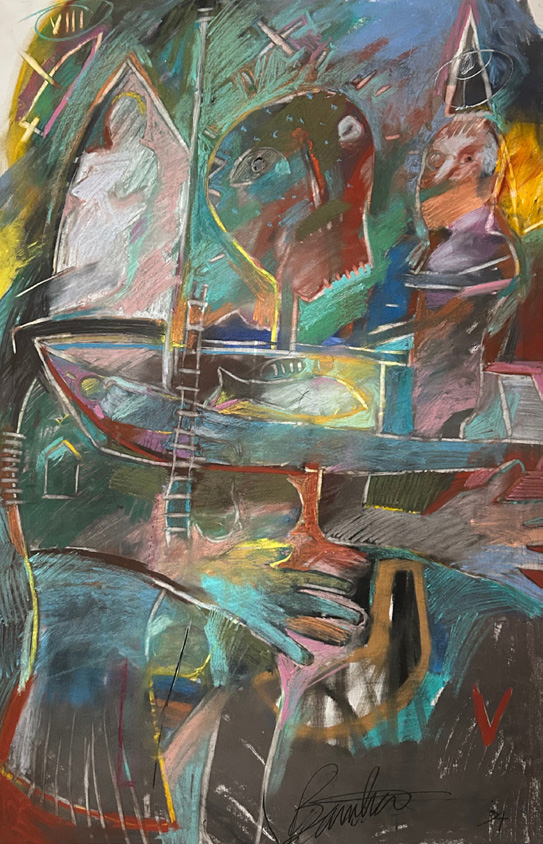
A large portion of these works are self-portraits, which he used to explore his identity a Siletz Indian and a man as well as his personal demons, many of which emerged during his service in the Vietnam War. These often-brutal compositions—such as Autobiographical, a pastel and graphite piece from 1994—explore his sometimes-fractured psyche, one complicated by alcohol and drug addiction. Here, Bartow uses abstract images of houses, boats, feathers, fins, ladders, faces, and human limbs to create an intense portrait of his fragmented inner and outer world.
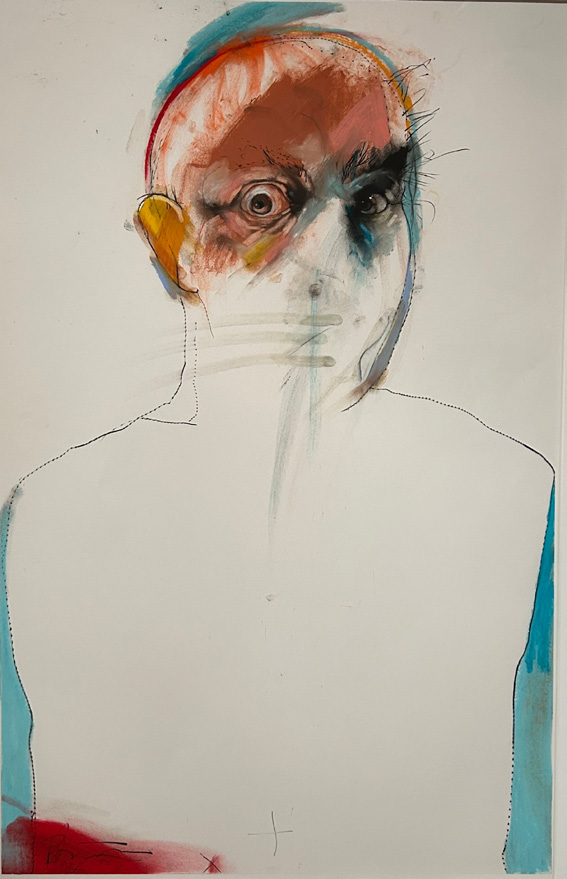
In his 2002 pastel-on-paper self-portrait To Everything A Season, he reduces himself to an intense pair of eyes set in a head that floats above an empty, armless body; and in Surprise—a pastel and graphite opus from 1995—hands (which are tracings of his own) restrain him while a skull-like demonic being prevents him from speaking. Barlow is not afraid to reveal his soul, and the viewer grasps that this revelation is a profound personal act. We come to realize that he is not making art for us; rather, he is creating works that release the toxic psychological steam bottled up within himself.
Equally potent for him was our relationship with the animal kingdom. Bartow often chose beings like the crow, the salmon, and the bear to create visual stories derived from Native American traditions. One of those beliefs—often discerned through meditation or shamanistic guidance—is that we humans not only have animal or spirit guides, but that we, in our primordial past, were once able to transform ourselves into those creatures. We moved freely between our human world and the animal world because humans and animals are not separated at all—we are all one. Song Bear—an acrylic on canvas created in 2011—vividly illustrates this connection between a human figure and its ursine spirit: The bear seems to be emerging from the body as the human form slips away into a mere series of lines.
Similarly, Bartow’s three-dimensional works—represented in the Portland Museum’s collection by several superb carvings—portray our interconnectivity with the creatures of the animal world. A superb example— based on a Siletz sweat-lodge ceremonial tale—is Ursa Major, a wood sculpture completed in 2005, which clearly shows the great bear, his companion raven, and several humans as fellow travelers preparing for the constellation’s journey across the night sky.
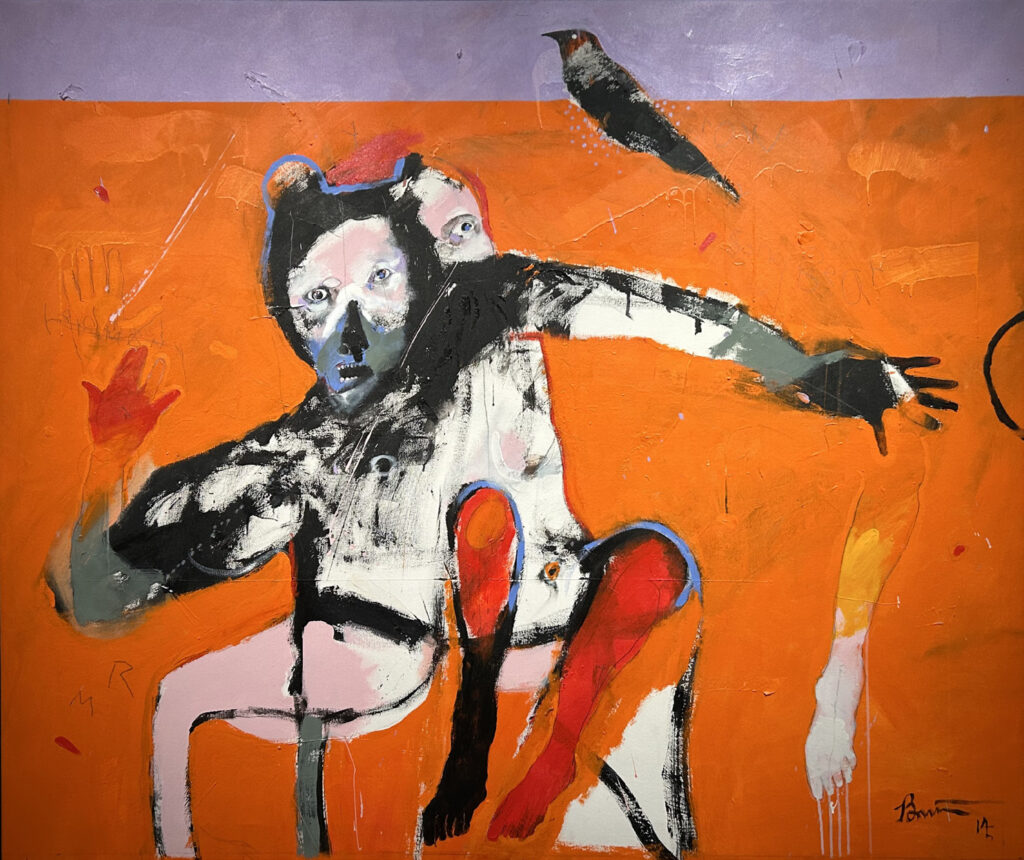
Meanwhile, remembering that Bartow was also a fine musician, we see that these animal stories were often combined with musical references. Two acrylics on canvas from 2014 are particularly touching. The first, Crow, Song, Bear, represents Bartow’s participation in the Wiyot Tribe’s 2014 World Renewal Ceremony in Humboldt Bay, California. Despite his serious health issues, including two debilitating strokes in 2013, joining tribal members to witness their ceremonial dances was intensely meaningful to him. The choreography of the arms and legs of the humans and the bear within the vivid orange background are overseen by the crow, and while Bartow himself could no longer dance as he once had, the beings on this canvas can, allowing him to become the vicarious participant in the joy of Nature.
The other work—Sing Crow—whose title is scrawled along the top of the canvas—reveals even more of the artist’s personal story. We see the crow transforming into a human, agonizingly trying to sing, the terror clearly seen in the one eye behind the blue beak. In “real life,” the 2013 strokes that Bartow survived took away his ability to speak or sing. His performing days with his band were over, made more poignant by the fact that he was no longer able to remember the words to any of the songs he had written or learned. Even the wrench—seen on the right of the canvas—cannot fix him, being reduced to an insubstantial outline rather than a usable tool.
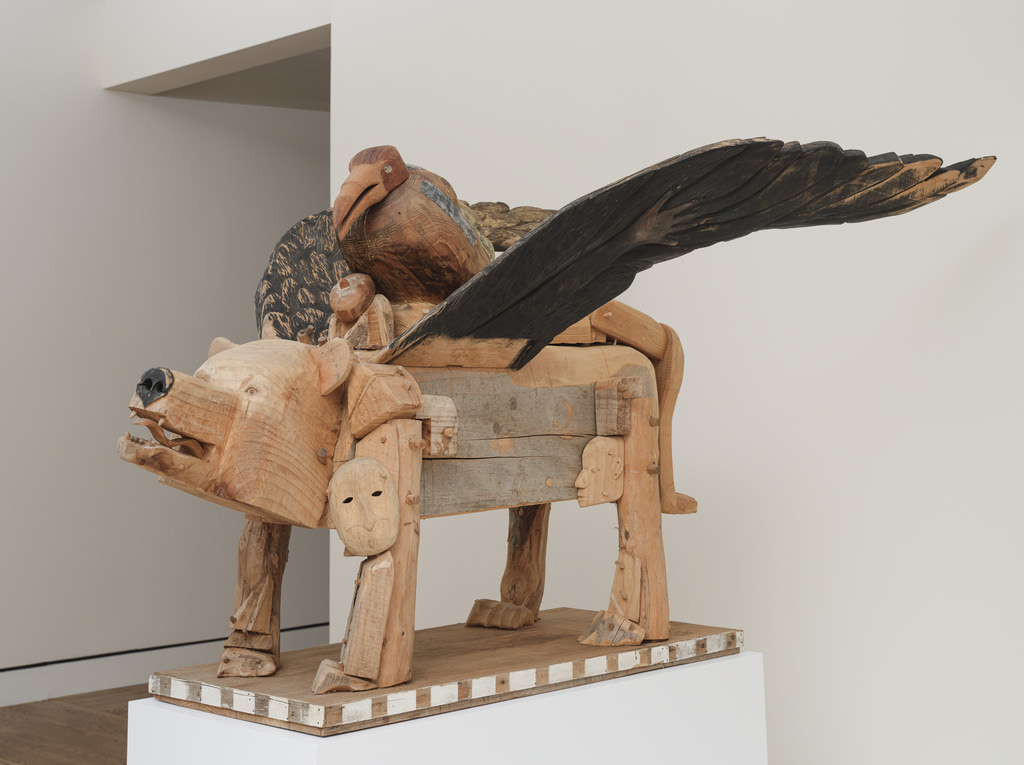
In both of these paintings and other works, the brilliant colors—-especially yellows, reds, and blues—make the juxtaposition between his inner turmoil and the joyous world around him all the more telling.
Rick Bartow’s confessional art is simultaneously both representational and abstract, recognizable and expressionistic. It is rooted in traditional Native American sensibilities and yet is timelessly universal. Though he often cited among others Marc Chagall, Francis Bacon, and Māori art of New Zealand as influences, Bartow’s vision is truly his own. Once you have seen a Bartow work—including his sculpted pieces—you immediately recognize it as uniquely his: the product of an Indigenous voice that speaks to all of us who are willing to peer into the recesses of our hearts and minds. G&S

Leave a Comment