
A recent visit to the permanent collection of the Museum of Modern Art in New York truly triggered my grey cells—and my heart. As I was wandering slowly, taking in the visual banquet of offerings—everything from paintings and sculpture to video—I also began to notice that I was—like many other visitors—gravitating towards certain pieces. Starting with the oldest works on the fifth floor and working my way down to the more recent art on the third, certain works (primarily paintings) were gathering more clusters of viewers than others. And I was right there with them.
And that set me wondering why these paintings—like the Sirens of Greek mythology—were calling me while other quite wonderful works hung in loneliness on nearby walls, often whizzed by with barely a perfunctory glance. Of course, I could have asked people directly why they were flocking around a particular painting, but I didn’t want to put anyone on the spot or interrupt their experience. Frankly, I was interested in why I, too, was so drawn to certain pieces.
So, while I went up and down the escalators to visit and revisit those three floors several times, I googled various arts and psychology journals to see what they had to say. The Joyful Artist asserted that “certain art triggers feelings of pleasure” and that “a moving piece of art can synchronize heart rhythms with emotional states, prompting a sense of inner harmony known as ‘heart coherence’.” Meanwhile, The Conversation said: “Famous art often remains relevant [and famous] because it is validated by major galleries, museums, and auction houses. These institutions act as gatekeepers that signal cultural value.” And the Harvard Gazette maintained that: “Art that ‘breaks new ground’ or sets new standards, such as Picasso’s Cubism or Van Gogh’s unique emotive style, creates a lasting reference point for future generations.”
Okay, all of that was fine and good, but what I realized is that for many—including myself—the most important reasons have to do with personal resonance. Yes, it’s wonderful to know the backgrounds to the artists and the importance of individual works, but most important is the dialogue that transpires between me and the painting. I bring my life’s story, the art brings its “story,” and somewhere in the middle, we talk to each other. It’s a special conversation, a private moment of understanding.
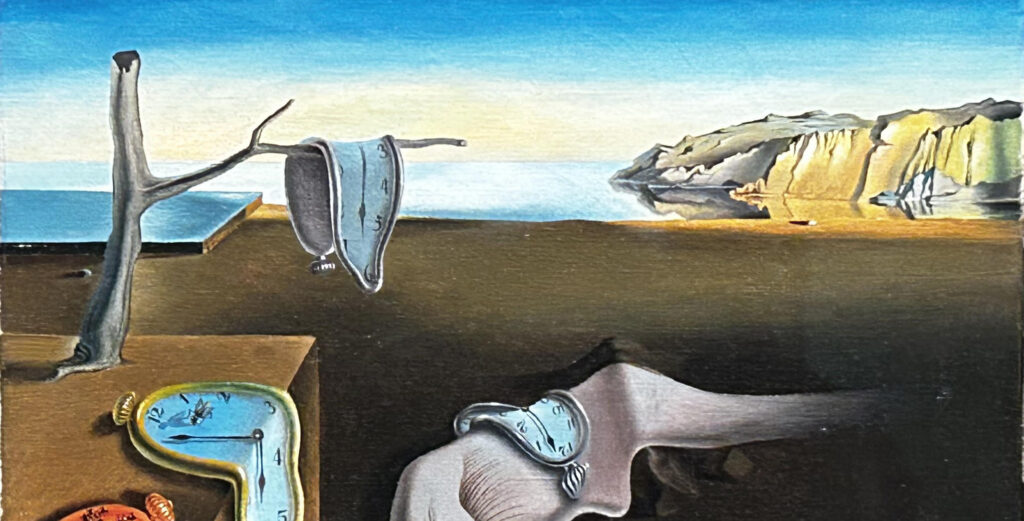
I imagine that was true for the others in the museum the day I visited. For example, Salvador Dali’s The Persistence of Memory is always a magnet. I’ve seen this work on book covers and in wristwatch advertisements for years; it’s familiar; it’s an old friend. And then you stand in front of it and one of your first reactions is: “My, how small it is!” And you move in—while the museum guard warns you not to get too close—and notice all the remarkable details.
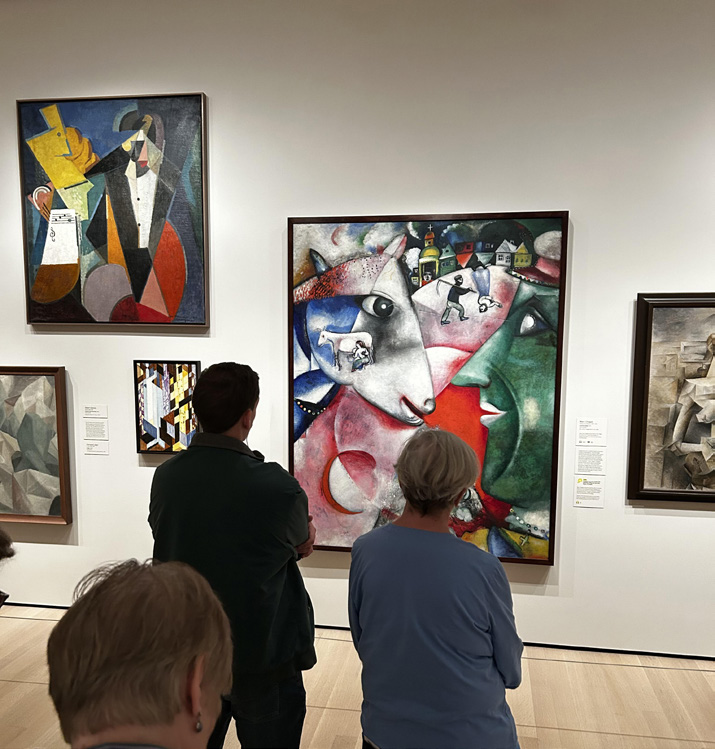
In another room, Marc Chagall’s I and the Village stands out in all its joyousness, always gathering an aura of onlookers. What is it about this 1911 painting that strikes home? Why do I experience “heart coherence” when I linger? Is it the imaginative use of color? Is it about the childhood memories I have of my wonderful Jewish neighbors who had come from Russia back in the day? Is it because I always hear songs from Fiddler on the Roof playing in the background of my mind when I stand there? There are other remarkable pieces by Chagall—including those fabulous murals at the Metropolitan Opera House at Lincoln Center—but this piece. Ah, this piece holds my heart like few others. And I’ve come to accept that it’s perfectly fine that I don’t really know why.
I bring my life’s story, the art brings its “story,” and somewhere in the middle, we talk to each other.
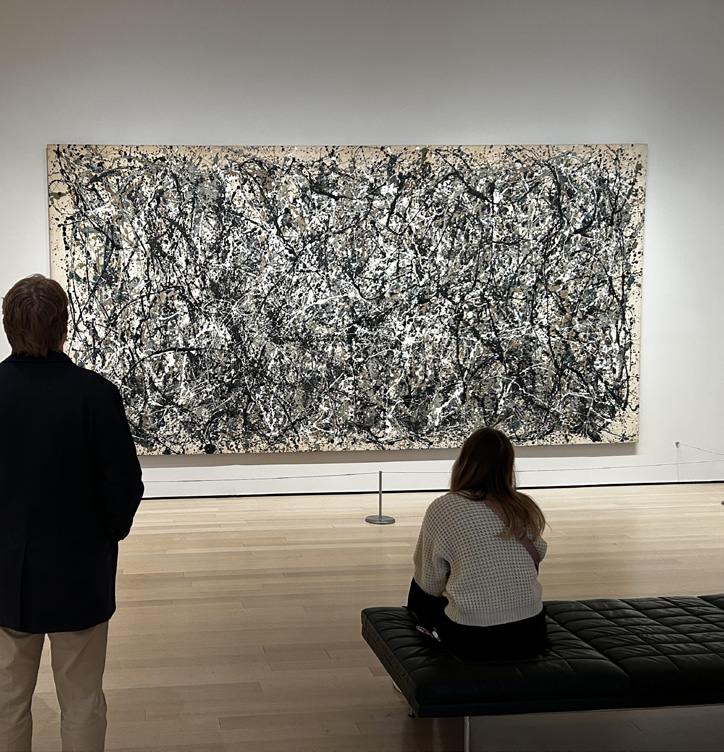
In the same way that I’m not completely sure why I swim through the layers and tendrils of Jackson Pollock’s One: Number 31, 1950. For me—and perhaps the others who sit on the bench in front of the painting—the work becomes a meditation piece. When I look (perhaps it’s more like profound staring), I see myself immersed in the cosmic web. These aren’t drips of paint for me. No, these are streams of energy and dark matter; clusters of stars; and the gases of nebulae. It’s a very personal conversation with one of abstract art’s most famous warhorses. And that conversation was probably very different for the others gathered around the day of my visit because their life experiences are as unique as mine.
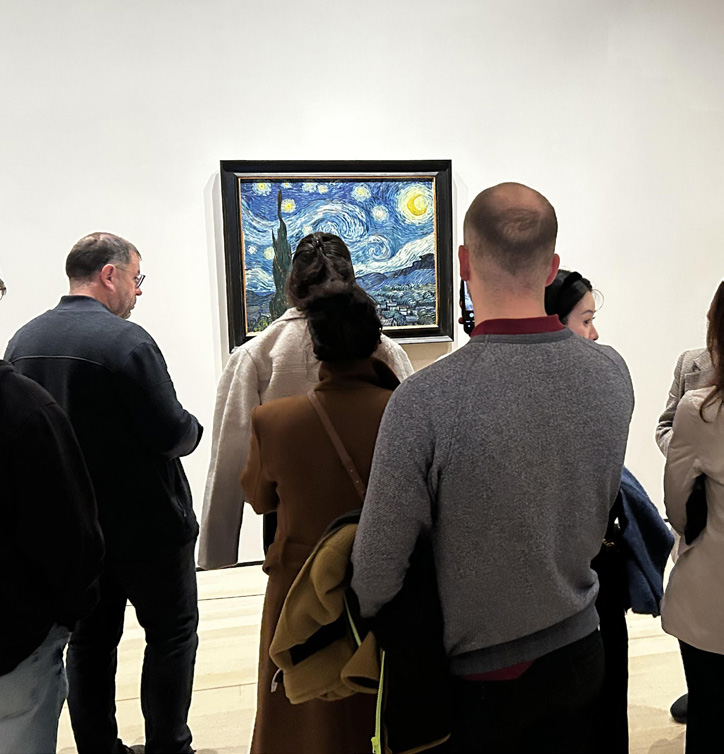
And, of course, there’s Van Gogh’s Starry Night. Like the Mona Lisa, this work is rock-star famous and that fact alone is a reason for some to see it. And like the da Vinci, it’s much smaller than people might think—which is a surprise and perhaps a disappointment. Yet—besides having “must see” fame—for many (me included), it’s the bold use of color; it’s knowing something about the artist’s personal life; it’s even a sense of sadness that he never knew the impact his work would have on the development of Art. But my conversation with Starry Night is very much informed by a childhood memory of one moonlit night when I sat alone on the porch of a cabin on the shore of Newfound Lake in New Hampshire, watching—truly experiencing—the glittering reflection of the moon and stars on the water: the smell of pine, the sound of gently lapping water, the coolness of the nighttime air.
Perhaps that’s really the allure of so-called warhorses like Monet’s Waterlilies whose gravity-defying, 41 feet of scintillating pond surface fills an entire room at MoMA.
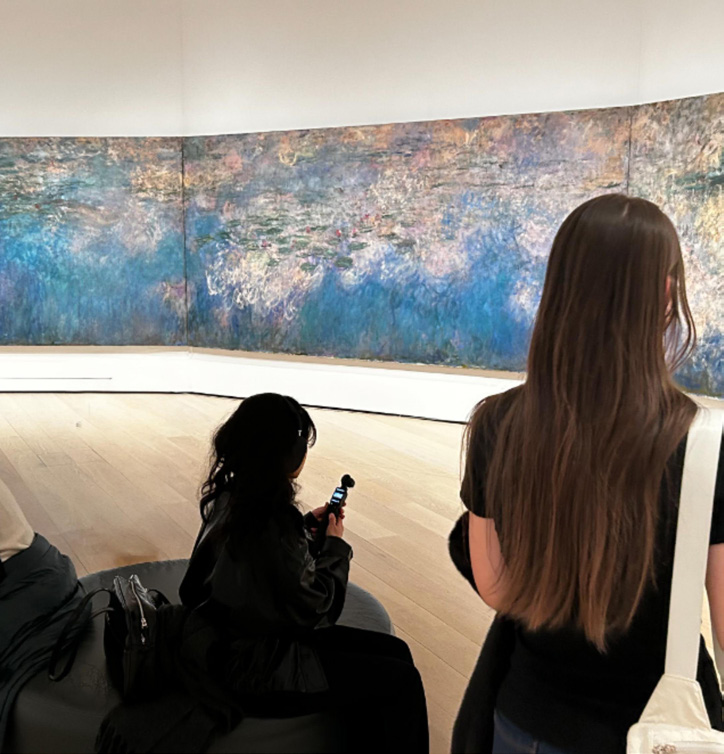
Famous works of art (literature and music, too) keep garnering crowds of admirers because they trigger our deepest memories and feelings. Sometimes we can’t pinpoint the exact reason, but somehow we just know that what we’re viewing is touching an intensely special part of our very souls. We also realize that our conversations change with the years because—while the physical painting has permanence—we’ve grown through life experiences. Each time we go back to our favorite works, we’re different from how we were the last time we said hello. And if we savor those ongoing, ever-changing conversations with works like Starry Night or I and the Village, we find that we are the ones who been transformed and that our lives have become more meaning-filled. G&S




Leave a Comment