
Call it a series of happy coincidences, or something deeper: divine intervention, the stars aligning. At the very least, the way everything has fallen into place for Brooklyn-based artists Sharmistha Ray and Dannielle Tegeder is uncanny. “There have really been a lot of unseen, connecting events,” Ray says of the collaboration.
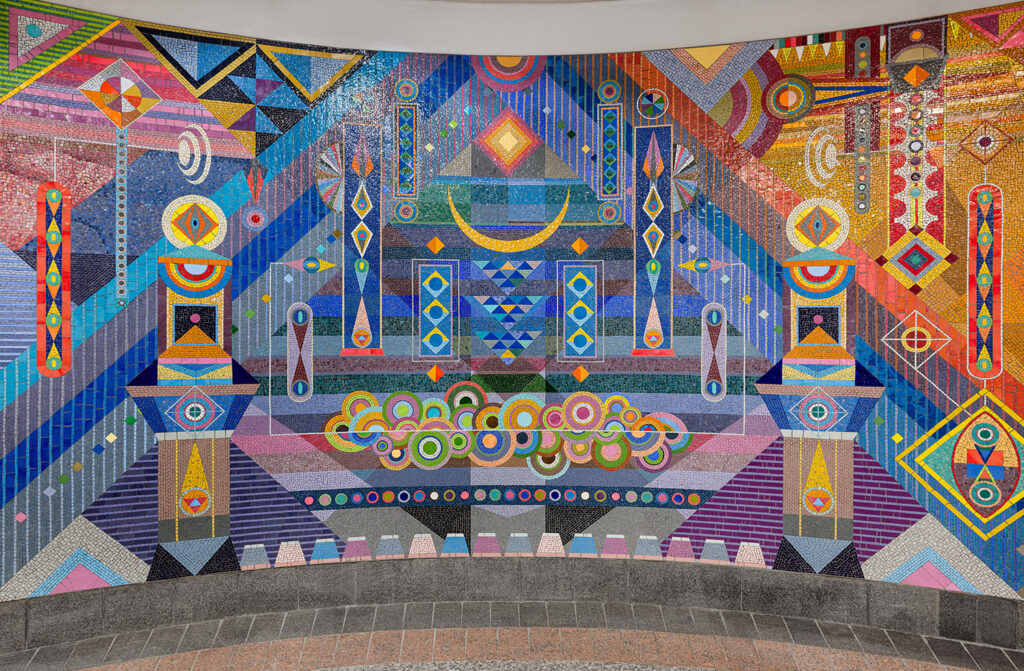
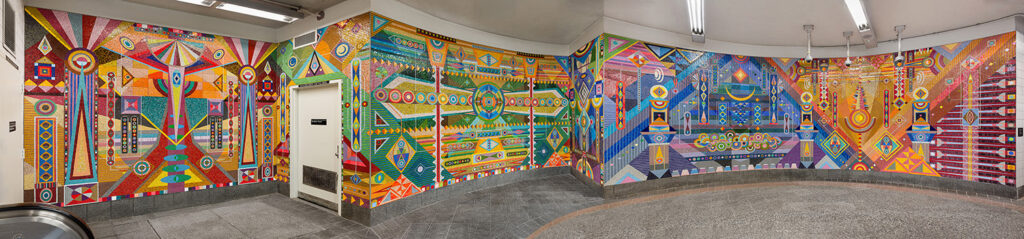
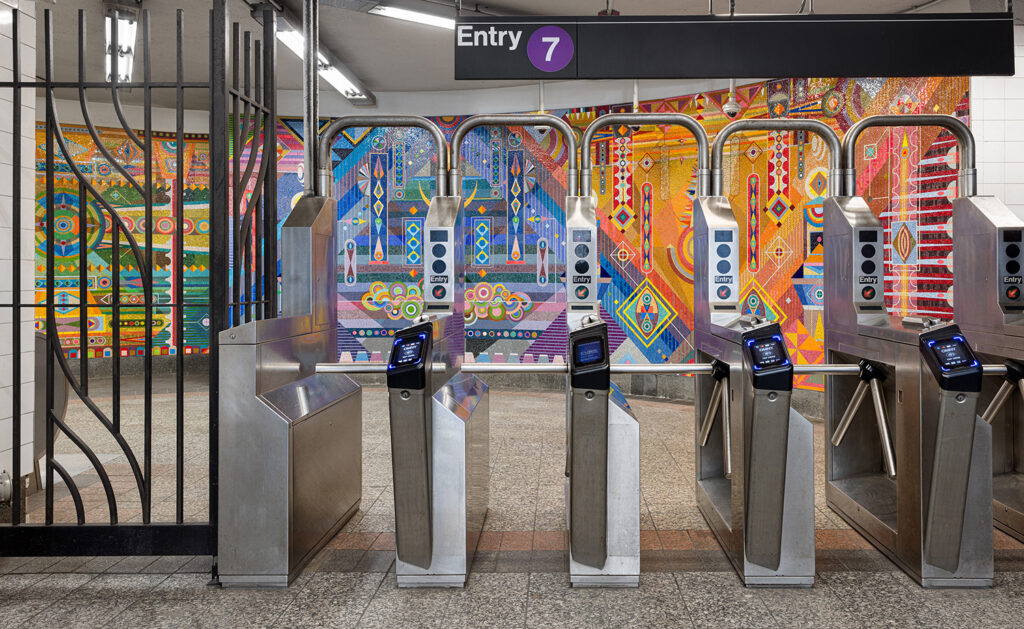
The duo, who created the feminist, mystical art collective Hilma’s Ghost in 2020, is capping off its most auspicious year yet. They presented the interactive Chromatic Altar with Eve Biddle at the Solomon R. Guggenheim Museum in February. The activation, a glorious swirl of dance, meditation, and color, paid homage both to the museum’s co-founder, Hilla Rebay, as well as to their namesake Hilma af Klint. Then, in May, they unveiled a 600-foot, permanent public art piece in New York’s heavily trafficked Grand Central Station.
Abstract Futures, a vibrant, glittering glass mural commissioned by MTA Arts & Design and created in collaboration with the world renowned Miotto Mosaic Art Studios, explores themes of magic, women’s voices, and the human journey, through the 78 cards in tarot’s Major Arcana. “The Fool [the first tarot card in the Major Arcana] as a New York City archetype is perfect,” Tegeder says. “This is the quintessential story of people arriving with a dream, a suitcase, and they don’t know what’s going to happen next.” She points to the constant flux of destruction and redemption in the traditional Rider-Waite-Smith tarot card imagery, reflected in the ever-transforming city. “You can’t help but think of the metaphorical death of how many lives we have. Then, through The Star, The Moon, and The Sun, we find renewal in parts of the city that are destroyed.”
The artists also pointed out the importance of acknowledging Pamela Colman Smith, who created the imagery for the iconic Rider-Waite tarot deck, but is rarely recognized for her work (in fact, the deck is often referred to simply as the Rider-Waite-Smith tarot). “She was an artist who died in obscurity, and part of our collective’s mission is to recover these overlooked voices,” Ray says.
Abstract Futures was inspired by a prior project, Abstract Futures Tarot, exhibited at the The Armory Show in 2021 with Chicago’s SECRIST | BEACH gallery, which happened to be Hilma’s Ghost’s first physical art project together. That exhibition, praised by critics, comprised five paintings, 78 drawings, and a limited edition tarot deck. The tarot deck, which initially sold out, is now in its third edition.
Tegeder and Ray have been keenly aware of the taboos that can come along with tarot and mysticism. However, their abstract style helps mitigate potential concerns and allows people to interpret the images in context with their own spiritual inclinations. “We are quite lucky in that [abstractionism] subverts some of this overt, specific information that might put people off in some ways,” Tegeder says. The MTA notes that public reception to Abstract Futures has been overwhelmingly positive.
“We look for those moments and experiences that elevate or transform a rider’s daily experience through the [subway] system,” says Tina Vaz, Director of MTA Arts & Design. She emphasizes the sheer number of commuters that traverse the New York subway system each day, exceeding 4 million. “We look for work that responds really successfully to the site, but also work that rewards repeat viewing, which is definitely the case with Abstract Futures. It’s very visually rich. If you are passing through that space multiple times, as many of our riders are, there is still something for you to discover every time you pass it.”
Public art, by its very nature, can be fraught with architectural challenges, idealogical conflicts, and practical delays, but Abstract Futures went off without a hitch, according to Hilma’s Ghost. “When we got the project, we thought, ‘oh public art—this is going to be so challenging for us,’ ” Tegeder recalls. “But, again, we can’t explain this, it was so smooth. It’s never smooth in public art, but we had an incredibly smooth project, even into the installation.”
Vaz also points out another fortuitous facet of the project—she came aboard the MTA after Abstract Futures was installed, but she was well aware of Hilma’s Ghost, having been involved with programming for Chromatic Altar in her former role as Deputy Director, Chief Brand and Communications Officer at the Guggenheim. “It feels special that I had that connection to the exhibition,” she says.
In keeping with the mysterious forces that seem to have been at play all along, Tegeder and Ray still have no idea who nominated them for the commission, but they say that they would love to do more of this work. “There is something about public space and there being no barriers to the art that makes it very interesting and exciting for artists,” Ray adds.
Connecting to the public has been important to the artists’ practice since day one. They originally met while occupying adjacent studios at The Elizabeth Foundation for the Arts in New York, and they formed a school of magic before collaborating on physical artwork. The Swann School of Art, Feminism, and Magick presents both in-person and virtual community workshops spanning shamanism to spell jars.
Feminine, trans, and nonbinary voices are integral to everything they do. “It was specifically women artists who were [historically] written off, who practiced divination, magic, witchcraft,” Ray says. “They were challenging these patriarchal systems through their use of self-empowerment. That is a history that’s really important to us.” Both artists are college professors—Tegeder is a professor of art at CUNY’s Lehman College, while Ray is Estella Loomis McCandless Assistant Professor of Art at Carnegie Mellon University—so teaching is integral to their work and their identities.
The connection to Hilma af Klint is also a natural one, given that af Klint was a mystic and abstract artist in the early 1900s, whose work went largely unnoticed in her time. “Hilma af Klint: Paintings for the Future,” a groundbreaking retrospective and first major U.S. solo exhibition featuring af Klint at the Guggenheim in 2018, cast a new spotlight on the Swedish visionary’s work and led to 2025’s Chromatic Altar. “It really opened a portal for artists in general, mostly women,” Ray says of the af Klint exhibition. “This space has opened that has allowed us to work with spiritual subject matter, and so many other artists who have now been included in this rearranged timeline of art history.”
In addition to the Guggenheim and MTA Arts & Design, Hilma’s Ghost has been featured in such prestigious institutions as Marlborough Gallery in New York, Museu de Arte de São Paulo (MASP), and Galeria RGR in Mexico City. Upcoming exhibitions include The Morgan Library & Museum in New York , Palm Springs Art Museum in California, and DePaul Art Museum in Chicago. G&S



Leave a Comment