
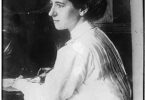
The Guggenheim New York’s exhibition, “Gabriele Münter: Contours of a World,” is the first retrospective in the United States devoted to the German Expressionist. Münter, an early 20th century artist, was sidelined and overshadowed by her male contemporaries.
This exhibition—sixty paintings and nearly 20 photographs—is long overdue. It firmly establishes Münter (1877-1962) as a pioneering German modernist and innovative painter.
“Münter’s unwavering curiosity about the world around her shaped both her life and art,” says Megan Fontanella, Curator of Modern Art and Provenance at the Guggenheim New York. “She wielded color and line in remarkable ways and this spirit of exploration led her to become a uniquely international artist.”
Born in Berlin, Münter took formal drawing lessons as a child. Her family had spent time in this country and after her parents died, the artist and her sister, both in their early twenties, traveled in the United States from 1898-1900. While visiting relatives in Arkansas, Missouri and Texas, Münter became obsessed with a Kodak camera she received on her 22nd birthday She took hundreds of photos depicting American life.
The 20 photos included this exhibition reveal her early experiments with cropping, lighting, and composition—techniques that would become central to her later work as a modernist painter.
In an essay in the exhibition catalogue, Victoria Horrocks cites a statement of Münter’s that effectively sums up her life’s work: “My pictures are all moments of life—I mean instantaneous visual experiences, generally noted very rapidly and spontaneously.”
After departing the United States and returning to Munich, Münter began studying at various schools including an avant-garde institution founded by the Russian artist Wassily Kandinsky. He was 36, Münter 24. Initially, he was her teacher and eventually became her romantic companion.
As a couple, the two artists traveled together extensively and even settled in a suburb of Paris for a few years. Her work was influenced by artists such as Matisse, van Gogh, and Gauguin who were moving into radical, non-naturalistic work.
Returning to Germany in 1908, Münter purchased a small house in Murnau, a quaint, Bavarian market town near Munich where she spent most of her later life. Along with Kandinsky, she became a founding member of the influential German Expressionist group, Der Blaue Reiter (1911-1914) and was active in avant-garde circles. Together she and Kandinsky transformed her house into a work of art, painting folk motifs on its walls.
According to the catalog, while Kandinsky’s reputation flourished, Münter found herself in a compromised position as the mistress of a famous man, often referred to as the father of abstract art. Their relationship was marked by an imbalance and lasted 14 years, ending in 1914 when Kandinsky had to return to Russia during World War I. (They reunited briefly in Stockholm, but after that, she never saw him again. Kandinsky married twice before he died in France in 1944.)
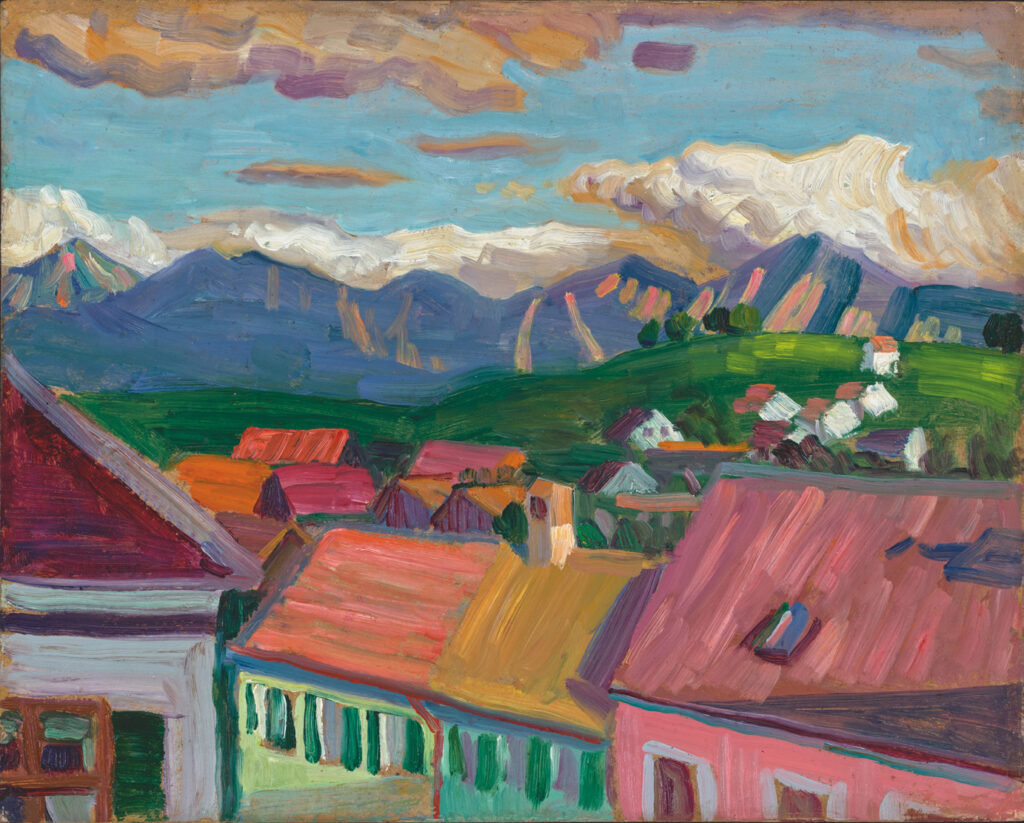
Murnau was the inspiration for Münter’s landscape paintings where she used unusual colors—blues, greens, and yellows—and nearly abstract and simplified shapes. In the landscape painting, From the Griesbräu Window, she depicts a tranquil scene using colorful blocks of bright colors to depict provincial harmony. This work is remarkable for its use of color to achieve a deep sense of peace and calm.
While Kandinsky became well known for his vibrant abstract paintings aimed for the spiritual, Münter focused on tangible objects, and a visual reality conveyed through bold colors and simple forms.
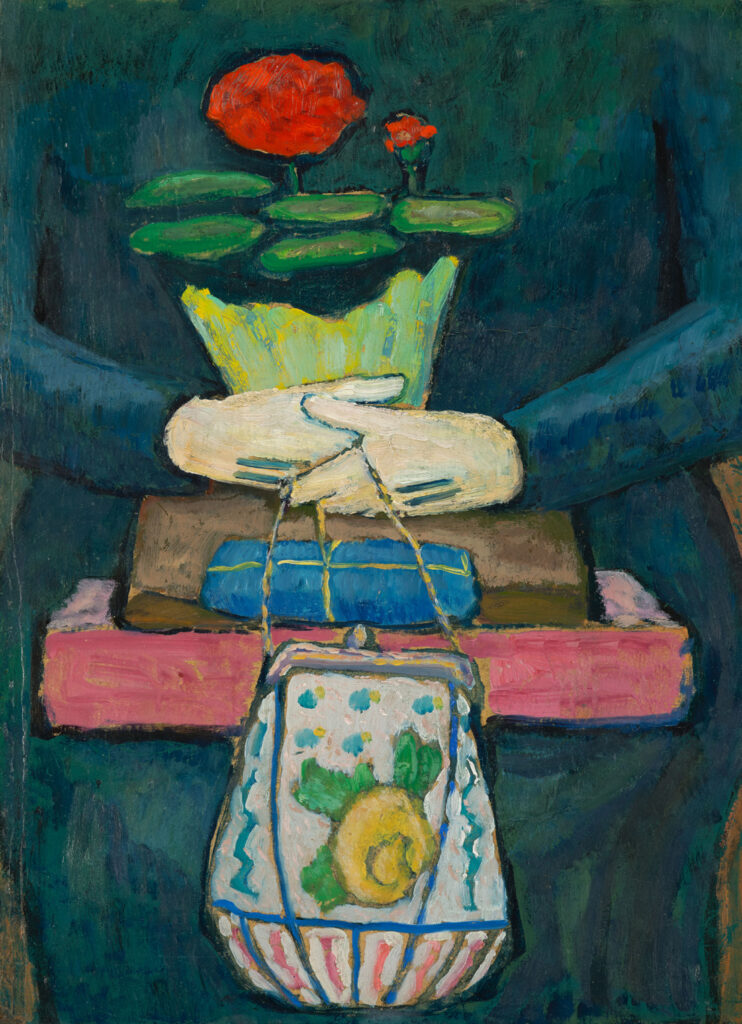
Still Life On the Tram (After Shopping) exemplifies her approach to still-life painting. She records everyday objects resting on the lap of a headless woman wearing white gloves. Some might say it is a tribute to simple pleasures and a retreat from the complexities of modern society.
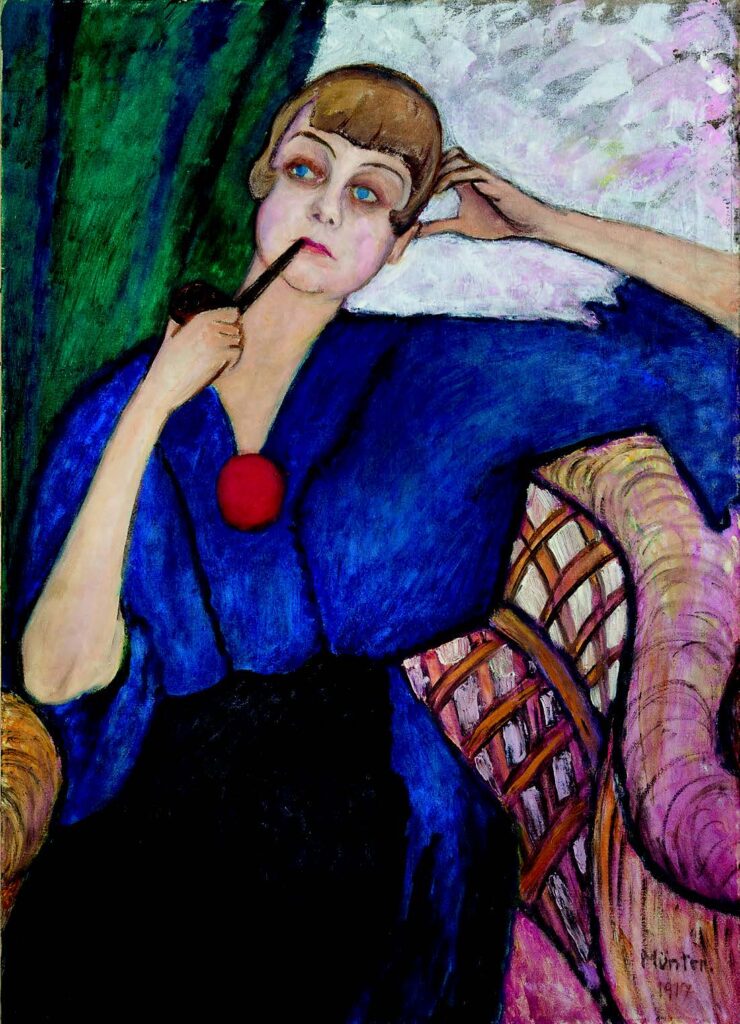
After the war, Münter concentrated more on portraiture. One of the most compelling, painted in Scandinavia where she spent the war years, is the Portrait of Anna Roslund. Here we see a modern, stylish woman with cropped hair, smoking a pipe and gazing directly at us. Münter is clearly sending a message: This is what a modern, confident woman post war (1917) looks like. Roslund (1891-1941) was both an author and a musician.
In the 1920s, Gabriele Münter began a relationship with art historian Johannes Eichner (1886-1958). Together they established an arts foundation. Until her death in 1962 at age 82, she continued to paint, make etchings, create paintings on glass and experiment with collage.
This exhibition introduces Münter, no longer overlooked, to a new audience as a modernist artist who made major contributions to 20th century Expressionism. G&S
guggenheim.org On view through April 26, 2026.

Leave a Comment