
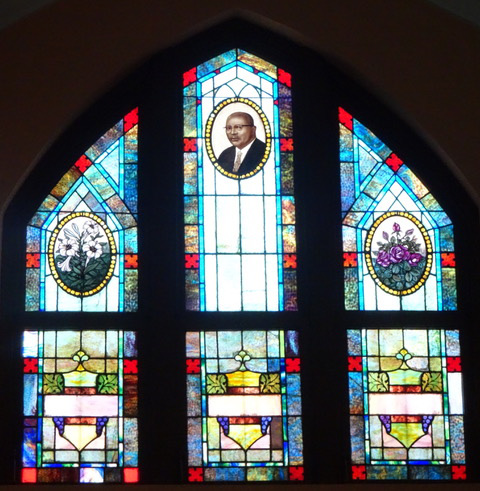
The Civil Rights Trail in the American South encompasses a collection of museums, churches, courthouses, schools, and other landmarks across 15 states that were home to pivotal events in the struggle for social justice in the 1950s and ’60s. My own first steps on the Trail began in Brooklyn and took me to Washington, DC in 1958 on the “Youth March for Integrated Schools,” and again in 1959. Both times thousands of high school and college students came together at the Lincoln Memorial to demand the desegregation of public schools throughout the country.
In the early ’60s, my path took me to a picket line in front of Woolworth’s in Manhattan, supporting the brave SNCC students staging sit-ins at segregated lunch counters in the South. In 1963 I stood in front of the Lincoln Memorial to hear Dr. Martin Luther King, Jr.’s “I Have a Dream” speech–and I heard Bayard Rustin calling out our demands. As a member of the Congress of Racial Equality (CORE), I was in Harlem in July 1964 during the riots that followed a police shooting, part of a citywide reckoning with inequality and violence.
In 2025 I felt it was time to visit some of the key sites on the Civil Rights Trail in the South. My wife and I visited museums and memorials in five cities. In Atlanta we stood in front of the modest home on Auburn Avenue where Dr. King was born. We also went to the gravesite of Dr. King and his wife, Coretta Scott King at the nearby King Center. We explored the surrounding neighborhood where he grew up and we sat in Ebenezer Baptist Church, where he, his maternal grandfather, and father all preached. At the edge of the memorial site we were touched by a quote that read: “There are no evil men. People who do evil things are also victims.”
Nearby, the African American Panoramic Experience (APEX) Museum brought the horrors of the slave trade vividly to life, including replicas of banners that advertised human beings for sale. The APEX Museum also displayed examples of the notorious “literacy tests” used by segregationists from the end of Reconstruction until the 1965 Voting Rights Act to prevent Black Americans from voting. Some questions included: How many jellybeans are in the jar in front of you? How many seeds are in a watermelon? In what year did Congress gain the right to prohibit the migration of persons to the states?
In Montgomery we were overwhelmed by our visit to the Legacy Museum and its companion sites. The main building featured a vast array of multimedia exhibits, including interactive holograms and short films exploring different chapters of the civil rights struggle—brought up to the present day with a focus on the mass incarceration of Black people. A short boat ride brought us to where chained human cargo—at least those who survived the horrific Middle Passage—were unloaded, and to a deeply moving sculpture garden.
The Museum’s National Memorial for Peace and Justice, informally known as “The Lynching Museum,” documents more than 5,000 lynchings–not only across the South, but also as far north as New York, and as recently as 1981. Some lynchings were even advertised in local newspapers to attract crowds, occasionally drawing as many as 10,000 men, women, and children. Victims were tortured, shot and deliberately kept hanging for days. Photographs and picture postcards were later sold as souvenirs.
While in Montgomery we also visited the Rosa Parks Museum, where her courageous protest is powerfully re-created; the former home of Dr. King that was bombed shortly after he became leader of the bus boycott; and the Dexter Avenue King Memorial Baptist Church (1883), where he served as pastor. We ate in a restaurant housed in a building that had once been an auction site for enslaved people. At the Alabama State Capitol, where the Selma-to-Montgomery March ended 60 years ago, we reflected on the courage it took to walk that road.
On our way to Selma we listened to songs sung on the march, recorded by New York radio station WNEW and later published by Folkways Records. Pete Seeger and Len Chandler described how old songs evolved and new ones were created along the way: “Oh Wallace, you never can jail us all. Oh Wallace, segregation’s bound to fall.” The old spiritual “Oh Freedom” was sung again and again—as I have sung it over the decades with my children and grandchildren in their schools.
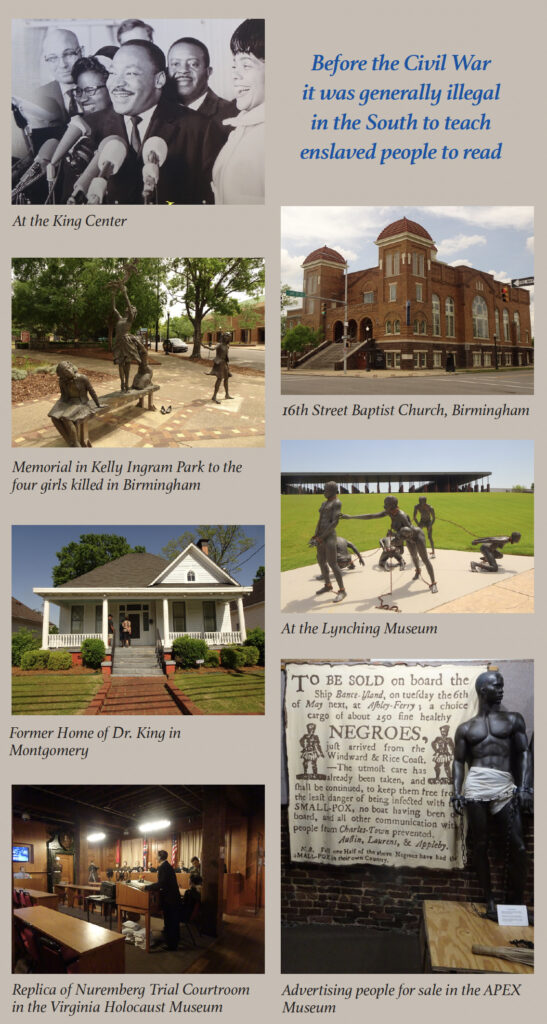
Crossing the Edmund Pettus Bridge into Selma, we passed the Brown Chapel A.M.E. Church, where marchers gathered before each attempt to cross the bridge. In Birmingham we stood outside the 16th Street Baptist Church, where a bomb killed four little girls in 1963. In the adjacent Kelly Ingram Park we visited memorials honoring them and the children of Birmingham who faced firehoses and vicious dogs for protesting.
Before the Civil War it was generally illegal in the South to teach enslaved people to read. After the war most freed people remained uneducated, homeless and in poverty. Congress created the Freedmen’s Bureau on March 3, 1865, to address these problems, but by 1869 it was nearly defunct, defunded by southern Senators and Representatives in Congress. Meanwhile, the Ku Klux Klan—also founded in 1865—was rapidly gaining influence across the South. Although Black communities made gains in the immediate postwar period, electing local and national officials, they were quickly met with violence and the passage of Jim Crow laws that stripped away their rights. (“Jim Crow,” once a minstrel show character, had become a synonym for Black men.) It wasn’t until Brown v. Board of Education in 1954 that meaningful cracks in the legal framework of segregation began to appear.
We ended our journey at the Virginia Holocaust Museum in Richmond, built in part to honor 400 Holocaust survivors who had settled there after World War II. There we learned that Hitler had studied the Jim Crow laws of the American South as he developed the legal basis for Nazi Germany’s antisemitic pogrom. We reflected on the shared dehumanization at the root of both systems of oppression.
I thought about Dr. King’s words– “People who do evil things are also victims.” Having visited Auschwitz, Dachau, Mauthausen, the remains of the Warsaw Ghetto and Montgomery, Selma and Birmingham, I struggled with this idea. Were the Nazis who slaughtered six million Jews—or the Americans who raped and killed enslaved Black people and sold children away from their mothers—also victims? And what about a man today who orders the separation of immigrant children from their parents to serve his political ends? G&S
Photos by Norman A. Ross

Leave a Comment