
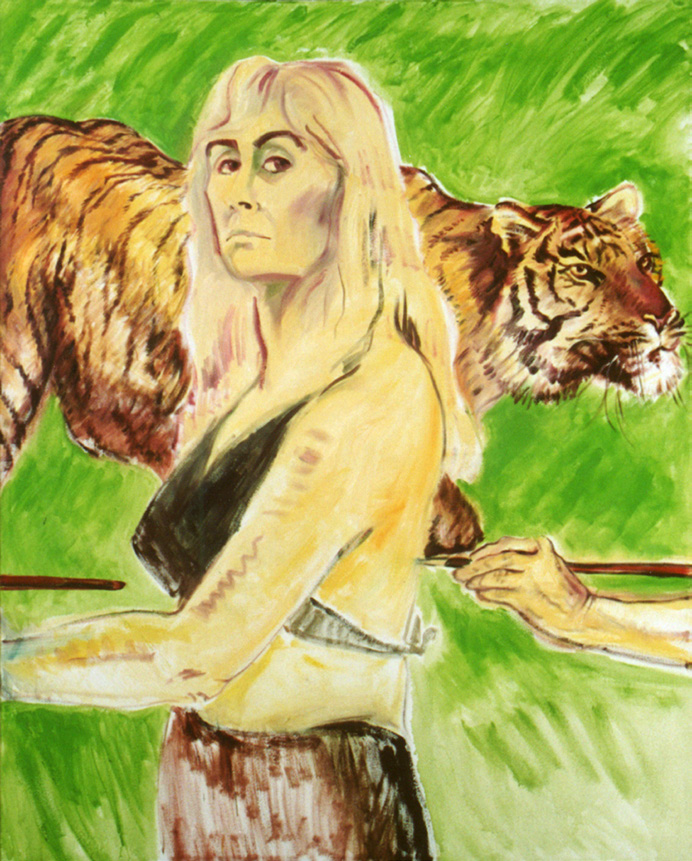
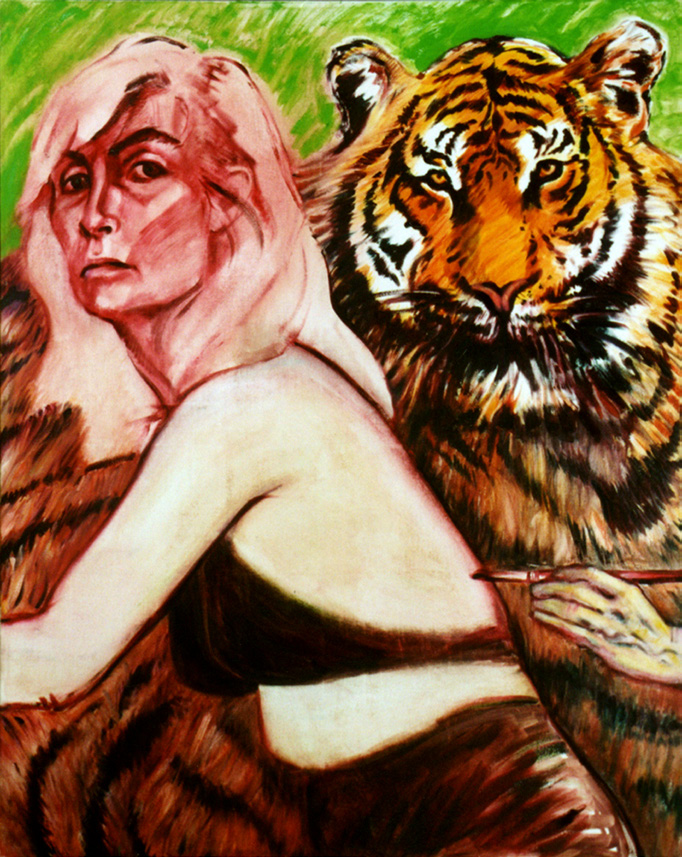
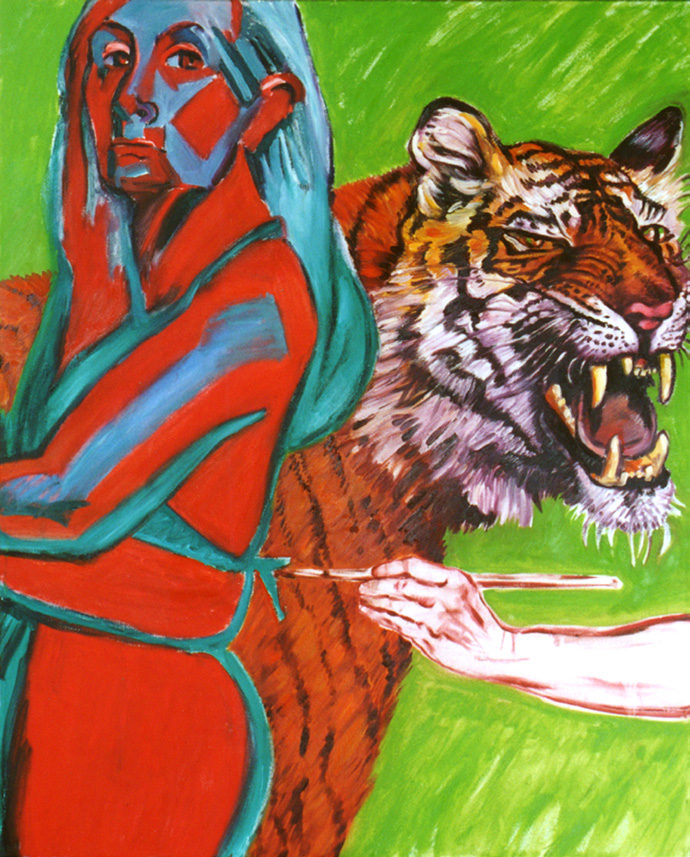
For centuries, artists around the world have portrayed the tiger, king of charismatic megafauna, with attention historically focused on the male artists who depicted this formidable feline predator: Rembrandt van Rijn, Peter Paul Rubens, Eugène Delacroix, Salvador Dalí, Andy Warhol, Walton Ford. But women artists also gravitate to the tiger, seeing a majestic queen of beasts “burning bright” (in William Blake’s phrase), capable of tenderness and ferocity in equal measure; among them are the painters Rosa Bonheur (1822-1899) and Chunbum Park (b. 1991)—G&S article Fall 2025—the sculptor Anna Hyatt Huntington (1876-1973), the photographer Ylla (née Kamilla Koffler, 1911-1955), the poet Adrienne Rich (1929-2012), and the painter Sharon Wybrants (b. 1943).
Throughout her career, Wybrants—also a performance artist, and poet—has tirelessly promoted herself by creating large-scale self-portraits with unflinching defiance, all of them larger-than-life yet just human-scale enough so her viewers will relate.
Her monumental Self Portrait as Superwoman (9×5 feet) is a pillar of the Sister Chapel at New Jersey’s Rowan University Museum of Contemporary Art, where it stands alongside works by, among others, Alice Neel. First unveiled in 1978, Superwoman remains timely as ever—as evidenced in 2019, when the editors of Harper’s Bazaar magazine, once again proving its reputation as a cultural thought leader, selected Self Portrait as Superwoman to be a backdrop for a fashion photography shoot.
Today, at 82 years young, Wybrants is a triple Libra adept at balancing several things at once while perched on the six-foot ladder she climbed for four years, the time it took her to complete Endangered, her monumental tribute to the world’s tigers. An amalgam of many “-ists”, Wybrants is an artist, feminist, and political-environmental activist. The latter distinction is self-evident in her evolving series of self-portraits with wild animals.
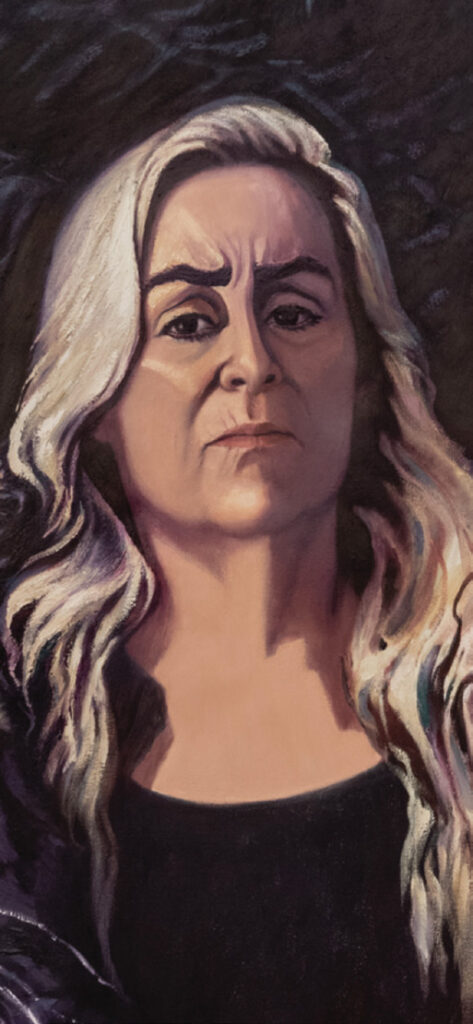
Brow furrowed, the artist fixes a ferocious focus on her wild subjects, and herself
Endangered depicts the artist’s inner circle: Wybrants front and center, frowning and wielding her paintbrush like a sorcerer’s wand, flanked by a female Sumatran tiger and the tiger’s cubs, each held by Wybrants’s three grandchildren, their eyes wide with worry: a trio of melancholy, juvenile Keane figures reborn as cub-handlers.
Surrounded by flora native to Sumatra, together the figures form a posse with a powerful message: “Please, please, please help us save sentient creatures from extinction—we don’t want a world without them,” Wybrants explains. And the figure who most frontally compels the viewer to stop and think is the artist herself, who “fell in love” with tigers—the Sumatran species in particular—in the 1990s, on a visit to the San Diego Zoo. “For me, tigers represent raw emotion and survival,” Wybrants says.
“Please, please, please help us save sentient creatures from extinction
— we don’t want a world without them.”
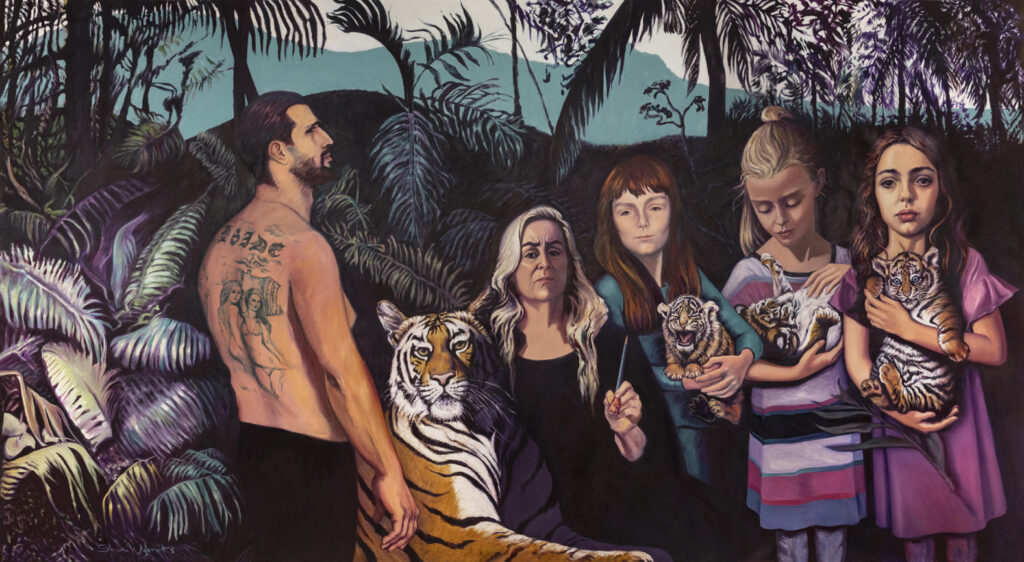
Also pictured in Endangered: Wybrants’s former roommate, a tattooed medical doctor who tended to many patients during the COVID crisis, including Wybrants; his presence hints at humanity’s hope for healing. Artists, Wybrants reminds us, are healers too: “Fundamental to making art is awareness. We must be awake. There is too much to learn and to say for any of us to rest. The world needs its shamans, and the artists have the responsibility to speak the truth. We aren’t going to win any popularity contests by holding up a mirror to society. However, without the truth, no healing can occur. We are the healers if we choose to risk everything for this calling.”
The dominantly blue background palette of Endangered—executed with Wybrants’s favorite UK-made brand of oil paint, Michael Harding, in viridian, amethyst, and dioxazine purple—also has its own healing aspect. Blue plants—purple and red fruits and vegetables such as blueberries and cabbage—contain anthocyanins, antioxidant pigments with proven therapeutic qualities, a specific category of flavonoids that fight cell damage. “It’s good for you,” says Wybrants, determined to do her part to help fight global cell damage. In her universe, there is still hope for healing, if we stop and think long enough to care, and set aside our egos to act in service to our planet, without delay.
Can we bring back the tigers and their fellow endangered species from the terrifying brink of extinction? At stake is not only the survival of the world’s beautiful megafauna, but also what they symbolize: the untamed creative freedom of the artist, the woman artist in particular.
Perhaps the answer may be found in the following lines from a poem, another product of the artist’s heart and hand:
Please, this painting says,
Can we wake up in time from our slumbers?
Can we save the Tigers and our precious planet?
Can we do it for all our grandchildren?
For all the generations?
Can we do it for ourselves?
G&S
sharonwybrants.com
All photos by Adam Reich


Leave a Comment