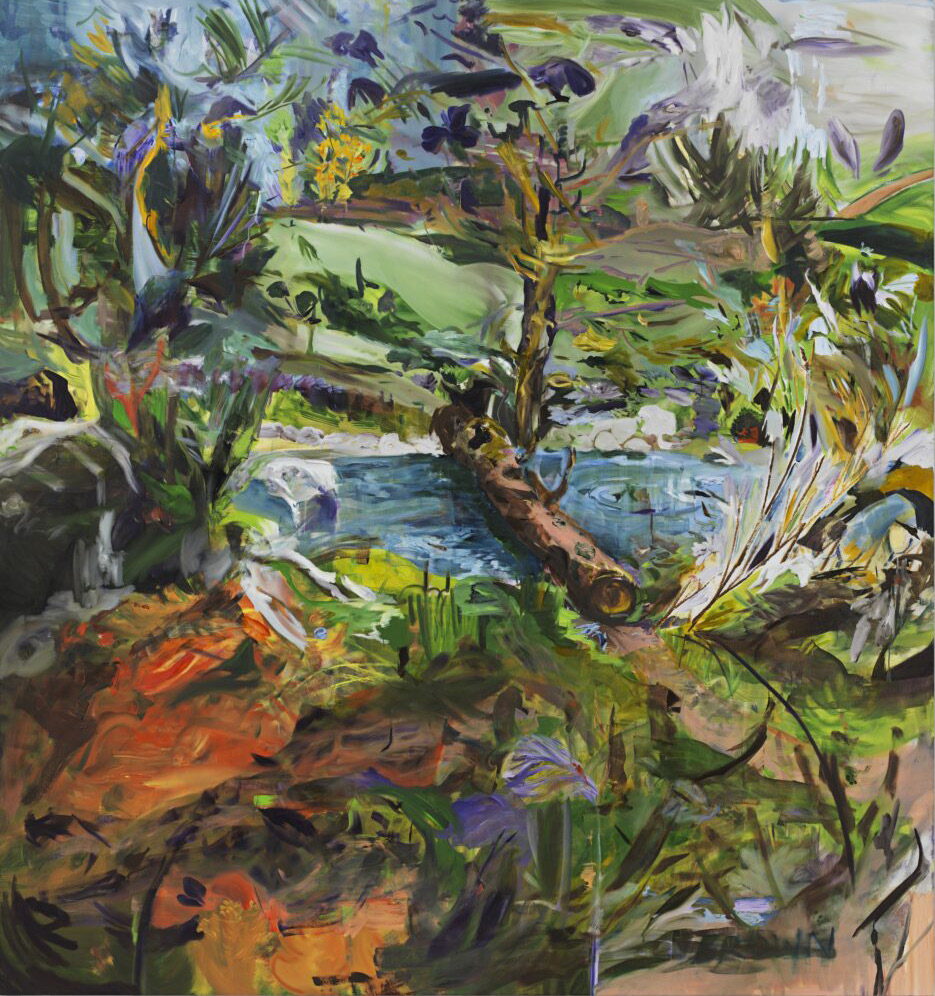
2024, oil on linen, 226.06 x 210.82 cm (89 x 83).
Photo: Genevieve Hanson
A short walk from the South Kensington tube station, passing several major museums, leads you to the Royal Albert Hall and into Hyde Park. Nothing remains there of the legendary 1851 Great Exhibition but the proceeds from it have shaped this part of London. The Royal Park itself is a haven from traffic and a centre for exercise and recreation. It cocoons two small but important art galleries, Serpentine South and North.
The Serpentines are run by a charitable (not for profit) foundation and provide free admission to a rolling program of exhibitions of important and sometimes famous artists. Their location and accessibility encourage you to experience the work of artists that are unknown to you and even to expose yourself to work that you may fear you will not enjoy. Equally, they put on shows by artists of international renown. The Galleries are positioned on opposite sides of the Serpentine lake, joined by a bridge, so it is easy to visit both locations on the same day, and often experience very different exhibitions.
I approached the Cecily Brown exhibition “Picture Making” at Serpentine South with no prior knowledge or expectation. She is a British artist but has for many years been based in New York. The moment I entered the gallery, I realised that I was going to have to work to understand and appreciate what was before me.
The viewer is presented with paintings that pose visual questions; there are no easy interpretations or explanations.
Most of the paintings defy simple categorisation. Are they representational? Only partly. Are they abstract? To a degree. What are they about? Largely landscape, but some are figurative. What exactly is she doing? And why?
The answers to these questions must be subjective and personal. They are likely to change with time and with repeated viewing, but everyone has to start somewhere. Where is a way in?
The “Nature Walk” series exemplified my experience. Each canvas has a central motif of a felled log, leading us into the picture, bridging a stream that runs crosswise. That motif is visible, with varying clarity, on each canvas but the context seems to change with varying elements and increasing abstraction. I felt that John Constable would be smiling! On closer inspection faces and figures appear within the landscape. The broad brushstrokes evoke Cézanne’s constructive marks. Everything seems to change and move on the canvas, the viewer must either actively interpret and ‘finish’ the image or let go and enter a sea of brush strokes and colour. Why not do both? The changing context raises questions about the central motif which now seems unmoored. Is it an actual spot, familiar to the artist, or is it imagination and meaning? The shifting partially defined backgrounds suggest motion, undermine perspective, remind one of Cubism. Viewing the paintings close by as a series draws attention to the static two dimensional nature of the canvas but also seems to overcome it. I felt I was on a journey but not moving. It’s something to be experienced rather than described.
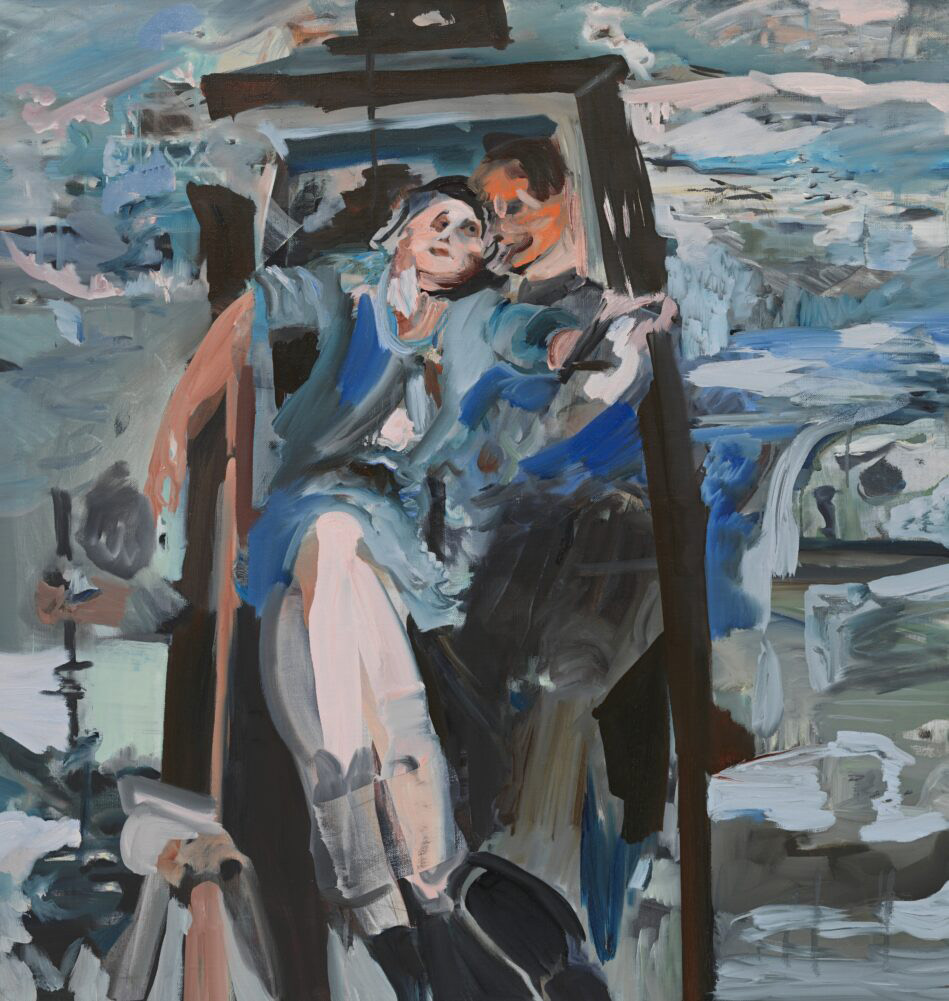
2021-2025, oil on linen, 78.74 x 73.66 cm (31 x 29).
Photo: Genevieve Hanson
The more figurative pieces often seem to clash subject and background, creating new meaning and emotion. The couple embracing in Untitled (Boating) seem perhaps compressed together in a coffin-for-two rather than romancing in a boating skiff.
Continuing on to Serpentine North, I reflected that I had experienced jazz built on the history of modern and contemporary painting. There must be much that I had missed or misunderstood. Ahead lay the more familiar but the no less exciting art of David Hockney and his exhibition “A year in Normandie and some other thoughts about painting.”
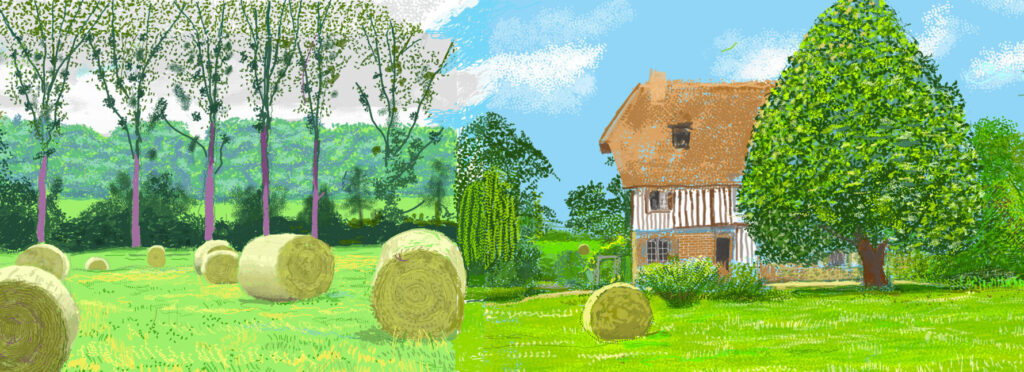
installation view, Serpentine North, 2026. Photo: George Darrell
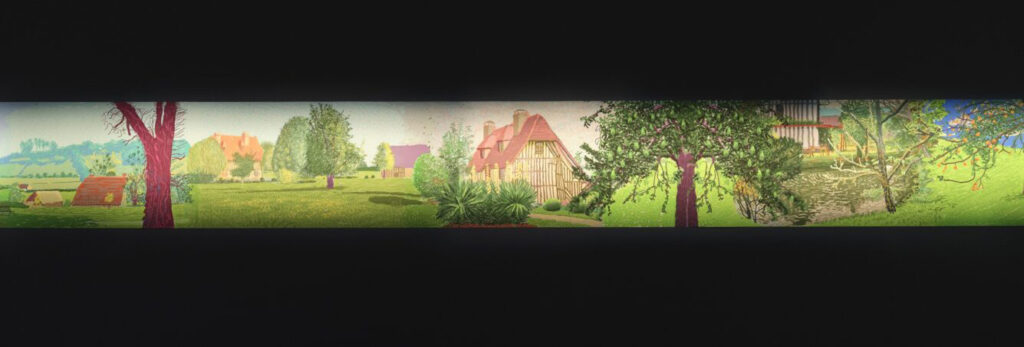
His Year is a monumental frieze that encircles the rectangular gallery space. Its origin was a series of iPad paintings that he made while at his studio in Normandy, beginning during the Covid lockdown period. He set himself the task of depicting the landscape and changing seasons around his studio. He used an iPad both because of his love of technological innovation and its portability and speed—a move echoing the Impressionists use of the, then, new tube paints and portable easels to paint landscape ‘en plein air’. Later, inspired by the Bayeux Tapestry, he conceived the idea of fusing selected images together to be printed on a continuous roll of paper to create the frieze.
The main protagonists of the frieze are the changing trees, foliage and flowers as they exist in the context of the buildings and features of the land. It immediately became apparent that Hockney had created a very specific visual language both suited to his medium and characteristics of his endeavour. The images are a hybrid between drawing and painting, reflecting Hockney’s relationship with intense colour. Looking more closely, there is a deliberate lack of detail and the style seems, in many ways, closer to illustration than fine art but everything is intentional; while the representation is not realistic, it is absolutely clear what he is showing you. The consistency of style achieved throughout his Year is visually exciting.
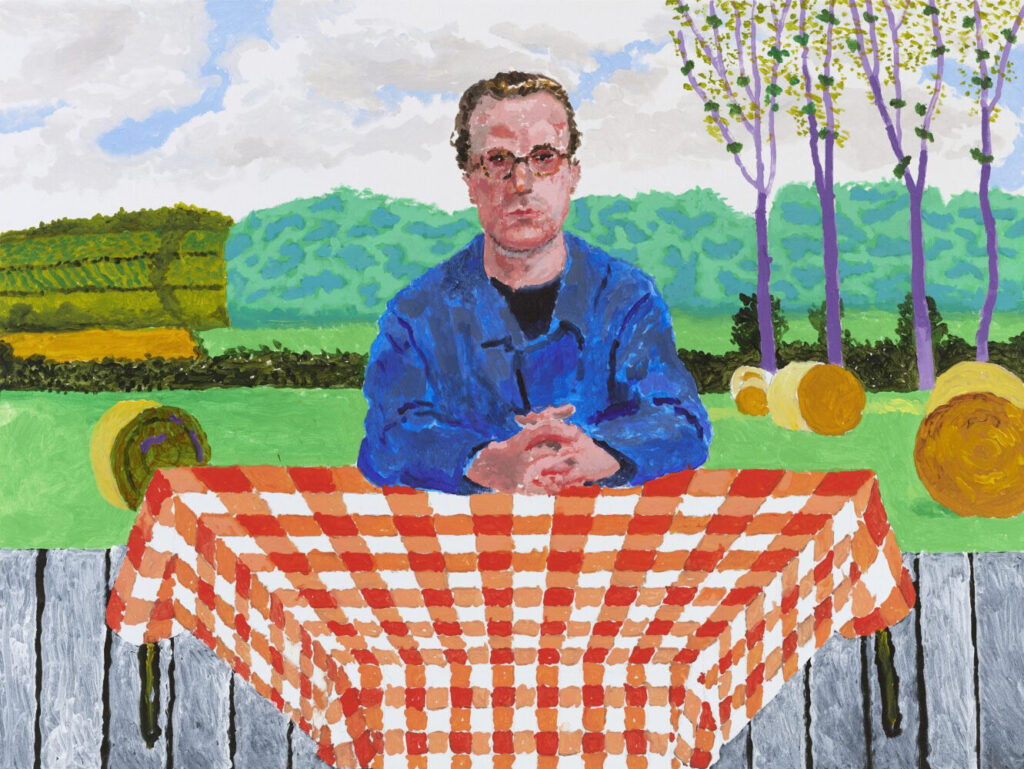
So what of his “other thoughts”? In the central portion of the gallery there is a small group of portrait and still-life paintings which have been made specifically for this exhibition. The predominant theme is that of perspective. The sitters are positioned behind tables covered with checkered tablecloths, each presented in reverse perspective so that the rear edge of the table appears wider than the front—a perspective that enlarges the size of the subject in the frame and which was often used in mediaeval Orthodox icon painting. But why? In optically generated images and conventional linear perspective orthogonals converge to a distant vanishing point. Perhaps Hockney is making us aware the we are looking at something different, something determined by a human mind rather than the product of an optical mechanism? The lines seem to converge in front of the picture plane, exactly where we are standing; perhaps he is suggesting that we each have our own self-centred perception of the world? The pictures play with perspective in other ways too. The tables resolutely refuse to sit on their floors. The still lives appear as paintings on flat canvas and each, while standing upon its table, appears stuck resolutely to the picture plane… Paul Cézanne feels close at hand.
Returning to the Year, I focused on the issue of perspective. The appearances are relatively flat, there is no tonal modelling and few shadows or reflections. The convention of providing more detail in the foreground is generally ignored. Depth is reflected by a change of scale and vertical position but I began to feel that both were determined by artistic choice.
What about the horizontal dimension? In a conventional landscape this also reflects position but here that cannot be so. The same tree or building may reappear, sometimes almost side by side with itself, but seen from a different point of view. I became aware that horizontal position reflected the artist moving within the landscape and through time. The breadth of the frieze represents the beauty and story of the changing seasons. It also reflects a spiritual quality, the progress a pilgrim makes through a gallery of seasons.
At the end of the frieze, there is the option to return to the first wall and begin anew a cycle of seeing. The whole “perspective” of the frieze is a meditation on the passage of time, the nature of artistic representation and the cyclical nature of life itself. G&S


Leave a Comment