These days, many art lovers are aware that while Michelangelo was painting the Sistine Chapel and carving out David, he was also writing beautiful, passionate sonnets; and that while William Blake was creating his breathtakingly surreal prints, he was also penning ferociously complex prophetic poems, many of which were illustrated by his own colorful etchings. These are two of the many artists who write. Conversely, there are great, inventive minds whom we know primarily as authors who also created art, who needed art as another language to express feelings and to explore the realities of the world around them.
So, while Sylvia Plath was writhing with angst while “the tulips are too excitable,” and Henry Miller was nakedly escapading through Paris, and e e cummings was decapitalizing whole sections of his poetry—they were also creating visual art. So were Franz Kafka, Tennessee Williams, D. H. Lawrence, and Beatrix Potter to name just a few others. And why? Because writers want to develop a sharper eye for environmental detail, allowing them to use words to create effective pictures in the minds of their readers, to physically materialize the imagery they intend to put into text. Painting, watercolor, collage, and other visual mediums, allow authors to express feelings directly, test out stories in new ways, and find a fresh creative spark without using words. Art becomes an alternate language.

A superb example of this “bilingual” creativity is Sylvia Plath (1932-1963). Best known for her intense poetry and her semi-autobiographical novel The Bell Jar, Plath was also a passionate visual artist. Throughout her childhood and university years, she worked in pen and ink, charcoal, and collage, and her intricate, clean-lined sketches focused heavily on quiet cityscapes, domestic items, botanical studies, and loved ones like her husband, the poet Ted Hughes. She described her visual art in a 1956 letter to her mother: “I feel I’m developing a kind of primitive style of my own which I am very fond of. Wait ‘til you see. … It gives me such a sense of peace to draw; more than prayer, walks, anything.”

Similarly, before publishing her iconic children’s books, Beatrix Potter. (1866-1943) was a highly skilled naturalist and mycologist who found a sense of meaning and peace by drawing precise, scientific illustrations of plants, animals, and fungi. Her deep understanding of anatomy and landscape allowed her to create the whimsical yet anatomically grounded watercolor illustrations for The Tale of Peter Rabbit and her other cherished animal stories. In her diary she wrote: “It is all the same, drawing, painting, modeling, the irresistible desire to copy any beautiful object which strikes the eye. Why cannot one be content to look at it? I cannot rest, I must draw, however poor the result, and when I have a bad time come over me, it is a stronger desire than ever.”

And Henry Miller (1891-1980), the controversial author of Tropic of Cancer, was an incredibly prolific painter, producing several thousand vibrant and expressionist watercolor and acrylic pieces during his lifetime. He frequently stated that painting gave him a pure, conscious joy and mental release that the grueling work of writing could never reproduce. In a 1960 book about his art, Miller described his creative process as an unpolished, intuitive journey: “My way is by trial and error, by groping, stumbling, questioning,” and famously said: “To paint is to love again, live again, see again.”
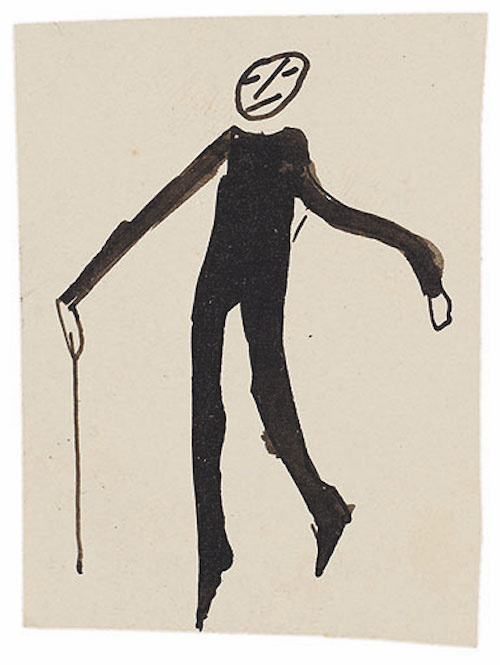
Another writer-artist, Franz Kafka(1883-1924) —who gave us the macabre horrors of The Metamorphosis and The Penal Colony— proclaimed in a conversation with Gustav Janouch that prayer and art are passionate acts of will: “Art like prayer is a hand outstretched in the darkness, seeking for some touch of grace which will transform it into a hand that bestows gifts.” His simple, almost childlike sketches are often visual representations of his alienated protagonists.

e. e. cummings (1894-1962) treated painting as his “twin obsession” alongside writing. Cummings painted daily with the same focus he applied to his poetry, creating mountain landscapes, still lifes, nudes, and portraits—often of his partner Marion Morehouse. In his prose piece The Artist, he noted that “the Artist is no other than he who unlearns what he has learned, in order to know himself.”

In a 1982 conversation with James Grissom, the great American playwright Tennessee Williams 1911-1983) said: “The world is violent and mercurial—it will have its way with you. We are saved only by love—love for each other and the love that we pour into the art we feel compelled to share: being a parent; being a writer; being a painter; being a friend. We live in a perpetually burning building, and what we must save from it, all the time, is love.” Williams went on to say that he considered his paintings to be literal textual self-portraits, calling them “a picture of my own heart.”
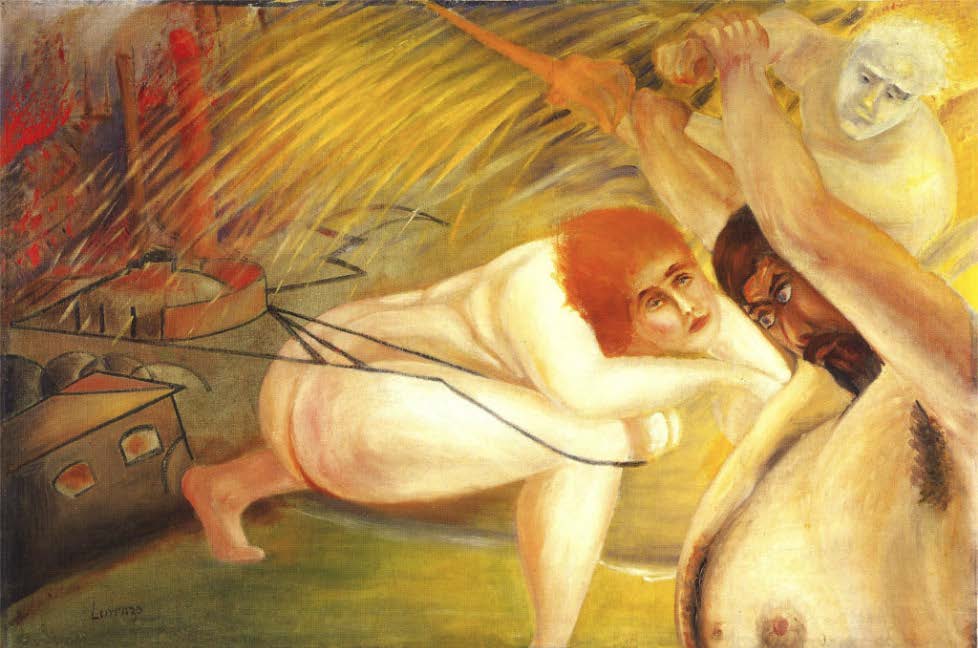
And then there’s D. H. Lawrence (885-1930). In his essay “Making Pictures,” he explained that he started painting for the “sheer fun” of it, describing his work as a direct outpouring of his inner vision with little concern for “correctness,” valuing raw vitality over technical perfection. His canvases focus heavily on the naked human form, with unashamed honesty about sex and physical existence. It should then come as no surprise that the author of the banned novel Lady Chatterley’s Lover also found his art “banned.” In July 1929, police raided the Dorothy Warren Gallery in London and seized 13 of his oil paintings. Authorities deemed the nude figures and frank depictions of sexuality “obscene.”
The list could go on: Vladimir Nabokov’s butterfly studies, J.R.R. Tolkien’s illustrations, William Faulkner’s Jazz Age etchings, Flannery O’Connor’s cartoons, and Zelda Fitzgerald’s watercolors. The link between the written word and visual art has always been strong, but we readers are often left clueless about that link. We know Plath’s Ariel and Williams’s Cat on a Hot Tin Roof, but many of us are unaware that the process that went into creating those masterpieces was deeply rooted in the creation of something visual—a second language that allowed those writers to explore their deepest wells of thought and feeling. G&S


Leave a Comment