
Vivian O’Shaughnessy’s homage to Walt Whitman
250 years has birthed a wealth of writers in the United States of America. Cherry-picking from the nation’s catalog, the names easily come to mind. Thomas Jefferson, Benjamin Franklin, Mark Twain, Ernest Hemingway, F. Scott Fitzgerald, J.D. Salinger, Harper Lee, and Jack Kerouac. In more recent times we have had Maya Angelou, Toni Morrison, Danielle Steel and Stephen King, just to list a few. However, naming poets can be a little bit more challenging.
Walt Whitman is probably the most well-known poet, often described as “America’s poet,” having developed a free verse style, eschewing the more formal poetry that followed rhyming, rhythm or meter driven language that had historically been used. His style was more conversational, had no formal style rules, and was dependent on story-telling and vivid imagery to create impact. For a man who ended his formal schooling at the age of 11, and was largely self-taught, it is quite the accomplishment. His passion for reading encouraged him to become a teacher at seventeen.
Whitman was born in Huntington on Long Island in 1819. He moved to Brooklyn, then Washington DC and finally ended up in Camden, New Jersey. He worked as an office boy for lawyers, apprenticed with newspapers, and became primarily a publisher, journalist, editor, author and also a poet, known best for Leaves of Grass, a collection of poetry, originally with 12 poems which he continually revised and added to, for 37 years, with the final edition having nearly 400 poems.
He was the subject of a conversation between Vivian O’Shaughnessy, artist and poet, and Valerie Hotchkiss, Azariah Smith Root Director of Libraries and Professor of English and Book Studies at Oberlin College & conservatory (2021-2026). Hotchkiss had brought O’Shaughnessy a gift of a hand printed poem, Whitman’s In Paths Untrodden, prepared by nine students in her class. Together they discussed Whitman and the germ of an installation project to be created by O’Shaughnessy emerged, which Hotchkiss christened Printer Poet.
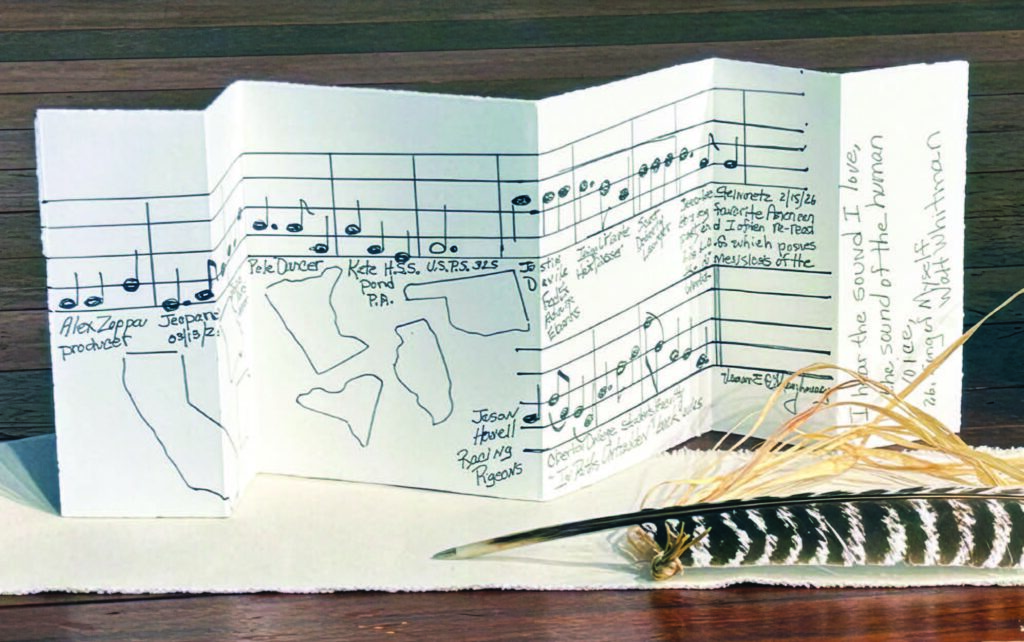
Printer Poet is a fusion of O’Shaughnessy’s connections to Walt Whitman. It starts with the gift Hotchkiss gave her. Then a handwritten copy of Whitman’s I Hear America Singing written on a long card, folded and stood on its side. This anchors the installation. On the back, she has transcribed the music of the song My Country, ‘Tis of Thee. Asked what she most admired about Walt Whitman, O’Shaughnessy replied, “it’s his connection to the everyday people he knew.” So in emulating his style, she named the people she meets regularly in her neighborhood, including her FedEx employee, her hairdresser, her lawyer, the US Postal Office clerk, and a pole dancer. Her doorman, a “fancier,” who owns, trains and races pigeons, is also identified. He even participated in this project by providing a beautiful feather from one of his prize pigeons, when it molted, to remind us that Walt Whitman wrote with a quill and ink. She finishes this part of the installation with a quote:
“I hear the sound I love,
the sound of the human voice.”
Song of Myself by Walt Whitman
O’Shaughnessy may appear to be sweet and genteel, with her Southern charm, (she is originally from Texas,) however like any good Texan she has a core of steel, and a strong sense of right and wrong. Below her friends and acquaintances, she has identified celebrities who have included Walt Whitman’s words in their own works but would not allow her or other artists to use their names. She identifies them by the state where they are from. If you know, you know…
Next to the folded card, is a hand constructed layout of The Cell Theater, NYC, to which she was first introduced at a performance of Leaves of Grass. The show card for the performance is included in this project. Additionally, there is a compilation of poetry by a friend, Alan Britt, who teaches creative writing and poetry at Towson University, including a class about Walt Whitman.
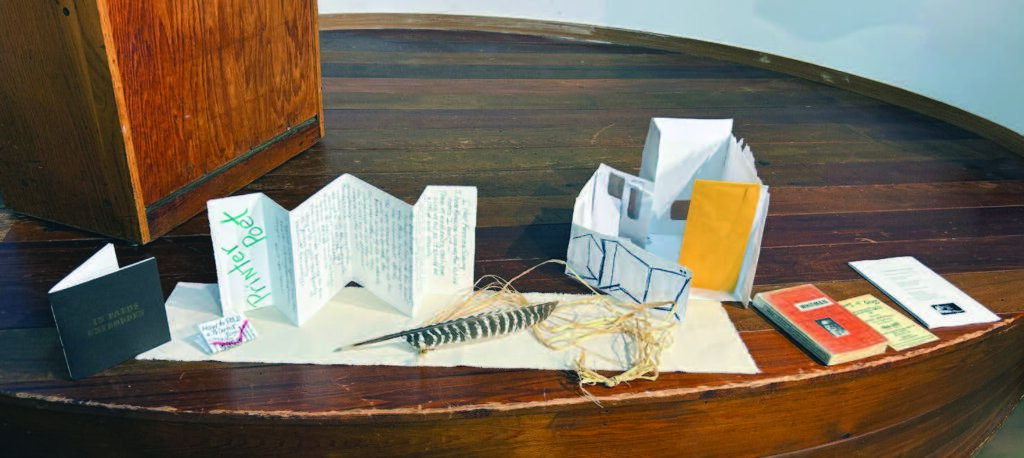
O’Shaughnessy has always been an artist that aims for inclusion, often providing translations in French, Spanish and Braille. To this end, she has included in the installation an old book on Walt Whitman, printed by the renowned French publishers Gallimard, with the added bonus of it being an ‘unopened’ book, a book whose pages were never completely sliced apart before binding. This was not an infrequent occurrence in the earlier days of printing. It shows how books were printed on large sheets, folded and then sliced. To continue on this theme, O’Shaughnessy includes a little hand drawn maquette created by Valerie Hotchkiss, that explains how pages of a book are laid out and printed, to be folded into the correct sequential order. This whole installation can be folded up and wrapped in the cotton runner that it all sits on and tied with raffia ribbon to be easily transported or stored.
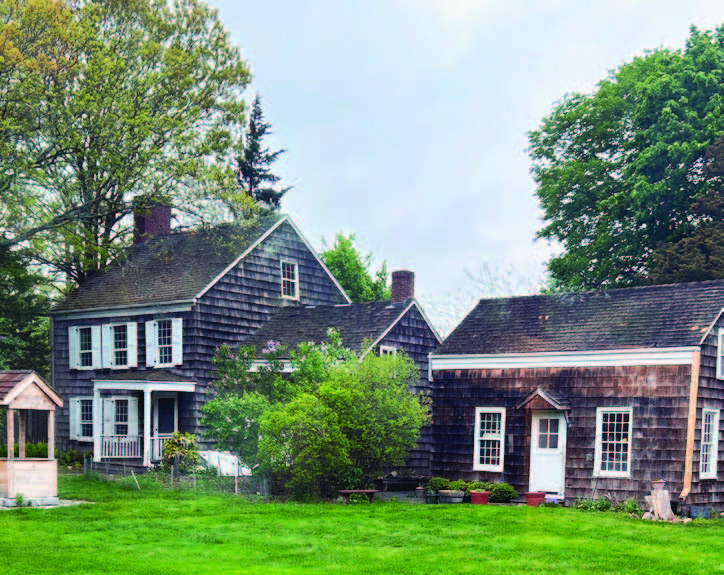
Printer Poet has been gifted to the Walt Whitman Birthplace Association, in Huntington, NewYork, with an agreement that Caitlyn Shea, artist and Executive Director, will collaborate with a painting of a local bird to add to this installation.
This is Vivian O’Shaughnessy’s storytelling of Walt Whitman using vivid imagery to create impact, just as Whitman did. It is a creation which exemplifies the words of another famous historical American:
“Poets, prophets and reformers are all picture-makers—and this ability is the secret of their power and of their achievements. They see what ought to be by the reflection of what is, and endeavor to remove the contradiction.”
– Frederick Douglass


Leave a Comment