
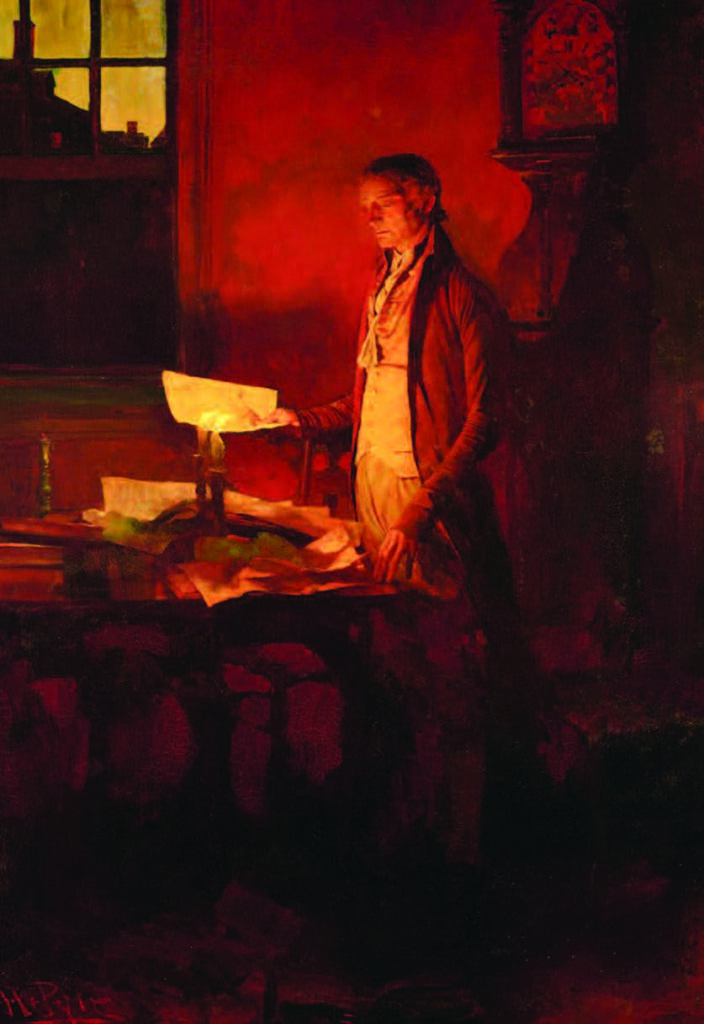
Magazine, March 1898, Howard Pyle (1853– 1911), oil on canvas, 36¼” x 24″ (92.1 × 61 cm). Delaware Art Museum, Museum Purchase, 1912
Thomas Jefferson was the reluctant author of the Declaration of Independence. He needed vigorous persuasion by fellow-members of the Committee of Five, the leading proponents of independence at the 1776 Second Continental Congress in Philadelphia. Jefferson recommended Massachusetts member John Adams, but as Adams later recalled, the committee agreed that Jefferson was the best writer and that “a Virginian ought to be the head of this business,” to ensure Southern colonies’ support. When Jefferson continued to demur, Adams reminded the amiable Virginian that “I am obnoxious, suspected and unpopular; you are very much otherwise.” Jefferson replied: “If you are decided, I will do as well as I can.” He wrote what he called the document’s “rough draft” between June 11 and 28, 1776. After delegates’ revisions, the Second Continental Congress approved “A Declaration of Independence” on July 4, 1776.
Thomas Jefferson Writing the Declaration of Independence was one of Howard Pyle’s 12 illustrations for The Story of the Revolution, by Massachusetts Senator and former Harvard history professor Henry Cabot Lodge. Scribner’s Magazine serialized the text throughout 1898. Later in the year, Charles Scribner’s Sons published a comprehensive two-volume book based on the series with Lodge’s significant alterations and additional illustrations by various artists.
Pyle was a well-known illustrator of American historical fiction and nonfiction for adults and young people. He was an enthusiastic researcher into visual and literary sources, especially of the Revolutionary period, and his Wilmington, Delaware, teaching studio overflowed with colonial artifacts.
In an era when—according to one jaded commentator—“a picture to every page is a sign of the times,” Pyle challenged his students: “When you make a picture for a magazine, put yourself in the place of a person who opens its pages and glances on them—is your picture interesting?” He stressed that historical rigor is important but emotional immediacy is paramount. Even a cursory glimpse must arouse a natural desire to linger and look, and to read.
Lodge does not describe Jefferson’s appearance or surroundings as he worked on the draft. Pyle’s imagination brings both to life. When we look at the color oil painting, our eyes need to adjust—as if we were with Jefferson in the dim candlelight—before the details reveal themselves. We have entered one of the two second-floor corner rooms that Jefferson rented from brick mason Jacob Graff during his Philadelphia stay. The tall clock, hardly readable in the dark, shows twenty-to-four, a time when the earliest glimmer of dawn begins to appear in June over Philadelphia’s rooftops.
A breeze from the invisible window at left sways the flames, and glints of light flicker on the pewter candlestick and the edge of a book. One candle has burned down, and two almost-spent ones barely illuminate Jefferson’s face, shadowed against the russet wall. He is reviewing a page marked with Xs and marginalia; other papers have fluttered to the floor among open and closed books, signs of deep research and tireless reworking. Some pages rest on Jefferson’s tilted lap desk among more books on the tabletop.
Jefferson’s white cravat, buff waistcoat, long-tailed frockcoat, and breeches are worthy of a formal portrait. Ignoring the chair behind him, he shows no sign of fatigue or tension. At his imposing height of over 6’2”, he stands confidently, his long fingers relaxed and lightly touching the table. His face is a study in concentration.
At the painting’s center, flames highlight the Declaration itself, an affirmation that —as Lodge asserts— “in the Declaration of Independence, Jefferson uttered in a noble and enduring manner what was stirring in the hearts of his people. …Hope, faith, patriotism, victory, all cry out to us in that mighty hymn of the Revolution…” Alone in the pre-dawn silence, burdened with the weight of his unsought responsibility but loyal to the cause of freedom, Jefferson embodies the dignity and gravity of the American Revolutionary hero.
In the nation’s early years, Jefferson’s authorship of the Declaration was not highlighted, the better to emphasize the signers’ unity. But as the 19th century progressed, schoolroom recitations and July 4th readings turned Jefferson into a national idol, honored for his patriotism and enlightened principles. Many of the 10 million attendees at the 1876 Centennial International Exhibition in Philadelphia, likely including 23-year-old aspiring illustrator Howard Pyle, stood in awe before Jefferson’s lap desk, now in the Smithsonian.
At the nation’s 100th anniversary, the organizers—despite their decision to keep Black and Indigenous participation to a bare minimum— celebrated Jeffersonian concepts of individual freedom and democracy. By 1898, however, many influential Americans, including Henry Cabot Lodge, rejected Jefferson’s concepts of an agrarian economy with a decentralized government and embraced instead the industrial progress and strong federal authority championed by Alexander Hamilton. Still, public adulation of Jefferson prevailed. And even though Lodge, an ardent Hamiltonian, distrusted Jefferson’s vision of government, he too was grateful that in the Declaration of Independence, Jefferson “spoke his message so that it went home to the hearts of his people with an unerring flight.”
Today, at the nation’s 250th anniversary, Jefferson’s legacy remains contested, less for his political philosophy than for his racial hypocrisy. Despite his abolitionism and moral condemnation of slavery, Jefferson enslaved over 600 persons and freed fewer than 10; he used some enslaved individuals as collateral for his debts. He considered Black people immutably inferior and called for their universal deportation after emancipation. Lodge presents another conundrum. He was a eugenicist who regarded everyone of “non-Anglo-Saxon” ancestry detrimental to the United States, but his tribute to Jefferson is stirring:
“(he) was setting forth the reasons for a Revolution…for which men were to be asked to die… It is the glory of Jefferson that he did just this and it was no fault of his that the South dimmed one of his glowing sentences by striking out his condemnation of human slavery.”
Readers and viewers of paintings will bring their own meanings to Thomas Jefferson Writing the Declaration of Independence. The 2026 semiquincentennial may reanimate the spirit of President Ulysses S. Grant’s opening speech at the 1876 centennial, when he hoped that “we may the more thoroughly appreciate the excellences and deficiencies of our achievements.” The Smithsonian’s National Museum of American History will celebrate our ongoing quest in the aptly named exhibition “In Pursuit of Life, Liberty & Happiness.” G&S
Mary F. Holahan © 2026
www.delart.org



Leave a Comment