
The graphic design book, Continuum, by Marlena Buczek Smith (author), brews brisk cups of coffee as socially conscious refreshment to temper acrid standard coffee shop fare. Buczek Smith hails from Poland and is a creation of a society where a history of political surveillance curtails self-expression. Her personal understanding of life is informed by this, contributing to her strong belief in open and democratic societies. Through her art studies and living in the US her own experiences were enriched, her graphic designs sparking positive societal actions.
Continuum’s words and images meld, the author dressing her subjects in neat prose. The book explores current societal issues, using clear language and relevant graphics to help readers understand our global challenges. Buczek Smith treats the subjects of war and conflict as critiques of our planet’s approaching a tipping point toward ecocide and human extinction from climate change; her words and images underscore the need for earth stewardship through her choices of contributors who entreat us to reject war.
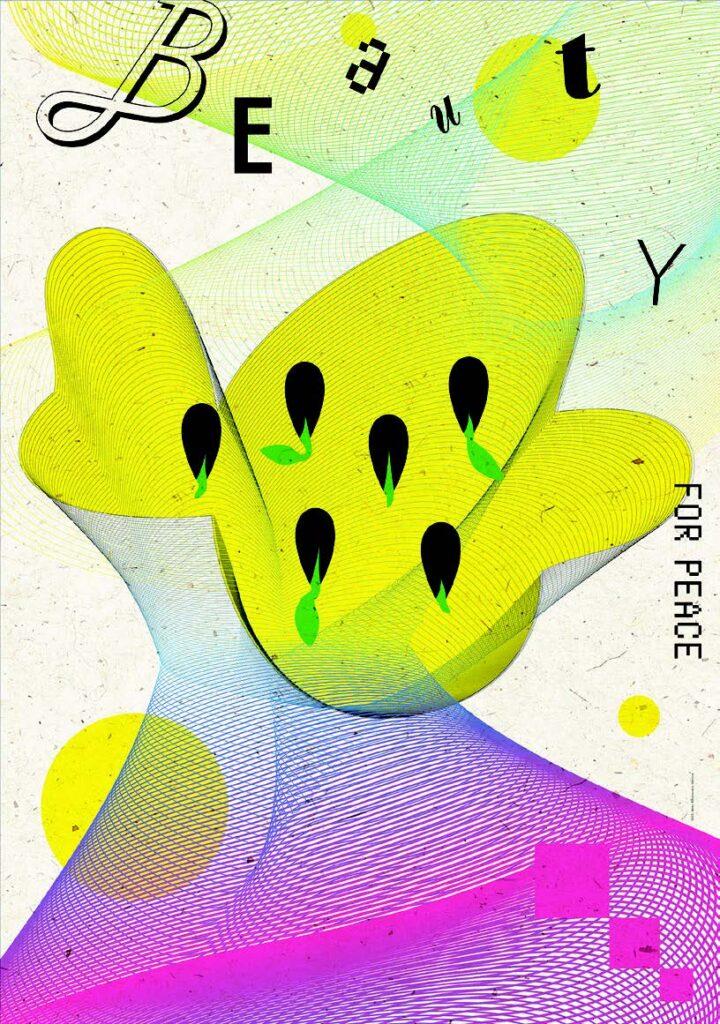
Helen Baranovska contributes both a compelling poem and felicitous graphic of spring colors entitled Beauty for Peace, as an earnest platform for environmental issues; the poem underscores the need for hope’s germination in a war-torn land, coaxing accord to decrease conflict:
“In her homeland’s embrace, her plea unfolds,
To the invader, where peace untold.
‘Take these seeds,’ she implores, eyes sincere,
From invader ashes, peace’s bloom shall adhere.”
Throughout her career, Buczek Smith’s work has been displayed as visual designs and paintings that have been featured in publications such as Graphis and Print Quarterly, along with the 8th International Biennale of the Socio-Political Poster helping to unite people in support of noble causes. In some of her art, Ukraine is showcased, an empathy to supersede war’s ravages as balm for the nation’s struggles. The city of Verin is home to the legendary Millennium Oak, said to provide protective powers for the nation during wartime, the wood standing for stability and deep roots, important for the country in their present political climate. I imagine a tiny acorn growing from seed to a mighty oak as emblem of survival, strength, and endurance, qualities significant in Ukrainian folklore; it is said that a white oak tree can live for hundreds of years, giving forth shade, shelter, and sustenance.
I think of American poet, journalist, and soldier Alfred Joyce Kilmer, best known for his 1913 poem Trees which extols transcendent natural beauty in verse. While fighting in France in WW1, Kilmer fatally caught a bullet to his head from a sniper’s gun, his resultant death not only a personal tragedy, but also one for American letters. However, through text preservation, this poet’s words endure as artistic vision.
Honest journalism is greatly needed now to expose truth, especially in this time of shadows of encroaching concealment. It may be said Kilmer was an advocate for protecting life, viewing the natural world as sacred. His praise of trees reinforces one of the principal reasons for arboreal preservation, the need to provide us with the comfort of shelter and the filtering of atmospheric particulate matter to benefit respiration. Old growth forests are of key arboreal and human support, ancient woods perpetuating continued existence.
Continuum means unendings. In words and pictures, the book explores human struggles, documenting existence and endurance despite human brutality
and carnage. Today Ukraine fights for survival in an unsolicited war with Russia where people on both sides are victims of violence. Poet Kilmer, too, was a victim when conflict extinguished his life, but his words remain. His poem Trees celebrates nature’s eternal presence, an acorn, the oak tree’s seed, a harbinger of continuance. A sniper’s bullet, the devastatingly destructive seed, may have ended Kilmer’s physical life, but his writings permit his soul’s triumph over death as impetus for art’s creation. We realize Nature has the final word about mortality, but when we consider things of beauty, we can live on in spirit. G&S


Leave a Comment