
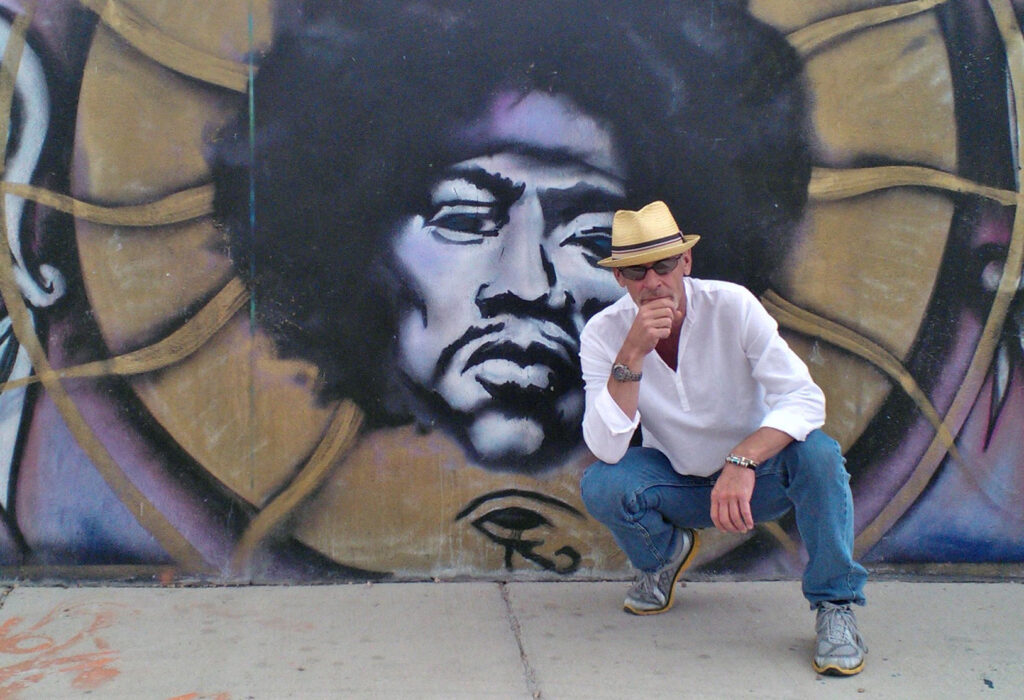
The first time I met Bob Hogge he said, “just give me 10 minutes of your time.” For the next 6 months, he didn’t stop talking. He talked so fast and on so many subjects that I just couldn’t keep up. My head was constantly spinning. Most of the time I had NO CLUE what he was talking about. All I knew was that whatever it was that he was talking about sounded exciting, inspirational, fascinating, funny, intense, serious, ground-breaking, meaningful, thought- provoking, compassionate… are you exhausted yet?
He was a polymath and a human dynamo. He knew a lot about a lot of things. He had experienced a LOT of things. Born in Richmond, Virginia with a father in the Air Force, he moved to Japan at the age of one. Later he and his family moved to Roswell, New Mexico, the mysterious town, home to “Area 51,” where some believe aliens are hidden. Some say that Bob was taken by the aliens, but they couldn’t handle him and so they spit him back to earth. Anybody who met Bob knew that this story could very well be true. He could talk a hind leg off a donkey, sell ice in the arctic and motivate the grumpiest of people to excel.
This same man was also a serious artist. He would spend hours and hours in a darkened den, quietly and meticulously painting with acrylic on canvas. He liked to paint in the dark, so that when he brought it into the daylight to varnish it, he would see his work as a finished composition for the first time, as anyone else viewing his art would see it.
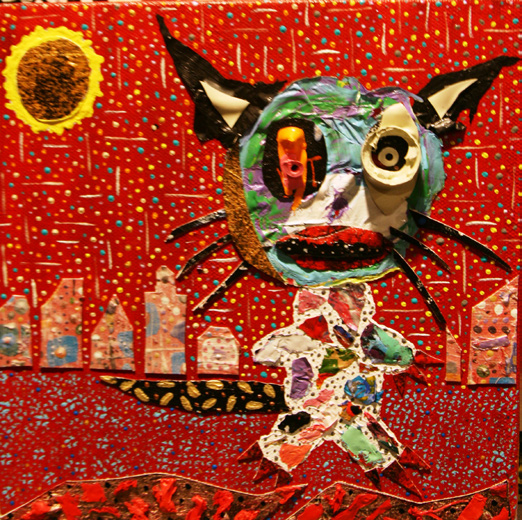
Robert d. Hogge, (1953-2016) or often simply known as R.d.H, was an Xfusionistic painter. “Xfusionism,” Hogge said “is a concept of art that incorporates any number of styles such as Abstract Expressionism, Surrealism, Neo Expressionism, Outsider, Brut or Aboriginal Art into one entity and the artist ‘X-tracts’ their major component parts leaving their distilled spirit to create a completely unique art form.”
The innate value of Xfusionism was that it “supersedes any parameters or boundaries, allowing artists to draw from established structures and styles and proceeding to be expansive in exploring the creative freedom that their word demands.”
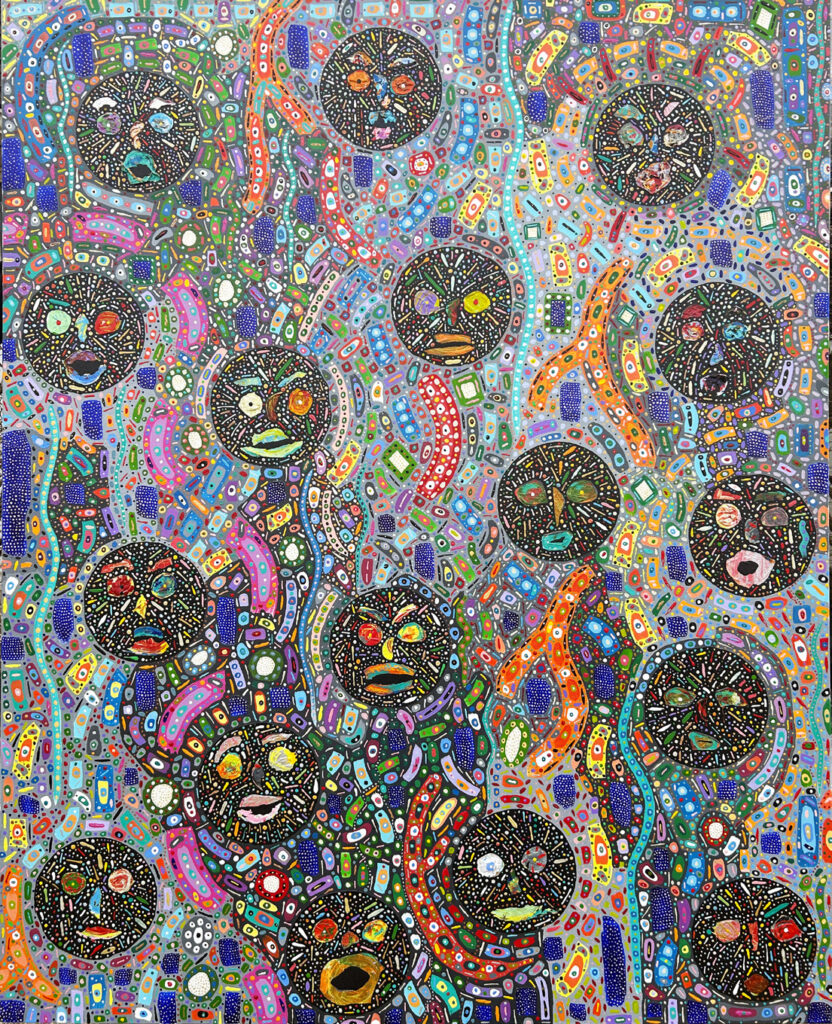
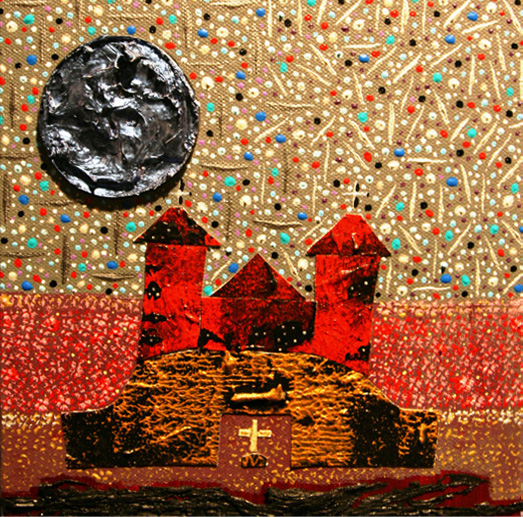
Much of his work was three-dimensional art. Layer upon layer of acrylic paint; in effect a collage of paint. He would place paint on plastic trays, allow it to dry, peel it off the trays and then incorporate it into the painting. Are you still with me? He would then layer more paint with brush strokes. Hogge called it “restructured pigment.”
Painting for Hogge was his religion. It was his spiritual quiet place, where he could still his mind, calm the intensity of his feelings and remember who he was.
He painted about feelings, his experiences, the world, the universe, cats (he and his wife Mary-Ellen had a LOT of cats), his bulldog, philosophy, books he had read, places he had been. His life was made up of multiple lives, ups and downs, twists and turns. He went to Hofstra University, and the New York Institute of Photography. He volunteered and joined the army in Germany during the Vietnam days. Later he worked in the corporate world: Wells Fargo, Masada Security and British Airways. This became the genesis for The Management Team, showing managers who blindly follow corporate dogma.
For the first half of his life, drugs and alcohol were constant companions. Then responsibility woke him up. He totally changed his world around for the joy of his life, his daughter Cristina.
Hogge’s paintings are vibrant and colorful and appear cheerful at first glance. However, look a little closer and you will see layers of complexity. There are shadows and darker moods. The images are never perfect, some are goofy, all are seasoned by his life. He understood the challenges of living and the work it takes to overcome them, but he always overlaid it with a dose of rock-solid positivity.
In 2006, he and I opened Monkdogz Urban Art, a contemporary art gallery in the now renamed Landmark Arts Building on West 27th Street, New York. The aim of the gallery was to create an environment that was in the heart of the Chelsea art district but was friendly and welcoming, unlike many of the other commercial galleries which were elitist and often decidedly unfriendly! With Sébastien Aurillon, a French artist who joined us soon after we opened, we curated many shows with hundreds of emerging artists from around the world. We wanted to give artists their first opportunity at an exhibition in a Chelsea gallery.
The show openings were always mobbed with artists, collectors, critics, art lovers, the curious and the just wandering by. Bob had time for everyone. He was always surrounded by people, hanging on his every word, even if they didn’t always fully understand everything he was saying. They just knew that what he was saying was worth listening to, even if they often went away only remembering something about “bouncing on a trampoline, hanging on a swinging chandelier, wearing a fireman’s hat…”!!?
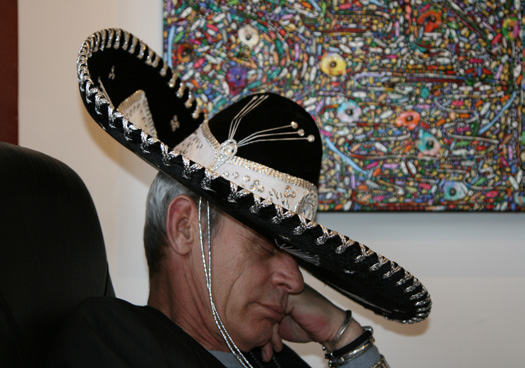
Hogge always spoke to artists about their art, their careers, and their lives. The conversations often ended with the words: “As artists we need to be accountable, to have imagination, and to fuse these things with courage and humility. Here’s the thing…you want something different than what you have, you got to be willing to do something different than you’ve ever done before. You gotta get out of your own way. Nothing changes if nothing changes.” G&S


Leave a Comment