

Change can be a slippery thing. We romanticize metamorphosis in poetry, film, and music, but when it comes to the real deal, it’s human nature to balk. That pushback can represent a significant stumbling block for artists, who find that some patrons cling to familiarity. They want what they are used to, which can be hard on both the artist’s vision and their sales.
“Culturally, I think we react to something and we like it, and we like to keep that recipe,” says David Hochbaum, a Boston-based visual artist. ”It definitely pigeonholes artists, but growing and evolving is very important.”
A prolific creator since the mid-1990s, Hochbaum is intimately familiar with change and all of its trials and tribulations. An artist who combines such eclectic mediums as photography, painting, sculpture, drawing, film, and woodwork, he has experienced himself—and therefore his art—in many iterations. “Every 10 years or so, naturally the work just starts transitioning,” Hochbaum says. “Your “Self Portrait,” 2011 physiology is changing, [your] chemistry is changing.”
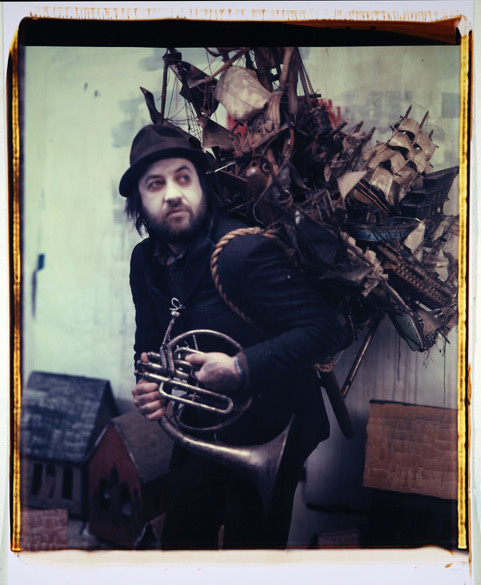
Born in New York City, Hochbaum grew up immersed in the lively creative scene that sprouted up in the derelict lofts and ramshackle studios of Manhattan. Although his parents were not artists, they were avid appreciators, so his indoctrination came early. He spent his childhood perusing museums, playing drums and hanging out at the Pyramid Club. Innovation runs deep in his DNA, too — an uncle loved to paint, while a grandmother was a concert pianist. A grandfather was a patent engineer in Poland.
Hochbaum attended college at the School of the Museum of Fine Arts in Boston. He initially aspired to work in film animation, but found his groove in photography. After graduation, he returned to New York, where he worked mostly solo, producing primarily photo-heavy figurative work, through the late 1990s.
He discovered his community in the early 2000s, a time when scrappy young artists and galleries thrived in up-and-coming neighborhoods across the boroughs. Hochbaum formed a collective, Goldmine Shithouse, with two other artists in the city’s East Village. The trio’s open studios, gallery exhibitions, and screen printing parties attracted fellow creatives and revelers from all over. “We started just doing Saturday nights,” Hochbaum recalls. “That evolved into commissions for people we knew who liked the work. Then it became gallery shows, which then became traveling gallery shows.
[My work] evolved in approach and style, but it also really skyrocketed in both technique and output. We were creating so much artwork, and we were so inspired by each other’s techniques. I was learning so much about painting, printmaking, and being a lot less precious with my work.”
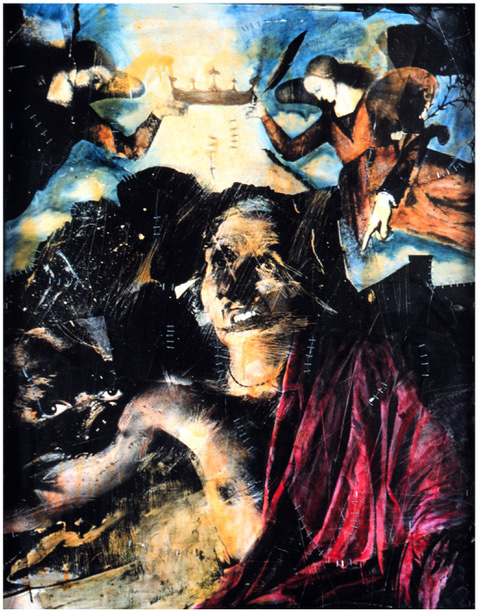
What resulted was a compelling signature style that to this day remains simultaneously whimsical and disciplined. Hochbaum’s early pieces from this era were collage-like paintings incorporating everything from acrylics to polaroids and carbon transfers, inspired by maritime lore, astrology, Marie Antoinette, and architecture. They often included black and white nudes juxtaposed with tall ships, sea monsters, floating ladders, and cityscapes. Many were adorned
with handmade frames constructed from found objects. “I was mixing it all together to create my own mythologies,” Hochbaum says.
His work has appeared in group and solo shows across the United States and Europe, including McCaig-Welles Gallery in Brooklyn and Strychnin Gallery in Berlin. Goldmine Shithouse disbanded after nearly a decade, and Hochbaum secured full-time representation with Strychnin. That gallery partnership ended after another 10 years, ushering in yet another transformation. “The big things that sent shockwaves through my practice were [that] I no longer had a gallery—I stopped working for a year—and then I moved [back to Boston],” Hochbaum says. “I no longer had my social network and support. And then a year later, my cat died.”
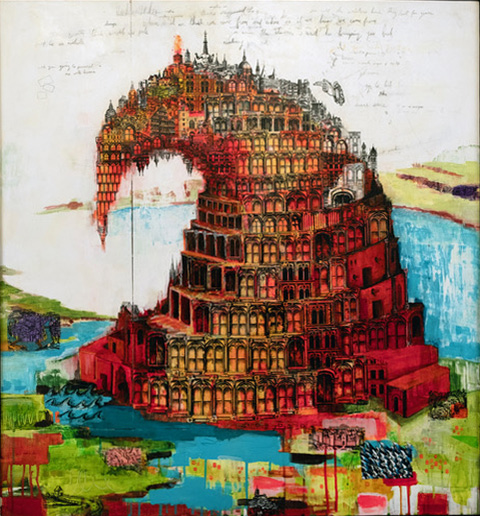
The tumult sent him into a depression, but Hochbaum fought back by deliberately injecting joy into his work. He focused on a brighter color palette and streamlined subjects. Boats and buildings harkened back to his time in New York and gave the work continuity, but collections like his Adrift series depicting empty rowboats on wood, paper, and canvas, and his stacked wood house sculptures, were minimalistic in comparison to ornate women and sea goddesses with shipwrecks in their hair. Even his sprawling paintings of towers, sprung from a lifelong fascination with the Tower of Babel, seemed spare in contrast. He recalls, “I kept what I liked and stopped doing what I no longer needed.”
Then came Covid. “The pandemic, I think, shook everybody up in a big way,” Hochbaum says. “It led me to question the validity of my work. The pointlessness of everything became very bright. I didn’t know how to paint again.” To cope, he reached back into childhood memories, mining inspiration from favorite television programs like The Joy of Painting. He launched a daily livestream, “Open to Suggestion,” where he showcased live art making, trivia, and giveaways. The interactive nature of that 22-episode endeavor reignited his passion for visual art. “It was a major transition that happened to work,” Hochbaum says.
Since that reemergence, he has remained productive, incorporating digital “Uncrowning,” 1994 photography and even a bit of peripheral AI into his paintings and sculptures, finding new approaches to cityscapes, but also delving into the abstract.
It’s still a challenge to stay successful when things, internal and external, are in constant flux. “I’m unpredictable,” Hochbaum says. “Even though you could line up my ’90s work with today’s work and still see that they’re related, a lot of people have trouble trying to sell an artist like me, because I am all over the map.” But the artist remains committed to authenticity and freedom. “I’m not going to ignore this natural evolution. I’m not going to jump on a bandwagon. I still react positively when people like the work, but I’m not chasing that. That’s not what’s going to determine, in my mind, what is a successful piece or not.” G&S


Leave a Comment