
As the United States celebrates its 250th anniversary, a familiar pageant is taking place: testimonials to our founding fathers and mothers, recollections of battles won and lost, and sweeping tributes to our arts and crafts, architecture, history, geography, and much more. Expect a sweeping celebration of the nation’s cultural inheritance. Yet beneath the commemoration lies a more provocative question—what exactly makes a work of art American?
The answer resists easy definition. If there is a unifying thread, it is not style or subject, but spirit—a restless drive to break accepted norms, challenge authority, and reimagine the possible. American art is rooted in place, yet is always pushing beyond it to new challenges.
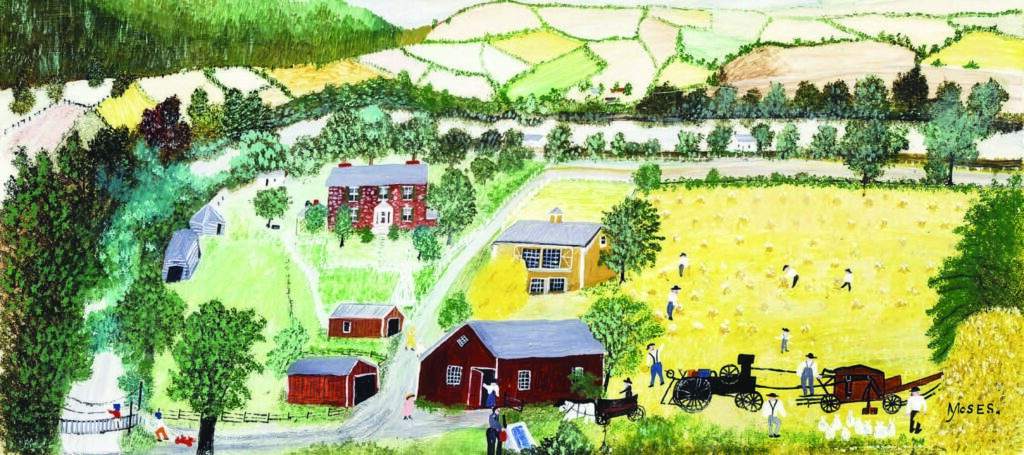
Consider the enduring pull of rural imagery. Grandma Moses transformed everyday farm life into scenes of nostalgic clarity, while Grant Wood’s American Gothic distilled the stoicism and fatalism of the heartland. Earlier still, Edward Hicks offered an idealized moral vision in the Peaceable Kingdom. These works do not merely depict America, but they construct a mythology about our past.
Set against this pastoral vision is the teeming energy of the city. Walt Whitman, self-appointed “poet of democracy” turned his gaze toward the working class, finding poetry in the rhythms of urban life. His voice helped define what would become known as the American Renaissance—a mid-19th century flowering of literature shaped by such luminaries as Ralph Waldo Emerson, Henry Thoreau, Herman Melville, among others. Their work grappled openly with identity and individualism. Mark Twain later extended that inquiry with his novels grounded in the textures and conflicts in American life.
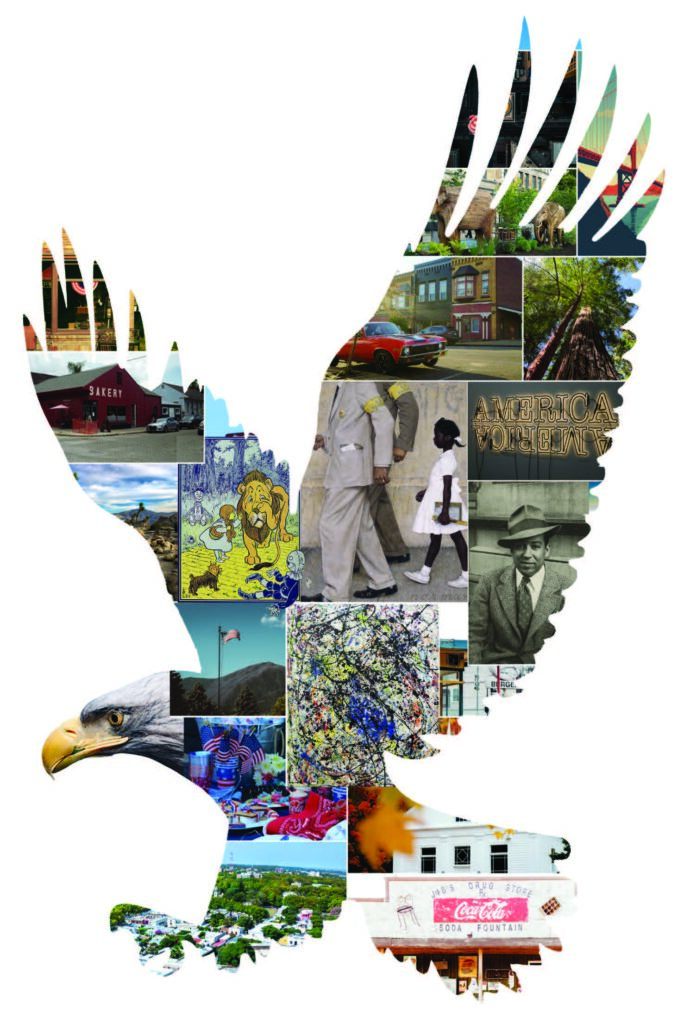
If the 19th century sought definition, the 20th often sought escape. In the shadow of the Great Depression and global wars, American culture produced works that balanced hardship with imagination—from The Wizard of Oz to Gone with the Wind.
At the same time, artists such as Billie Holiday and Duke Ellington gave voice to struggle and resilience, while John Steinbeck chronicled the human cost of economic collapse in The Grapes of Wrath.
Visual art, too, expanded the narrative. The realism of Winslow Homer and the cowboy myth-making of Frederic Remington captured a country in motion, while Ansel Adams’ stark images of Yosemite National Park helped elevate environmental consciousness.
By mid-century, American art no longer looked inward—it exploded outward, as New York replaced Paris as the center of arts innovation. The bold experiments of Jackson Pollock, Mark Rothko, and Lee Krasner redefined painting’s possibilities with new materials, techniques, and large scale canvases. Alexander Calder’s dynamic mobiles, Robert Rauschenberg’s hybrid works and Jasper Johns’ painterly depiction of the American flag represent a bridge between Abstract Expressionism and Pop Art.
Literature meanwhile continued its restless revolution. Writers such as James Baldwin, Toni Morrison, Norman Mailer, and Philip Roth interrogated politics, race memory, and identity with unflinching clarity while Harper Lee and J.D. Salinger captured the moral tensions beneath everyday life. In theater and music, Leonard Bernstein and Aaron Copland forged a distinctly American orchestration. The wildly popular play Hamilton, reframed the nation’s founding myths for a new generation.
Today, the tradition of reinvention continues in the global reach of American culture from Beyoncé to Taylor Swift—artists who blend personal narrative with mass appeal, shaping a continuously changing American vibe.
Any list is incomplete. American art has never been a closed canon nor is it easily defined. The arts, like American democracy itself, remain a work in progress: some speak to the past, others toward the future. G&S

Leave a Comment