

My cousin Stephen Robin has spent his life building fine furniture and kitchens, libraries and custom woodwork of all kinds. Today he works with a dedicated team that shares his passion for creating exceptional pieces. His workshop operates like a cooperative: team members collaborate with Stephen and with one another, each occasionally bringing in their own projects. “It’s about setting things up so people can work together, rather than in a traditional employer–employee relationship,” Stephen explains. “They can build their own businesses and develop their own clientele.” He’s been working this way since 1967.
Stephen began working with wood when he was 12 years old, growing up in Brooklyn. At around that time he built his first workbench in the family’s small apartment in Crown Heights. Years later his work was featured a mile away in the Brooklyn Museum of Art; in the deCordova Sculpture Park and Museum, the largest park of its kind in New England; in Esquire magazine and in the New York Times. A folk music aficionado as a teenager, Pete Seeger’s “If I Had a Hammer” could well have been his theme song. (Decades ago, Bob Dylan visited Stephen’s gallery; the two were friends for several years.) Now 87, Stephen is beginning to slow down, gradually passing more of the day-to-day work to his team.
“Years ago I visited furniture maker Wendell Castle, bought tools like his, and started creating,” he recalls. “I had showings at museums, taught at a couple of community colleges, and for about ten years focused on commissions—making furniture as art. That’s how I built my reputation.” Many clients come to Stephen with drawings of what they want. He transforms those ideas into functional works of art. That process shaped my own collaboration with him: I sketched a bedroom set inspired by furniture my wife and I had seen in a small hotel in the Pyrenees, and Stephen brought those sketches to life beautifully. My drawings and his craft also created most of the other furniture in our home. For several years Stephen was a representative of the American Craft Council for New York, where he met George Nakashima and Sam Maloof, two of the towering figures of American craft.
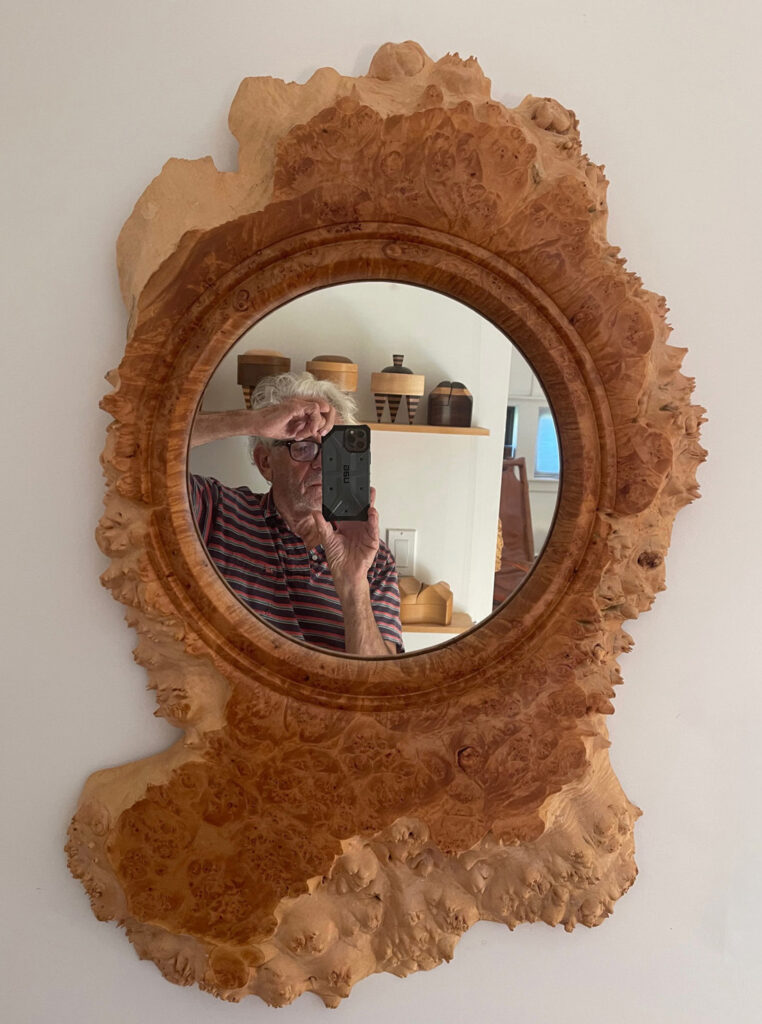
Stephen grew up in a family steeped in the arts, though he built his business out of practical necessity. His mother and her siblings, along with his sister Myra and his cousins, all played instruments—piano, violin, guitar. One aunt was a highly respected painter. A cousin, Fred Hand, became a renowned guitarist and performs in the Metropolitan Opera orchestra, albeit Mozart, Verdi and Puccini, et al, forgot to write guitar parts for most of their operas. Rossini’s The Barber of Seville is a rare exception. Stephen’s father ran a small business in the Chelsea area of Manhattan selling photo albums and photomounts to professional photographers, giving Stephen early exposure to visual composition and craft.
He trained as a draftsman and later as a teacher of industrial arts at SUNY Oswego. In many ways he has spent his life teaching—both in classrooms and in his workshop. “Passing on knowledge about wood, design and craftsmanship,” he says, “is just as important as producing fine furniture.” After several jobs, including teaching shop in high schools, he settled in Woodstock in 1965.
In 1983 Stephen and his wife Joan purchased four acres about a mile from the center of Woodstock—an artists’ community for more than a century and long associated with the historic 1969 music festival 60 miles away. There they designed and built their dream home, connected by a bridge to Stephen’s three-story workshop. The shop houses an extensive collection of hand tools, along with a large computer-driven CNC router from C.R. Onstud, acquired in 2007 with support from the U.S. Forest Service and the New York City Watershed Agricultural Council’s Forestry Program. The machine allows for precise, high-speed fabrication of intricate designs, complementing the traditional craftsmanship that defines Stephen’s work.

“When a client comes to us wanting, for instance, a custom dining table, the first question we ask isn’t about size or style–it’s about wood. Get it right, and you’ll have a table that becomes an heirloom. Get it wrong, and no amount of fine craftsmanship will save it. Black Walnut is the ‘Gold Standard.’ Its chocolate-brown color is warm and rich, its grain is straight and elegant. It has become almost synonymous with high-end furniture. American Cherry is the ‘Heirloom Wood.’ Fresh from the mill, cherry is a pale pinkish tan, pleasant enough, but not immediately striking. Give it a year in a sunny room, and it transforms. White Oak is the modern choice. No wood has risen faster in the last decade than white oak. Hard maple is the whitest of the common furniture woods. It’s extremely hard and durable, and it takes paint beautifully if you want a two-tone kitchen or a lacquered table.
“A word on exotic woods: We occasionally work with exotic species—bubinga, wenge, teak, zebrawood—for clients who want something truly unique. These woods can be spectacular, but they come with caveats: they’re often harder to source sustainably, they can be difficult to work, and they may not be available for future repairs or additions. We always have a conversation about sustainability and long-term practicality before committing to an exotic.”

Stephen’s creations include an Aron Kodesh (Holy Ark) that houses Torah scrolls in the Woodstock Synagogue and an extensive installation that includes enclosed bookcases, tables and chairs for a rare book collection in the Bard College Library. Myriad others can be found as well in homes throughout the eastern United States—including my own. He has galleries both in Woodstock, NY and on Cape Cod in Wellfleet, MA. G&S
furniture-as-art.com Photos by Stephen Robin



Leave a Comment