
“The newspaper is a greater treasure to the people
than uncounted millions of gold.”
Henry Ward Beecher
Newspapers have played dynamic roles in American history. In the colonial period, hey were passionate and persuasive voices for independence. In 1771, The Essex (MA) Gazette’s ominous warning about newly-arrived British soldiers noted that “the consequence of their coming here must be fatal.” A correspondent for the Virginia Gazette gave a stirring eyewitness account from Bunker Hill (1775), where “the fire from our lines… made …the enemy twice to give way.” They were usually one sheet, folded into four pages of about 10 x 15 inches, with small print, and circulated not far from their presses. Reporters’ distance and the laborious printing process made the news late, but avidly followed nonetheless.
In 1789, the Constitution’s First Amendment stated that “Congress shall make no law… abridging the freedom of the press…” By 1800, the US Postal Service (founded 1775), delivered newspapers far beyond their home cities. In small towns, they featured local news, opinions, and events. Most readers were home-delivery subscribers.
The invention of the telegraph in the 1830s and the steam-powered rotary press a decade later increased the numbers, size, timeliness, and reach of newspapers. Reduced postal rates and urban news kiosks won new readers’ loyalty. Streets rang with “newsboys” shouting headlines to draw passersby to their wares. Topics ranged from politics to science and industry to the arts. Editorials were often linked to political parties, which gave newspapers distinct identities.
In 1857, Harper’s Weekly was launched by New York City-based publishers Harper and Brothers. The masthead, drawn by Thomas Nast (best known for the political cartoons that unseated Boss Tweed) showed a hand, surrounded by symbols of the humanities and sciences, accepting a torch from the firmament. The image exemplified the paper’s subtitle: “A Journal of Civilization.”
The first issue asserted that “Neither labor nor expense will be spared to make it the best Family Newspaper in the World,” a nod to the Harpers’ Protestant moral values. During the Civil War, the paper advocated for abolition and rights for Black Americans and women. After the War, however, especially with the 1879 end of Reconstruction, the paper often presented prejudiced and stereotyped views of Blacks and other minority groups.
Harper’s Weekly won acclaim for its illustrations, first reproduced by wood-engraving and, in the 1880s, by the new half-tone photographic method, which allowed artists to use tonal media rather than line drawing.
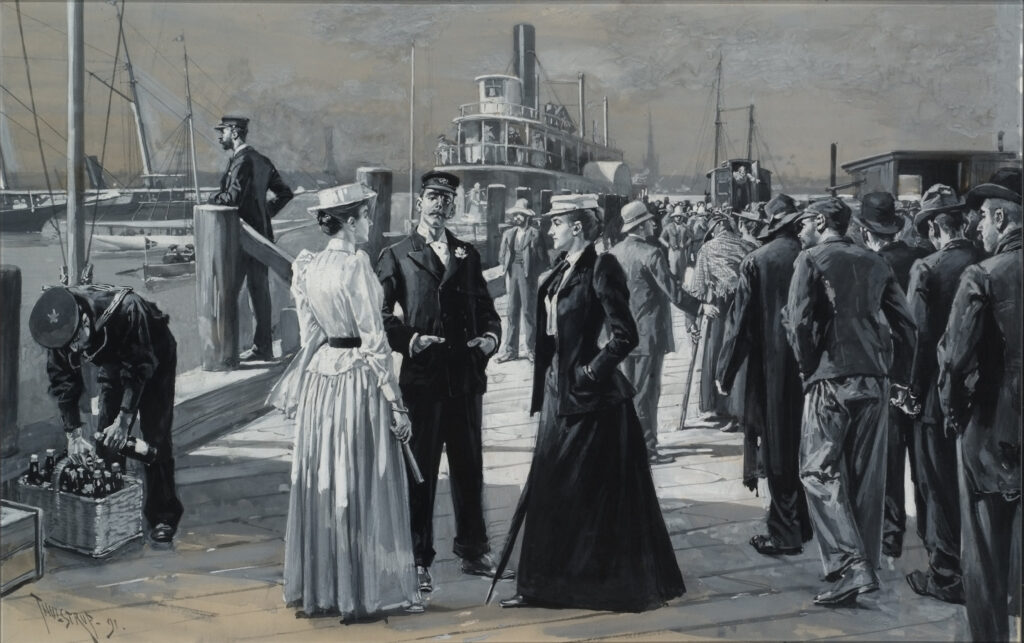
The August 15, 1891, issue, which cost 10 cents (about $3.50 today) or $4 with an annual subscription ($148), included journalist Edmund Collins’ article “Where Extremes Meet.” He describes Manhattan’s 26th Street pier, then located on the East River. The right side of the dock is reserved for the New York City Department of Public Charities and Correction, the agency responsible for the city’s destitute, sick, mentally ill, immigrants, and criminal convicts. The left side is allotted to the elite New York Yacht Club.
Every day, police herd men and women “like cattle” onto the pier. From there, they are transported to the four East River islands where the Department housed “the incarcerated… those unable to earn their bread… dull-eyed… with bruised faces…. the insane… some wild and vociferous… unkempt and unwashed… scores of sick babies (and) deserted children…the wicked and the wretched.”
Collins notes that they make “a rather sharp contrast with the smart yachtsmen and their wives and daughters” and a “trim and saucy” yacht with luxurious accommodations. He concludes philosophically that the scene highlights “the contrasts that exist in this great city and in all human nature…a miniature world of woe and happiness, and of the good and the bad.”
When readers turned the page, Thure de Thulstrup’s double-page illustration brought Collins’ words to life. We have just entered the pier, where we see the backs of handcuffed men and closely-guarded women shuffling toward a utilitarian boat. A bent-over woman in a shawl leans on a walking stick. In threadbare clothing, most look straight ahead but the two men nearest us look to the left. Their glances—reminders of their humanity in the faceless throng—fall on two stylish women with a yacht steward. Nearby another steward tends to the opulent yacht’s wine supply, and a third looks outward, perhaps assessing the weather for the excursion. Deck hands are at work in the background.
Both women sport the popular chignon hair style and up-to-the-minute international fashions. One wears the long jacket advertised in French magazines as le jaquette de yacht, a minimal bustle, and a yachting cap. Her companion models a veiled straw boater and a shirtwaist with slightly puffed sleeves. The first woman’s elegantly-furled umbrella is a dramatic contrast with the old, shawled woman’s rough walking stick.
These well-dressed ladies, among the most privileged of New York society, are unsmiling, and do not make eye contact or converse with anyone. Not even each other. They seem as impervious to pleasure their own wealth as they are unsympathetic to the impoverished. Their aloof disinterest crystallizes the stark gap—physical and emotional—between themselves and the city’s least privileged.
Illustrator Thure de Thulstrup (1848-1930) left his native Sweden after service in its military and later in the French Foreign Legion. While studying art in Paris, he mastered topographical drawing, which he practiced for a year in Canada. In 1874, at age 26, he began his career as an illustrator for major newspapers and magazines in New York City. By 1887 he had a contract to create at least one illustration every week for Harper’s Weekly.
Despite its comparatively moderate tone, journalist Edmund Collins’ article “Where Extremes Meet,” with its affecting illustration by de Thulstrup, signaled the beginning of the Progressive Era. By the mid-1890s, illustrated investigative journalism was a major force in the movement toward wide-ranging and overlapping demands for a more just and equitable America. Ida B. Wells, Jacob Riis, and Ida Tarbell would become household names, joined by so many others that an ambivalent President Theordore Roosevelt called them “muckrakers” when they frustrated him. But he also proclaimed that “there are… many and grave evils, and…urgent necessity for the sternest war upon them…I hail as a benefactor every writer (who)…in book, magazine, or newspaper, with merciless severity makes such attack, provided always that he in his turn remembers that the attack is of use only if it is absolutely truthful.” G&S
Delaware Art Museum
Delart.org
© Mary F. Holahan 2025




Leave a Comment