

In the mid-1950s Alfred Hitchcock did an interview with Vermont Life, in which he asked, “If one has to die, can you think of a more beautiful place to do so than in Vermont in autumn?” Hitchcock had just directed The Trouble with Harry on location in Vermont. The great filmmaker’s strength lay in his impassive, sphinx-like style of storytelling that could render the most grizly doings even more horrifying by treating them as ordinary. Harry’s trouble was that he was dead.
Not actually a regular reader of Vermont Life, I lifted the Hitchcock quote from a recent New Yorker article written by the ever eloquent Jill Lapore. The piece, about Bernie Sanders, is titled, “The Vermonter.” Much of it is dedicated to characterizing what we may think we know and what is more likely true about the Green Mountain State. The trouble with Vermont is that, briefly, things have changed. The red barns and covered bridges are still there but not so many dairy cows or wool-bearing sheep. Vermonters who, in days of yore, strove mightily in the making of milk and wool, now preside over a pastoral idyll…and think. Some, presumably, are still making maple syrup.
In Waiting for the End of the World, Vermont filmmaker Jeffrey Hoyt taps into the mindset of a populace in contemplative introspection, a world in which time, while not exactly ill spent, is being closely examined, particularly as regards its limits. A pall can be found to hang over paradise when one has leisure to seek it out, and the subject of death, not just its inevitability but the business of it, can crop up. Hoyt’s precise, measured and artful filmmaking in tandem with his apparent ease with people results in a series of tableaux, enacted and observed, that touch on life’s over-arching theme: the miracle ends. We cannot help but see ourselves in the way people face that dark certainty, be it hopefully or hopelessly, nobly or not at all. We are hapless fellow travelers sharing space on the same relentless, doom-bound conveyer belt. Occasionally, faced with the futility of it all, we just have to laugh.
Through his work, Hoyt takes his place in a category of artists — Hitchcock and Charles Adams, to name just two — who have leavened their work with gloom.
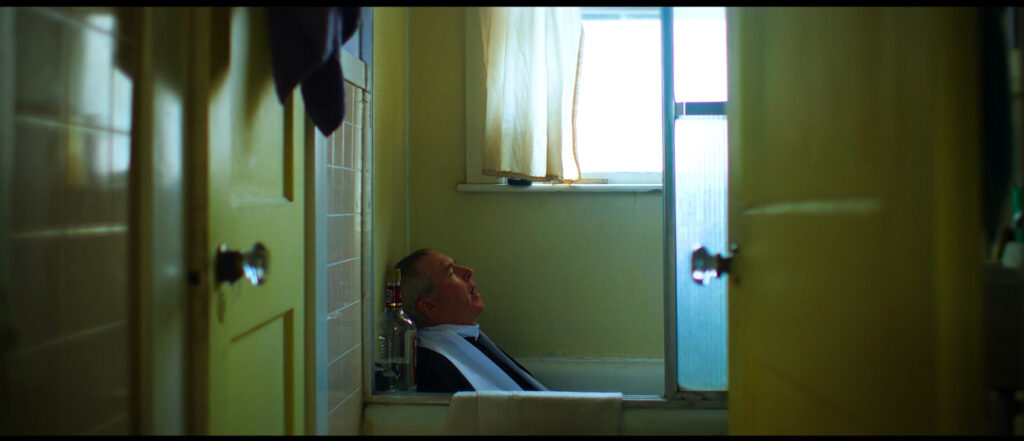
Waiting for the End of the World begins with shots of an ominously grey, cloudy sky. The viewer, compelled to gaze skyward, is forewarned by the sound of wind and distant thunder that gives way to the voice of a radio evangelist over images of people who are old—one very old—sitting quietly, eyes addressing something unseen. The evangelist is answering a listener’s query as to whether or not the devil rules over hell. As the radio voice concludes that it is God that has created hell and, having cast the devil into it, God alone rules over the lake of fire and the fates eternal of both the faithful and the faithless, we see a man of the cloth reclining in a dry bathtub wearing his clerical collar and stole. The man’s head is tilted back, his mouth agape. He lies in a state of profound repose. Next to him, on the edge of the tub, sits a half empty bottle of vodka.
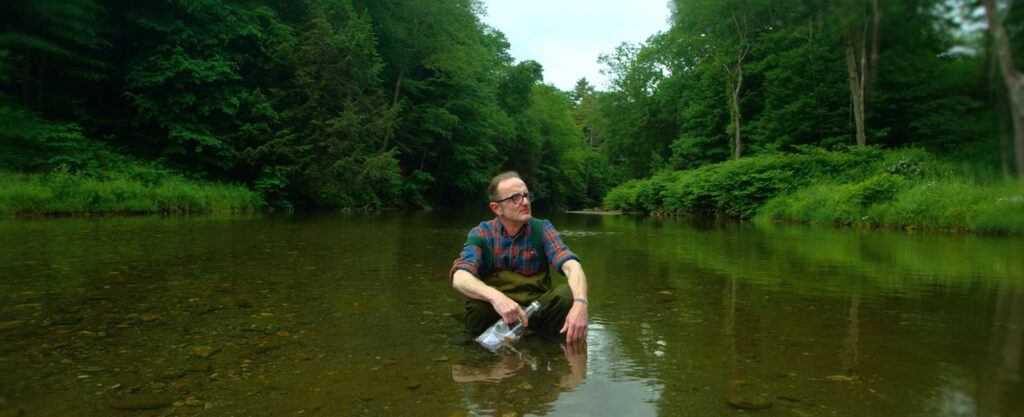
In Hoyt’s style of filmmaking, sound rivals image in the making of sharp modal turns so that the image of the fallen priest is jarring enough to surprise and amuse. This is not the last cut calibrated to evoke schadenfreude or self-derision. Following a lovely portrait of a young woman who has just been swimming, the image of a man on his haunches in hip waders, mid-stream, drinking an unthinkable amount of whiskey from a huge plastic bottle and then looking dazedly about in an aural atmosphere of buzzing mosquitos and police sirens is at once laughable and heartbreaking.
But next, a woman sits across a kitchen table from a man ravaged by age. Heard are police sirens, a far off train horn, a suite for violin. She smokes a cigarette and says:
D’you still love me? [He does not respond.] I know
you do. You always have.
[After a pause] And I love you. And I always will. [Another pause]
What a life! [The sound of distant thunder]
But it seems to be getting shorter.
CUT TO: the young woman, referenced above, doing the dead man’s float in a large above-ground pool. An expanse of lawn leads to a well-kept house in the background. Rain pours down. The sound of it fairly roars.
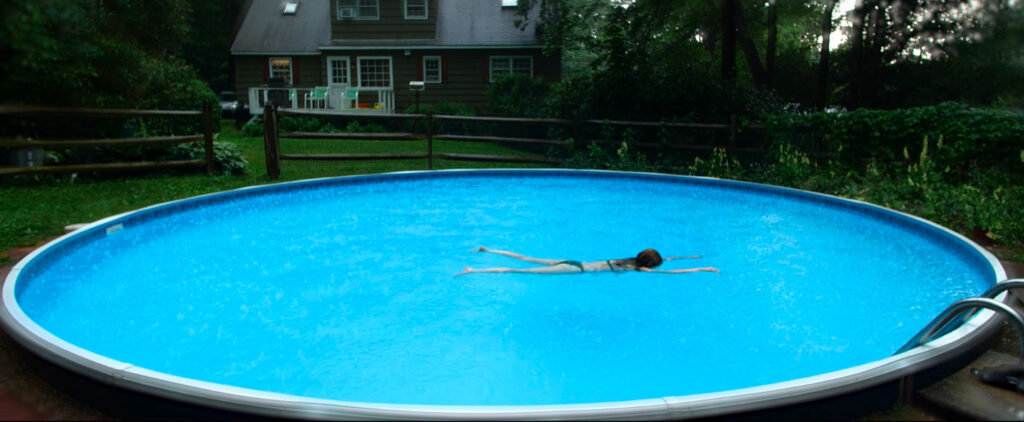
I choose this particular transition randomly to exemplify this filmmaker’s skill at interweaving image and sound so that, in juxtaposition, shots vary markedly but are intricately interlinked. Here the smokey claustrophobia of a woman, indoors, conducting a one-sided declaration of love with an unresponsive partner contrasts sharply with the body of a beautiful girl, alone and floating face down, outdoors in the rain. The sound of thunder in the previous shot relates to the sound of rain in the shot that follows; and, despite her extreme youth, isn’t the person in the pool doing a dead man’s float?
Waiting for the End of the World
Am I overthinking? I think not.
The mode of execution cited in the transition above is the norm in Hoyt’s work. His images are arresting and well-composed. His use of sound is subtle and masterly. Underlying these technical skills lurks an apparent social grace that empowers this artist to elicit refined, moving performances from people who may or may not have any prior experience or interest in acting. By shrewdly limiting what he requires of his actors and designing actions at once simple and powerful, Hoyt dignifies the efforts of the people through whom he communicates. A man stares into a fire while sliding a magazine into a pistol and racking the action. A priest lies unconscious in a bath tub. A girl swims in the rain. G&S
Waiting for the End of the World is one of several films by Jeffrey Hoyt. Other titles are:
I Was So Glad to Hear from You Read ’em and Weep
’Tis Nothing But Darkness Ruminations
Seek on Vimeo and ye shall find.

“Waiting for the End of the World” is currently being circulated to film festivals, but other films by Jeffrey Hoyt may be found on Vimeo.




Leave a Comment