
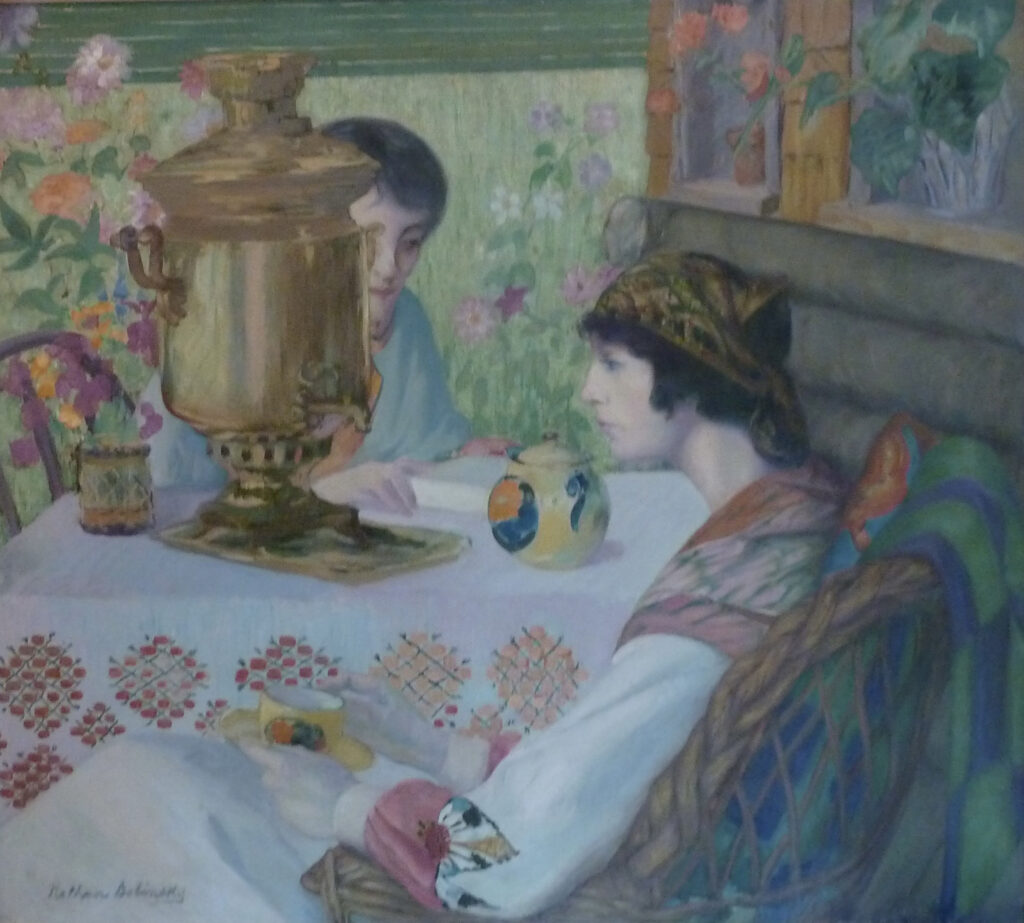
I knew Nathan Dolinsky when I was younger, but unfortunately, I had not yet come to know and appreciate his art works and style. Except for my years living away, while at high school, college and through some postgraduate studies, I have lived my life in Hunter, New York, not far from Dolinsky’s home and studio. Dolinsky and his beautiful wife Blossom traveled in the U.S. and Europe, but more and more lived in Hunter. They founded Camp Schoharie in the 1920s, which was on the property adjoining the homes of their extended families. When I and other family members attended the camp, Dolinsky had already sold it, but his model for a camp based on Fine Arts, as opposed to competitive sports, still held true. At least four members of my own family pursued the arts, which I’d like to think can be credited to the camp. I regret that I didn’t appreciate his works when I was younger and fresh out of art school. Now that I have come to know and love his great body of fine work, I also wish I could have studied with him.
Dolinsky created a series of 13 large allegorical paintings, collectively known as “The Panels,” that served as theatrical elements for the Dream Garden Conservatory. Two of the four panels, The Quarry Worker, aka Work, and Three Women and Two Children, aka Play, later graced the walls in The Restaurant at Hunter Mountain Ski Bowl when my family owned it. When not in use as a concert venue, The Conservatory consisted of three descending sections, divided by glass walls and French doors. For everyday use the rooms were the Dining Room, the Game Room and the Music Room. Dolinsky’s youngest sister and frequent model, Aida, was a concert pianist. When concerts were performed, the glass doors between all sections would be opened to create one long concert hall, or music conservatory. All of the exterior areas were lavish gardens, peppered throughout with large pillars, carved plaques, fountains, pedestal urns for seating, and a large, covered, semi-circular stone structure, which I assume was a stage area for musical performances.
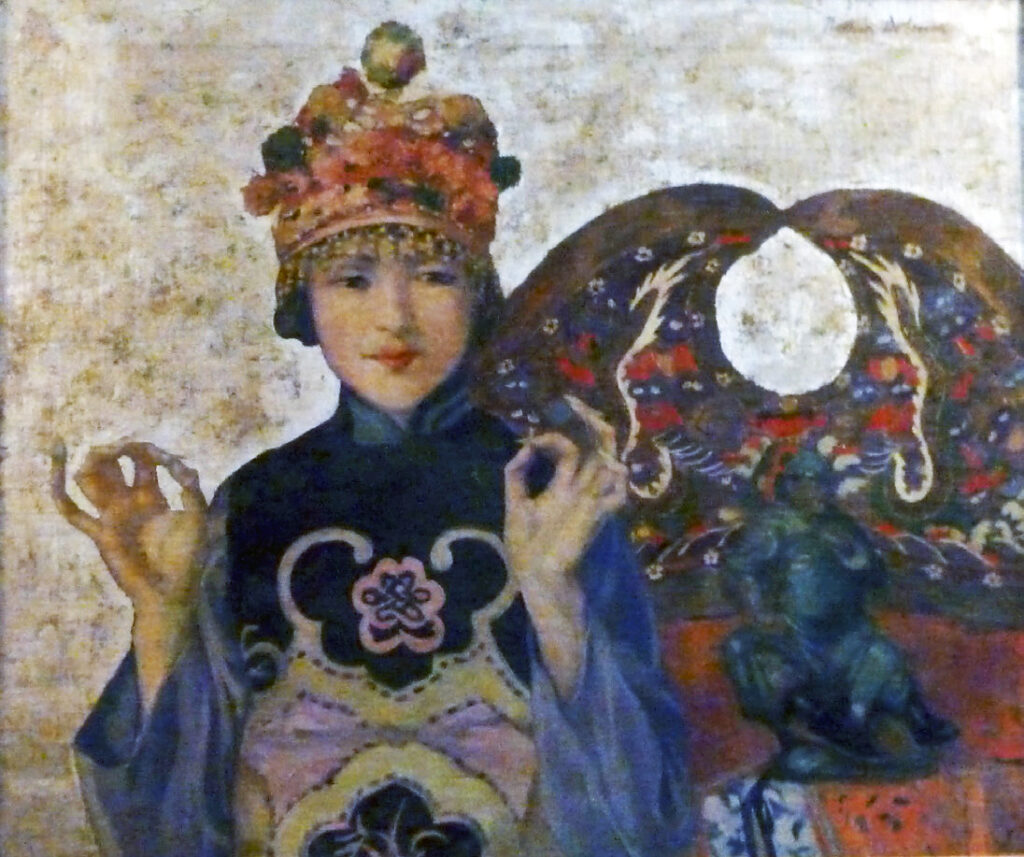
Dolinsky, one of seven children, was born in Russia in 1889. His family lived in Moscow and Kiev. When he was three years old, they emigrated to the United States and settled in New York City, as had prior generations in my own family. By the age of ten, his talent as an artist had been recognized and encouraged. He studied with Henry McBride at the Educational Alliance, a nonprofit community center established in the Lower East Side by an earlier generation of German-Jewish émigrés to help the mostly poorer Russian-born immigrants. He later studied with Jerome Myers at the Art Students League and with Sigmund Ivanowski.
The Ashcan School and Jerome Myers, who helped organize the famous 1913 Armory Show, invited Dolinsky to participate, and two of his paintings, Sightless and The Barker, were exhibited. He had been exhibiting since he was 16, and at 23 he was the youngest artist in the show. The Armory Show had what is still considered the greatest influence on American art of any such independent show ever because it displayed a great number of modern European works that influenced many American artists. The Armory Show is referenced frequently in museum shows of the artists represented and in publications about them.
The Ashcan School, influenced both by Impressionists and 20th-century social realists, was centered in New York City and played a significant role in shaping American art. In 1913, after his participation in the Armory Show, Dolinsky was invited to teach at Cooper Union in New York City. He stayed for six years. “This is my life,” he said. “I was one of the youngest instructors to teach at Cooper Union.” He also became a member of the Salmagundi Club, one of the the oldest artists’ associations in the U.S.
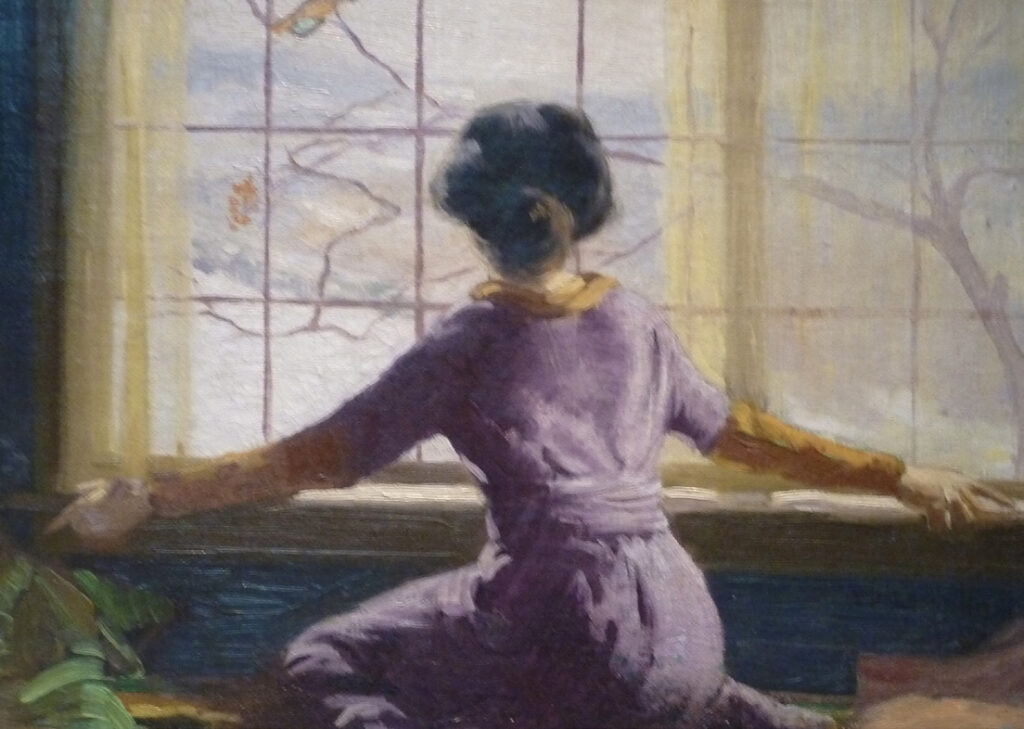
The family began spending vacations in Hunter in 1904 when his father purchased a 3,000-acre farm, much of which he bought from my grandfather. Dividing his time between NYC and Hunter, he was primarily known as a portraitist, but he also painted many landscapes. His passion for painting continued for almost 80 years. He had various studios in NYC and Hunter where he worked in oils, charcoals, and printmaking. Most of his models were family, friends and employees, including his wife Blossom and his sister Aida. He often posed them in costumes and elaborate settings, like many great artists who had preceded him, In his later years, he painted in his Hunter studio virtually every day.
In addition, Dolinsky and Blossom spent their winters in California, where he also painted regularly. While he never achieved great fame, he was a listed and noted artist. His works have been exhibited at the National Academy of Design, the Corcoran Gallery of Art, the Pennsylvania Academy of Fine Art and the Brooklyn Museum of Art. Some of his works are in the permanent collections of the Smithsonian Museum and the Munson Museum in Utica, New York. Most of his works are in private collections, but some are available online.
In August 2025, I curated the “Nathan Dolinsky Retrospective” for the Mountain Top Historical Society in Haines Falls, near Hunter. Several of his works were on display, along with two of my own paintings inspired by Dolinsky. In addition, the show included a finely detailed 1:12 model of the Conservatory, built by my husband, Peter Tenerowicz, and decorated by me. Known as “The Dream Garden,” the house was designed by Dolinsky together with Stanley Walker Hooper as a wedding gift for Aida. Hooper was rather distraught when he learned Aida had married someone else. When he asked why, she told him, “Well, my dear, you never asked me.” G&S
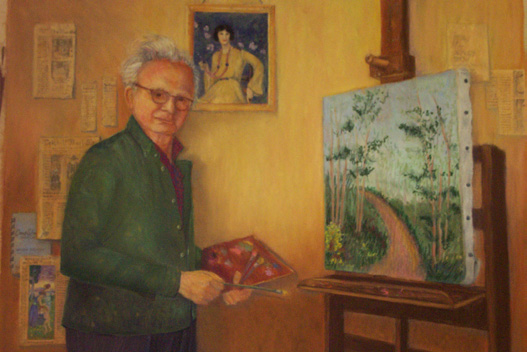
“Nathan in His Studio,” pastel, c. 2002. By Carol Slutzky-Tenerowicz
Special thanks to Kirby Kooluris, Nathan Dolinsky’s great nephew. Norman A. Ross contributed to this article.

Leave a Comment