
A film by Thales Banzai
Like anyone who isn’t Brazilian but who loves Brazilian music, I wish I could speak Portuguese. From the far away north, Brazil can seem a vast, lush, fragrant land nourished by a giant reptile of a river pulsating to the beat of a low-pitched drum. Via the suave harmonic dissonance of the chords on João Gilberto’s guitar, the only Bahia I may ever know is a sunny place smelling of skin lotion, lust, and melting sugar. Consider the sweet warmth of Villa-Lobos’ Prelude N. 2 in E major emanating like hibiscus blooming through ice from an FM radio in a Detroit winter. Outside: grey is the sky, white the snow and white the haze of road salt everywhere.
In the opening sequence of Tony Odyssey [Antônio Odissea]—a feature length film almost entirely in black and white by Brazilian director, Thales Banzai—a two-wheeled cart drawn by a small horse wends its way on the curving, cliff-hugging roads of a gargantuan strip mine. To one side of the little cart is a solid vertical wall of blasted rock, on the other side a steep escarpment ominously suggesting death by flying downward, down into the great maw. Gusts of wind, blow sheets of dust across the black and white expanse, and…Toto, this may be Brazil, but I don’t think we’re in Bahia anymore.
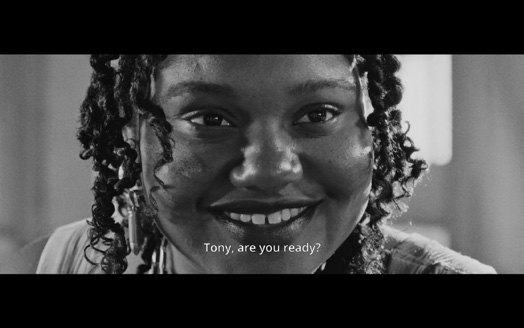
The cart carries two people: a driver, slight and frail, who will remain wordless, wearing what appears to be a satin hijab that covers all but the eyes; and the passenger, a powerful, sensuously zaftig woman whom we will come to know as Ivy, played mesmerically by the eye-enslaving, Iraci Estrela. Ivy is on a mission. She carries with her a message of strength, of change, of liberation and in her bag a large-caliber automatic side arm.
Cut to: Tony, played by Kelson Succi, cleaning a filthy toilet while trying not to vomit, and you have the set-up for, “Chapter 1: I Hate Reality.” Tony—thin, slight and a sensitive fellow, judging from his ordeal in the W.C.—is living a reality that could do with some hating: low man on the totem pole at a desolately remote drug transfer depot that masquerades as a restaurant or, as Tony describes it to Ivy, “…a bakery that never sold bread.”
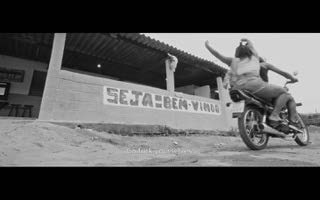
All this is made clear via a brilliant sequence of cinematic exposition. After the first glimpse of Tony, we see the proprietor, Tony’s boss, cutting and skewering pieces of meat. A young man at a table puts a chunk of beef in his mouth and raises a small glass of something clear—cachaça?—to wash it down. The proprietor throws a huge slab of meat on a grill. No bean sprouts, tofu or baby spinach is in evidence. A wide shot shows the covered, open-air dining area. Three armed men in identical body armor lean on a low exterior wall. Back in a cooking area, the proprietor crosses from the grill to a large cooler that is not a cooler, inside which are his cigarettes and a collection of unrefrigerated firearms. He adjusts the volume on a portable radio, sits on a stool, lights his cigarette and stares off into an oblivion that is all his own. An exterior shot of the “bakery” shows a courier arriving on a small motor bike. He dismounts and carries a satchel around the side of the building. Ivy arrives, surveys the scene, approaches the motor bike and uses its rearview mirror to put on lipstick before furtively appropriating the bike’s keys.
From how far away has Ivy come? What exactly is the Tony/Ivy relationship? The film’s title foretells an odyssey involving Tony, but, at its outset, Tony seems to be vying, albeit hopelessly, for Employee of the Year. Ivy has different plans for Tony, whose servitude binds him to a sad but ordered solar system of measured regular movements, in relation to which Ivy is a comet streaking in from deep space with news of disruption and a world elsewhere. The two ride away from the “bakery that never sold bread” on the courier’s motor bike with a bag full of drugs and money. Tony’s odyssey, the reality part, begins.



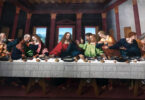
The word, odyssey, suggests a journey, but no ordinary one. The fantastical is hinted at. Odyssey-level storytelling is often founded in something extra-normal. Opera, a kindred medium, thrives on powerful potions, mystical spells and objects of supernatural potency. The sturm und drang (storm and stress) of Wagner’s Ring Cycle hinges on the world-ruling power of a ring, coveted by the great god, Wotan, sought by his son, Siegfried, and forged from stolen gold by a Nibelung dwarf. Tamino and Papageno set out on their daunting errand equipped by their employer and malefactor, the Queen of Darkness, with a magic flute and magic bells.
Odysseus, the odyssean prototype, has to navigate between Scylla and Charybdis, resist the wail of the Sirens, escape the lair of a man-eating Cyclops on his way back to Ithaca, his kingdom and his faithful queen. But, for our purposes, the most telling of Odysseus’ difficulties occurs when members of his crew eat the root of the lotus and lose all interest in rowing their king’s boat or ever seeing Ithaca again. It’s not really their kingdom after all, and we can assume that, for the many months and years since they all left Troy, Odysseus has not been doing much of the rowing.
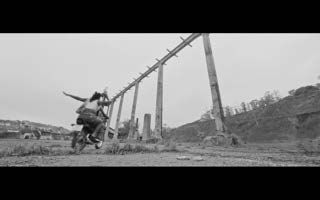
Like those disaffected oarsmen, Tony and Ivy do not descend from gods nor do they have royal pals. As they ride off on a stolen bike into a post-industrial wasteland, their lotus root is what’s in Ivy’s bag. If they were even bourgeois, they might have planned to use the money to hide themselves away and then, with an eye to a more comfortable future, sell the drugs to fatten their newly-acquired nest egg. But Tony and Ivy are not bourgeois, not even close. Their objective is not to make things a little better but to obliviate (a Harry Potter term) reality.
Ivy guides them to an empty warehouse. Leaving the bike outside, like a breadcrumb, they make their way to a bare concrete space where Ivy, by a curious alchemical process, converts some of their booty into eyedrops. Then, assuring him that she’ll be right behind, she applies the drops to Tony’s eyes, and Tony’s odyssey, the unreality part, begins.
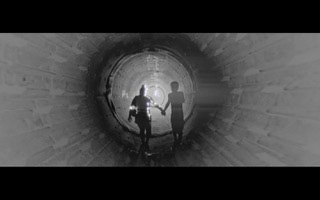
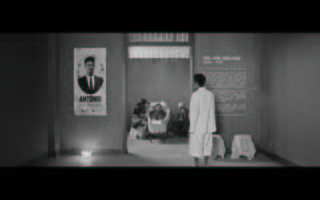
Up until this point, Tony Odyssey is pretty much straight exposition artfully rendered; but, from here on, this director shows what he can do in terms of invention, creating a series of dreamlike spaces populated by rare creatures both wonderful and grotesque. Banzai’s cinematic syntax is impeccable, but his skillfully hidden genius is to make very much out of very little. Lighting, strategic as opposed to lush set design and a meticulously selected cast of truly striking humans make this film a visual confection with tips of the hat along the way to Lang, Fellini, Sorrentino and probably many more that I’ve missed.
Tony’s journey, being hallucinatory, is perforce an internal one involving big topics like childhood, death, one’s mother, identity, sexuality, art—the kinds of things that tend to crop up when one tinkers with the brain’s motherboard. Looming over all of these weighty considerations is the concept of reality, which Banzai allows to drift in and out of conversation between the main characters, with the various phantasms met along the way and sometimes, breaking the fourth wall, with the viewer. “Look at them,” says Ivy, gazing into the lens,“They are so mediocre.”
I usually write for this publication about art/film, which more often than not means work that expresses itself in image and sound for however much or little time is required and without necessarily telling a story. Tony Odyssey is a standard length, narrative film that straddles the line between story-centered and image-centered filmmaking. Without subtitles or without knowing a word of Portuguese you could watch this movie, and your time would be well spent. Ironically, those same strengths could hinder Tony Odyssey’s finding purchase on American screens. But this director is not standing still. He knows where California is. If anything is ever right with this world, we, deserving or not, can expect more films from Thales Banzai. G&S
Tony Odyssey is currently being campaigned at film festivals and unavailable for online viewing. A trailer and additional information can be found at: tonyodyssey.com
Banzai can be contacted at: thales@5by2.art or IG: thalesbanzai and tony.odyssey



Leave a Comment