
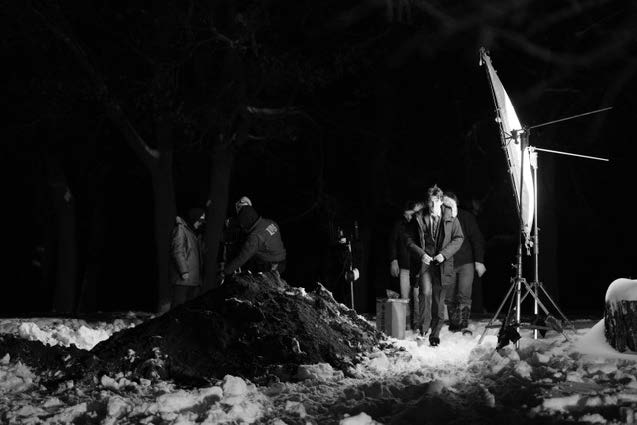
There’s a snowstorm in Little Falls, Minnesota. As a rule of thumb, I keep to myself. I cup my fingers, blowing air into them as I look out at the ten crew members standing in the dimly lit graveyard. Their faces shift with the sounds of 3000-watt generators on pickup trucks in the distance. The cables connecting the flickering lights are perched on apple boxes two hundred feet away and poorly tied with electrical tape. I should know they’re poorly tied, I tied them.
An excavator unearths a six-foot plot where the director and his actors huddle together. It is one in the morning, and the director’s brothers are behind the wheels of every truck in the area, drinking to stay warm. Our unpaid crew looks forward to joining them later tonight. Should any part of this fail – should any of our methods for departure fail – someone is sure to die. The nearest ounce of humanity beyond our diesel-fueled fever dream is ten miles south in the dark of winter. Every part of this, from the fourteen-degree frostbitten air to our heavily intoxicated team, is an affront to the safety standards set in stone by our university.
In the span of a year, my work takes me around the Northeastern United States on collegiate films whose budgets at their best allow for fifty-person unpaid crews with meals and transportation, and at their worst allow for ten-person unpaid crews and donated meals from mom and pop restaurants. These meals vary in quality. Some days lunch is on time; others, an hour late. We are ultimately, often to the chagrin of my directors, at the mercy of strangers. I reflect on this generosity as I pull on the starter cables to our generators in the snow.
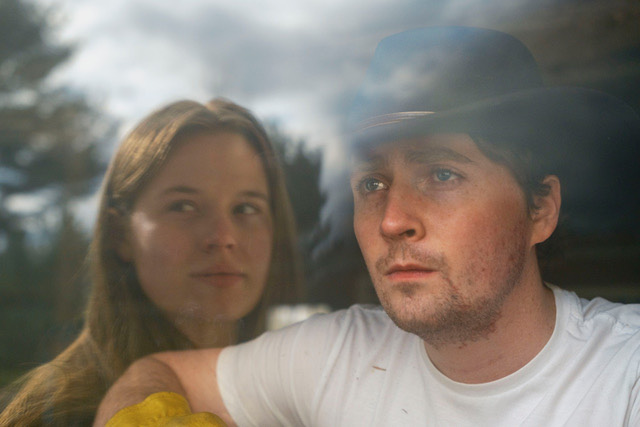
I decide to take a break from film for a while after Minnesota. I’m offered an opportunity to work with some of my favorite bands at a venue in the mountains of Idaho. It’s an enticing offer. But after a summer of labor with artists like Yo Yo Ma, Mt. Joy, Lake Street Dive and writers conferences for authors such as Judy Blume and Margaret Atwood, I’m keen to be in film again. I’d seen enough of the western frontier. The yelling, fistfights, and near-arrests of coworkers turned me away from live entertainment. After a Fall of wedding and concert photography in Vermont and New York, I get my chance.
One of my past projects necessitated the inception of a production company, Diner Films. It was a pilot starring David Iacono of The Summer I Turned Pretty
and, most recently, Jurassic World: Rebirth. The Chlorine Bible boasted a raucous friends and family screening at Cinema Village. It was subsequently followed by a lackluster performance at film festivals. We applied to nineteen festivals and got into none. It was a forty-five minute proof of concept covering a musician after his bandmate dies, and the misadventures he gets into while finishing his band’s final album.
It was too dark, dramatic, and subversive for sponsor-friendly festivals trying to attract an audience. These were tough, but fair, lessons that I needed to absorb.
In January 2025, my days working with unpaid college crews are over; there are only so many times someone can work for free. Under the umbrella of Diner Films, I’m approached by an old sound mixer friend I’d worked with on the shoot in Minnesota. He comes bearing another pilot in mind, this time about a cowboy bounty hunter in New York. It’s loud. It’s subversive. But it is a half-hour pilot with comedy and ample opportunity for sponsors.
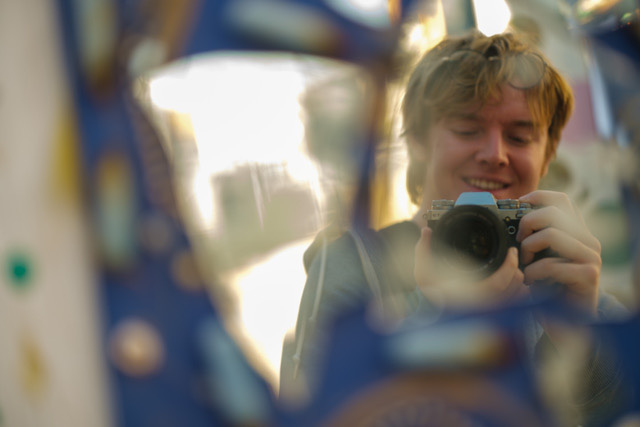
Within a month, Bowery Hunter becomes Diner Film’s largest production. My initial estimates for the project eclipse $100,000. As Diner’s Chief Financial Officer, it becomes my responsibility to find the capital to start up pre-production. Within two months, our primary producing team is assembled—Alec Inagamov, the show’s creator, Tessa Norfleet, the show’s art director, Nathaniel Danziger, the show’s head of brands, and myself, as its lead producer. With the team assembled, it is just a matter of obtaining liquidity.
We find our first break in a middle school gymnasium. Every year the Tri-State Railroad Historical Society hosts its annual train expo in Morristown, NJ. I discover it while searching for a train depot location during the shootout climax of the pilot. On the train to Morristown, we anticipate seeing a couple hundred people at the various booths laid out across two basketball courts. When we arrive, however, we’re met with over two thousand people in lines. In this sea of heads, our salvation is found in a gentleman named Al. Al had provided the subway cars for Francis Ford Coppola’s Megalopolis and graciously gives us his card for the Shore Line Trolley Museum. They become our first secured location.
Over the following months the rest of our locations lock in. We secure the support of other companies and nonprofits. We partner with Pabst Blue Ribbon and Other World Computing, offering spec ads and collaborations with social media marketing. We attend the BILD Expo at the Javits Center, and connect with marketing reps from Nanlite, Atlas Lens Co, DJI, Adobe, Fujifilm, Laowa, anyone that will listen. We speak in person with the New Jersey Film Commission to test our feasibility as a production to be granted their tax credits. If we succeed, we would be the smallest production in New Jersey state history to be granted their logo.
While doing outreach, we work with our marketing director, Madison Wine, and our graphic designer, Alina Apostolache, on marketing materials for a grassroots campaign on Instagram, YouTube, and TikTok. With the help of our friends from college and their equipment rental company, Trustfall Studios, we are able to shoot low-cost but high quality bumpers to put onto these platforms. In the summer, we do photoshoots where we work with actors in corsets and stockings in barns easily one hundred degrees Fahrenheit which we convert into stages. Amazingly, despite the low pay and tumultuous working conditions, everyone leaves excited to see the footage.
Often filmmakers are asked to justify their raison d’eˆtre. We scribble notes in movie theaters subscribed to the belief we may one day offer something of value to our silver screen meccas. The truth is, unless one is born into the favorable end of our two-tiered industry, this justification becomes exceedingly difficult to provide not just to ourselves, but our loved ones. It is solely the graciousness of filmmakers’ communities that allow them to exist. Everyone involved, from the small businesses to the filmmaker’s families, gives indie filmmaking its meaning. It is the collection of hope to make the world a little bit brighter that finds itself projected years down the line. G&S



Leave a Comment