
The ability to create and express oneself through art is a language that often supersedes verbal communication. This is true for everyone, but it can be particularly helpful for those who struggle to communicate verbally, or with societally typical mannerisms and expressions, or in any physical way. Art created by people who use it to tell us what they can’t say in any other way is a powerful window to understanding.
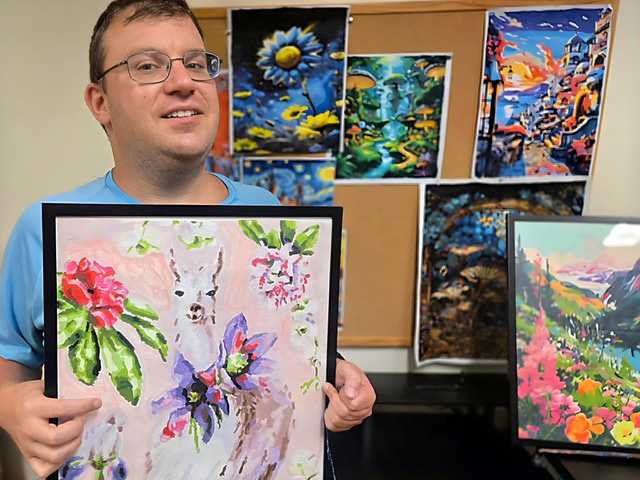
I’ve worked for 24 years at Independent Group Home Living (IGHL). It’s an organization on Long Island that provides opportunities, increases independence, and cares for people who have Developmental Disabilities. Folks I work with have a variety of diagnoses: Cerebral Palsy, Down’s Syndrome, Autism, Anxiety, Fragile X and myriad others. In my years, I’ve noticed that in relation to this field, there are two kinds of people – people who know a whole lot about it, and people who know almost nothing at all. It’s still a bit of a hidden field and misconceptions abound. The simple fact is that people with the aforementioned labels are much more similar to people without them than they are different. The same fundamental things are true, just the means to express them may be limited or take more time to develop.
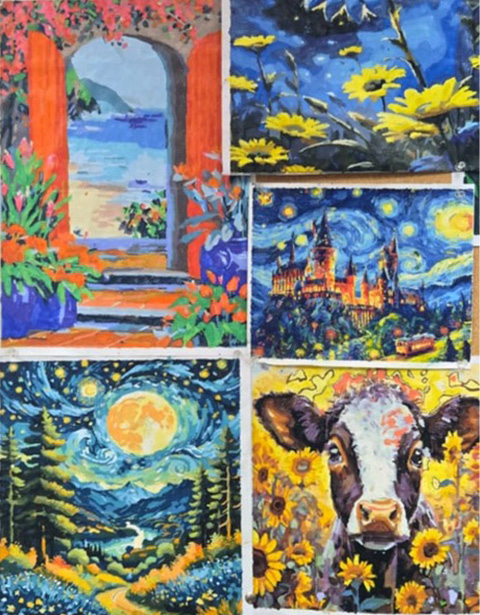
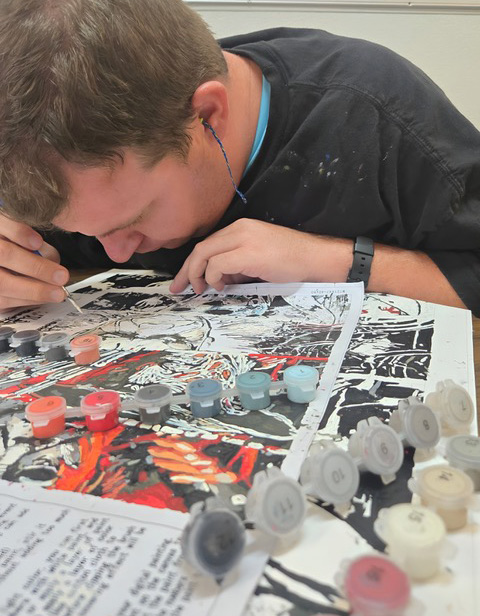
John Russell is a 33-year-old man with a lot of interests and hobbies who only recently discovered that he is a painter. He attends an IGHL Day Program and his classroom staff provided him a paint-by-number kit this past year without much expectation. He shocked everyone by absolutely zoning in on it. He was hooked from that first painting and has been absolutely churning them out ever since. John prefers paint by number or to copy images provided to him. He carefully applies the paint, blending and adding the texture that feels right to him and making the work his own. He works in a hunched, hyper-focused posture and has completed dozens of complex, large pictures. In stark contrast to the intensity he exhibits while painting, John is quick and happy to hand them off when done. It seems that the importance of painting, to him, is in the doing and not the having.
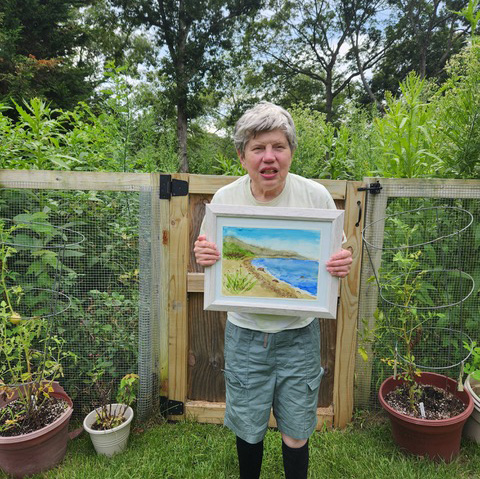
Mary Pat Callahan, on the other hand, has been an artist “oh…about as long as [she] can remember, probably.” She has a limited number of her own paintings at her IGHL group home. One on her bedroom wall, one over the fireplace in the dining room and a few others stacked in her closet. She doesn’t paint as much as she used to and some physical challenges with her hands have changed her abilities and therefore, the art she is choosing to do. When asked about why she paints, what she enjoys about it, what her favorites are, she hesitated and got a bit overwhelmed by the question, but eventually said “I always liked my classes and trying different kinds of art. I used to do what the class assignments were and that was good. Now I paint whatever I like and that’s also good.” I asked her what it felt like to paint and what inspired her and she stuttered a bit and shrugged, walking away. When she came back she was holding 4 paintings. She explained that they are the ones she is most proud of: a self portrait from “who knows how long ago,” a still life of daisies in a pitcher, a beach scene, and a recent picture that she says is of her vegetable garden out back. Sometimes Mary Pat has a hard time getting the words she wants to say out. She’s humble and tends to brush off compliments but she smiled when showing it to me and said she was proud of it and of her plants. She requested to be photographed in front of her garden.
Over the years, Mary Pat Callahan has left me gifts of sketches and watercolors—messages of friendship, things she wants to do, memories that she’s remembering. I’ll go to my work mailbox or office and find a small watercolor of rainbows, a sketch of a church and cemetery, a snowy scene with “love, Mary Pat” scrawled across the bottom. Once a black cat, signed “Mary Cat.” When she sees me next, she will smile and say “Hello, my friend! Did you see what I left you? That was what I wanted to tell you.”
While it’s never a great idea to make broad generalizations, it feels fairly safe to assert that all art is a form of communication. It shows the love, memories, longings, frustrations, rages and everything else that there will never be enough words to describe. People with developmental disabilities have just as much to say as anyone else. They have huge feelings, disappointments, hopes, goals, senses of self, and regrets. Most people reading this will say “well, of course, yes, yes…” but do people really understand that? We all make assumptions, have implicit biases, misconceptions, blind spots in our understanding and purview.
When meeting a person with visible disabilities, many (well-meaning) people will infantilize them, talk to them like babies. When an artist is tagged with a label of “developmental disability/autism/cp/anxiety/what have you” most people will admit that their expectations are fairly low, and yet in many cases, this could not be further from the truth.
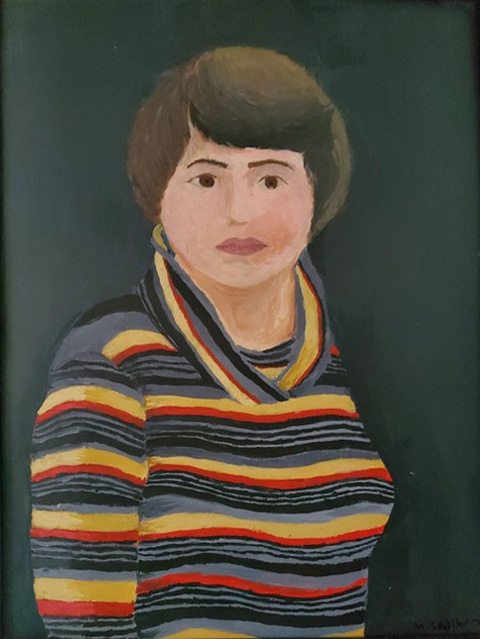
Mary Pat Callahan and John Russell, along with so many others, are good artists. Not “good for a disabled person” or any other trivializing and offensive dismissals, but genuinely and objectively good. They have the techniques, the focus, the tools, the supplies, but most importantly—they have something to say. Just like anyone else, it’s a communication—a release—a source of pride—and a glimpse within. Their work is their own, but many around them benefit from it. It is enjoyed by others and a source of pride to those that know them.
Opportunities, encouragement, and accommodations allow artists with disabilities to show everyone what they can do, what they may struggle to say or understand or what they have inside that we could never have guessed. Here’s to the people who encourage, who enable, and who have high expectations. To the artists themselves —the ones who are creating now and the ones who will discover a voice in photos, paintings, sketches, sculpture, or any other medium. Cheers to the freedom of expression that they will find, the gifts they may discover they have, and the minds they will absolutely blow with their genius. G&S
Photos by Sarah Malia ighl.org
Leave a Comment