
Joan Jacobson Elkin’s art creates intimacy in special ways. Her art story is connected to her life, which began in Chicago. She met Stanley Elkin at the University of Illinois at Champaign-Urbana as they were earning their degrees, and they married in 1953. Joan taught fifth grade as Stanley earned his doctorate writing about Faulkner. The two moved to Fort Lee, Virginia where Stanley did a stint in the army. By the 1960s, with Ph.D. in hand, Stanley began teaching at Washington University. Joan, as a faculty wife, did everything else; she was Lucy to his Desi, Gracie Allen to his George Burns—and the one designated to take out the garbage, cook, clean the house and pool, and raise three children.
Early on, Joan jogged, did handstands against the house, and carved out her identity as an artist creating her own body of work. Her original subjects, processes, materials, and influences also had art historical antecedents. And guess what? Stanley was her favorite subject.
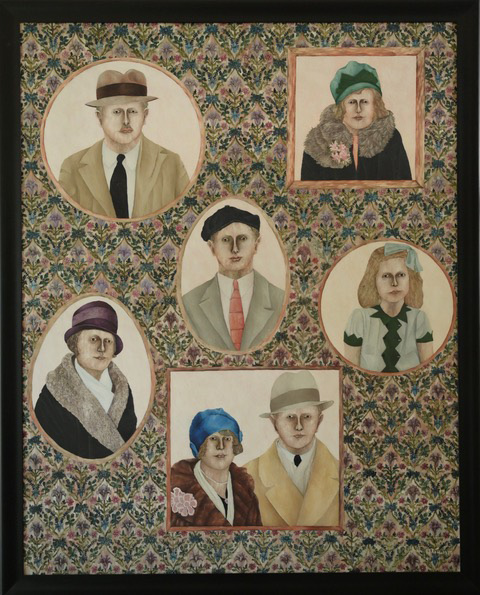
Joan Elkin’s family: Ted and Dorothy, an aunt, Bernie and Joan from the 1970s introduces us to Joan’s family. Joan’s parents, Dorothy and Ted are at the top and the bottom with Joan’s brother Bernie, who died at age 35, in the center between a favorite relative, and Joan as a child. Ted, a butcher and grocery store owner, looks a bit like a gangster, and Dorothy, with her turquoise cloche and fur collar with flowers, seems dressed for success.
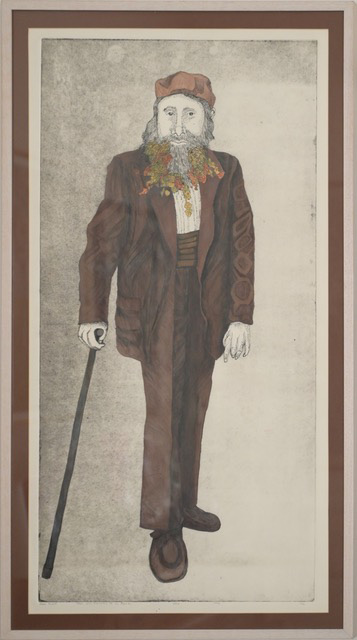
The lower portrait shows Ted and Dorothy as a smartly dressed couple. The elaborate overall wallpaper background and square and oval frames memorialize Joan’s family, especially her brother Bernie.
Joan Elkin’s art found its way into art collections, exhibitions, and magazines including River Styx in her lifetime; and her paintings graced many of Stanley’s book jackets, and hang in Washington University, yet her work has yet to find the curatorial spotlight that will broaden her recognition. The current exhibition (until July 13th 2025) at Washington University’s Olin Library, “Stanley and Joan Elkin’s Artistic Kingdom,” may be the beginning of Joan’s Living End. Unlike Stanley’s novel by that title, which gives God the last word, Joan’s paintings are the last word. They show us the macro and micro sides of life. These portraits slyly talk to observant viewers.
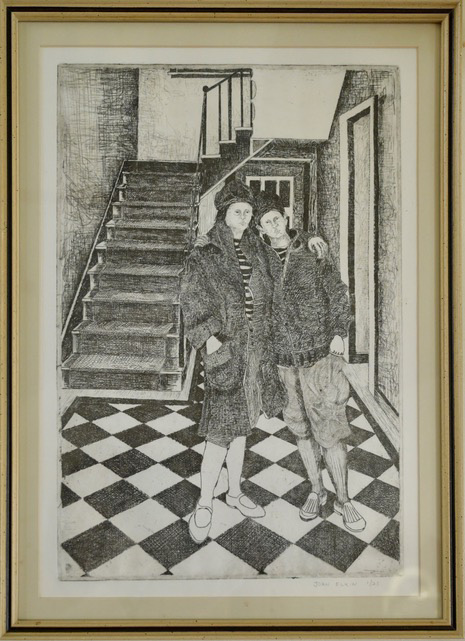
In Rose and Zelda, we see Stanley’s mother Zelda, or Tootsie, as she was called throughout her life, and her sister Rose in a Chicago hallway. Joan made this lithograph in a printmaking class at Washington University, and it was a frontispiece in River Styx magazine in 1984. The cloche hats, sporty period outfits, and setting suggest the roaring 20s. Tootsie gave Stanley and Joan what Stanley called his Tootsie grant so that he and Joan could go to Rome for a year and Stanley could write his first novel.
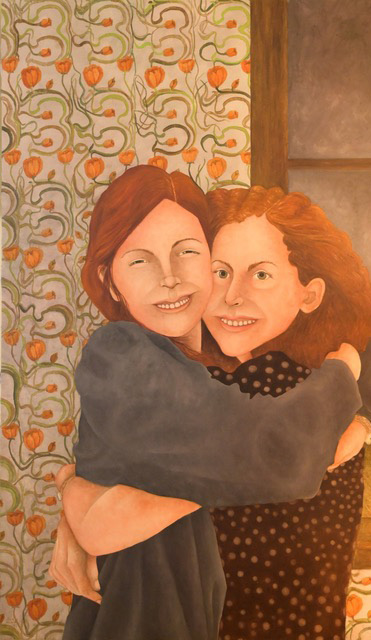
One of Jean Siméon Chardin’s secrets in the 18th Century may have been preparing his canvases with a dark gesso or background, while one of Joan Elkin’s secrets was sizing her canvases with light gesso on both the front and the back. Two more Chardin trademarks were painting everyday things and people rather than the Rococo high life and painting with meticulous care. Joan Elkin did this as well. She painted family and friends using her own version of pointillism and other labor-intensive styles that nod to Seurat’s Divisionism. She chose symbolic locations from her life, travels, art books, including the family’s Westgate house, a favorite library, hill, wall, or path. She also transformed favorite photographs into art. The resulting paintings, watercolors, and lithographs offer gestures and interactions that convey humor, irony, and empathy. Joan’s subjects gaze directly at viewers, as do those in Velasquez’s Las Meninas. Looking at someone directly can make a difference in life and in art.
Jan Rothschild, as a Washington University student, remembers: “As English Literature students at Wash U, we were all terrified of Stanley. He was famously grumpy. A friend in the writing program told me he remarked to a woman in her class: ‘I hope you can f-k better than you can write; otherwise, you’ll never be able to make a living!’ Joan, on the other hand, was warm, welcoming and calm. I used my sister’s car to chauffeur writers to and from the airport and around St. Louis, and since most of the fiction writers were friends of Stanley’s, we’d usually end up in the Elkins’s kitchen, sometimes late into the night. Joan made sure everyone had what they wanted, a drink, a snack, a comfortable place to sit and tell stories. She could hold her own against Stanley’s sometimes biting remarks, either laughing them off, responding in kind, or simply ignoring him. She was lovely to be with. She didn’t need the spotlight the way Stanley did. As an artist, she quietly observed and then used what she saw in her paintings, which are exquisite depictions of her world and the people and places she loved.” Molly, Joan’s daughter, has said, “Good stories were currency in our household. My Mom made up for Stanley’s gruffness. She was our rock.”
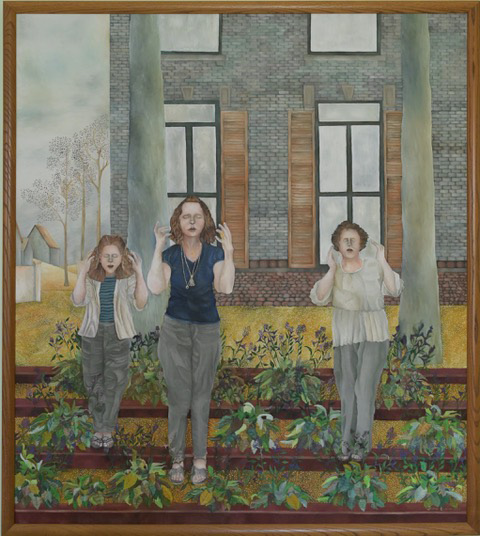
In Picasso’s War, Hugh Eakin documents Picasso’s unpopularity among art patrons in America from the time of the 1913 Armory Show and lasting until Alfred Barr’s big Picasso show in 1939 on the eve of World War II dazzled viewers at the under- construction Museum of Modern Art. Only a lawyer named John Quinn and a few art dealers and patrons saw early on how Picasso was reshaping art. In Joan Elkin’s life, Molly Elkin, her lawyer daughter, along with Washington University’s Joel Minor, curator of the Modern Literature Collection and manuscripts and his Special Collections superstars, have been prescient to feature Joan Elkin’s accomplishments. It’s time for Joan Elkin’s art to dazzle larger audiences. Her legacy is capturing the cosmic story of life’s seasons. She memorializes what it means to love in every frame. We who see why this art speaks to us can carry it forward. G&S


Leave a Comment