
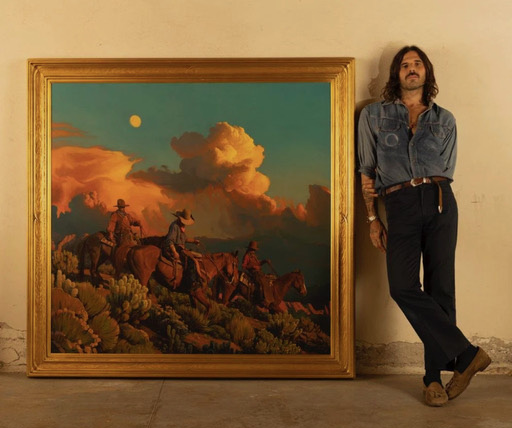
What does it mean to perfectly capture a world that is almost entirely foreign to you? For painter Mark Maggiori, this question isn’t a hypothetical, but rather an everyday directive. Best known for his intricate and vibrant renditions of the American West, Maggiori is an up-and-coming landscape painter. His works feel reminiscent of the large swaths of the American countryside that were delicately captured in the Hudson River School movement of the mid-nineteenth century—except instead of lush green forests and glistening lakes, Maggiori’s paintings feature the quiet everyday of Western cowboys, complete with Stetsons and matching wide-brimmed hats, traversing the dusty Red Rocks of Arizona. But Maggiori’s obsession with the vast American landscape doesn’t stem from his home-grown familiarity with the West, but rather his distance from it.
Born in Fontainebleau, France, Maggiori’s first exposure to American culture was through his obsession with skateboarding, a casual hobby turned burning passion that shaped his adolescent years. In an interview with Billy Meiners, he shared that “In 1987 they did a contest that was called the Open Air and they invited the Bones Brigade so all the guys from Powell Peralta came and it was awesome! There was Steve Caballero and Lester Kasai and Christian Hosoi. It was so good… I was like 9 and my parents were buying me the VHS ‘Wheels On Fire’ II the Santa Cruz videos. So that’s what I grew up with, dreaming of California. Just skating.”
At the age of 15, Maggiori was lucky enough to have the chance to take a cross-country road trip that took him on a journey from New York to California. Although he makes it known that his priorities were mostly focused on the skateboarding and sneaker culture in San Francisco at the time, the trip opened his eyes to the beauty of the American landscape.
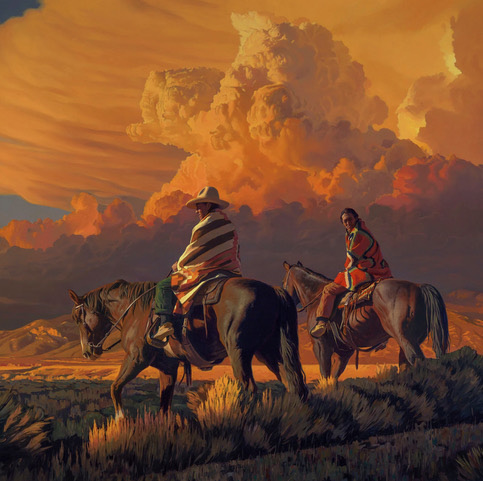
On returning to Paris, Maggiori decided to take the leap and pursue the fine arts. He began his artistic journey by studying painting at the Académie Julian in Paris, a private art school with origins in teaching the French Academic style of painting and a history of giving some of Europe’s most prolific artists a classical art training. Despite its traditional roots, Maggiori didn’t let his love of classical painting interfere with his very non-traditional skater background. During this time, Maggiori was also moonlighting as a singer for Pleymo, a French nu metal band in which he also functioned as the group’s photographer and creative director. Eventually, the band’s long hiatus—which lasted from 2007 to 2017 led to a visit to Oklahoma City where he went to the National Cowboy & Western Heritage Museum and realized that his love for the American West, combined with his fine arts training, could become a tangible career. In an interview with Wolf Schneider, he says that “when I was in Oklahoma and went to the museum, I realized there was a Western form of art. I mean, I might see a Remington painting sometime, but I was really into music. I left the museum and went to a newsstand. I saw magazines showing that art. I realized, ‘wow, there’s a whole scene of people doing this.’ I wanted to try myself at this. I wanted to paint a cowboy and a horse. I really had a feeling for it. I bought stuff and started painting. I told my wife, I want to start painting. So we gave up our little house in L.A. and moved to Arizona.”
After moving to Arizona, Maggiori dedicated his time to capturing the beauty of the Western landscape. His passion and respect for the West and its inhabitants is palpable within his paintings—there is no glamorizing the harshness of the landscape, no John Wayne-ing of the cowboys, no shaping of history or subtle undertones to sway the viewer. Maggiori shows the West how it’s supposed to be viewed—limitless, free, and vibrant.
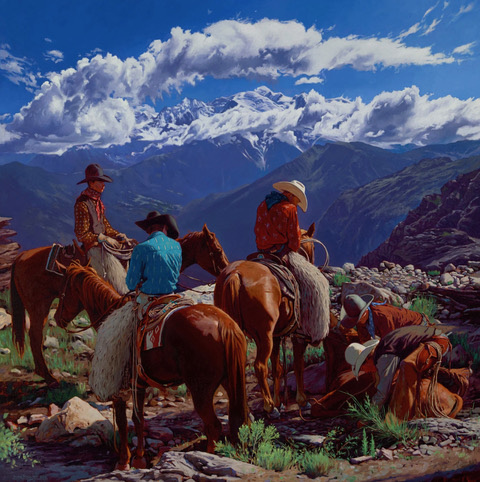
My initial obsession with his work was part of a larger fascination with the recent revival and popularization of traditionalist styles of painting—but specifically
a revival that highlights the subjects that have been historically sidelined or misrepresented in past works. Unfortunately, traditional American landscape paintings have a history of being used as fodder for political messaging, specifically ones that promote a harmful ideal of American nationalism. However, this new revival of the old works to distance itself from this association. Take Maggiori for example—while many depictions of the Western Frontier depict only a very specific type of cowboy (rugged, white, and John Wayne-esque), Maggiori’s paintings highlight the Native American men and women who both worked within and alongside these groups with equal gravitas. Surprisingly unknown (but perhaps not unexpected) to most, the majority of Western depictions of Native Americans in paintings and media wrongly match tribes and their specific manner of dress, leading to an upsetting and frustrating muddling of Native identities. Maggiori, however, gives each one of his subjects the thoughtfulness and attentiveness they deserve. His depictions of the Indigenous populations of the West are not only historically accurate, but also pointedly non-romanticized. While this should be the norm, the intentional steps that Maggiori and others are taking within this revivalist movement are slowly righting the wrongs of their artistic predecessors.
Despite not hailing from America, the love and dedication for the Western Frontier that is poured into each one of Mark Maggiori’s paintings is undeniable. Although he specializes in the vast, lonely expanses of America’s landscapes, he breathes an undeniable life and vividness into the mundane. His devotion to representing foreign expanses with overwhelming detail and dedicated fondness not only outlines him as an artist to keep an eye on, but also as one who is setting a precedent for a new kind of artmaking. G&S



Leave a Comment