
The phrase “Never let a good crisis go to waste,” is attributed to Winston Churchill’s wit during WWII’s dark days. The word “waste” refers to opportunities to be grasped in perilous times, overcoming fear in danger’s face.
One of the meanings of the term “waste” today refers to the pervasive use of plastic packaging in our society, bringing us a perilous environmental predicament. An ecological emergency on land, sea and air, damaging flora and fauna, the harmful effects from plastic’s use will echo in the future. Exposure to plastics may also contribute to endocrine disruptions, bring risks to fetuses and promote the formation of cancers due to this catastrophe looming down the road.
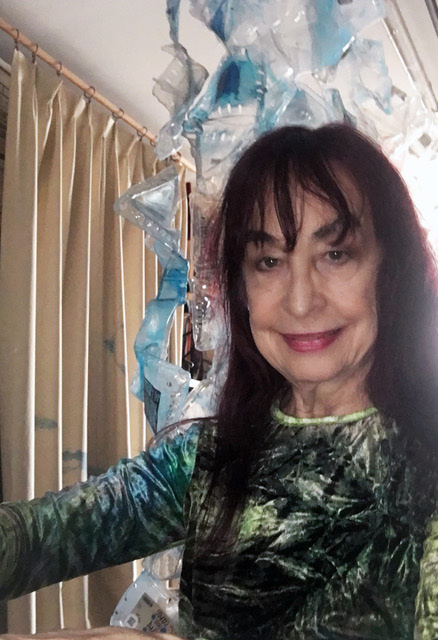
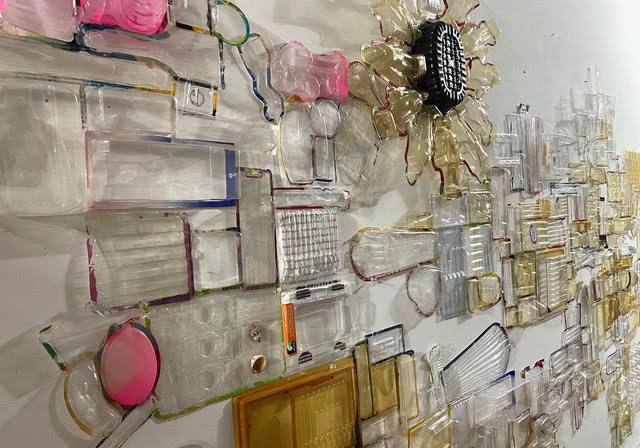
Artist Vernita Nemec tackles this daunting situation head on, repurposing items of trash, the detritus of our modern world, as collaged pieces of artistic and social relevance. She turns junk into thought-provoking sculptures, sparking discussions and questions for viewers to catalyze actions toward climate change mitigation. Additionally, her appreciation of Japanese Butoh movement in performance art and cognizance of wabi-sabi sensibilities play roles in her artistic realizations so that her pieces are imperfect, inferred instances of artistic value, subtle ways to reveal underlying spiritual dimensions.
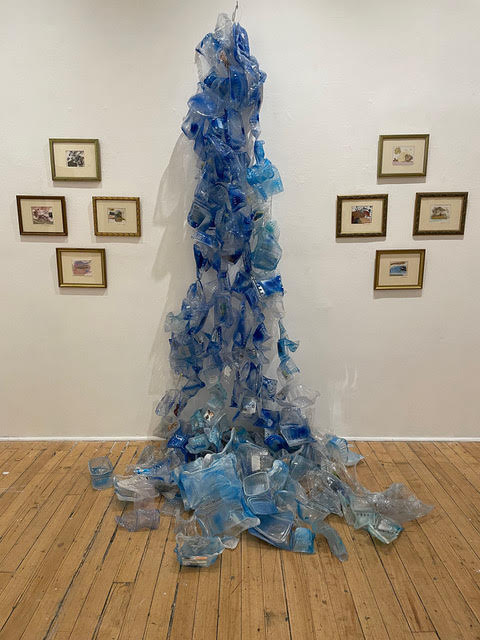
Upon viewing Nemec’s installation Plastic Waterfall, my thoughts turn to childhood visits to Niagara Falls where I would stand awestruck at the mighty waters majestically cascading before me, bathing my face in cool mist. Ancient indigenous people knew the profound value these falls had, respecting them as holy dwelling places of the Thunder Beings, powerful entities tasked with protecting land and home. The striking azure hues of Nemec’s sculpture belie a tragic message about the piece, that nature is in a sad state as finite resources are desecrated by careless human hands, a formerly pristine world increasingly degraded.
At this time in her life, Nemec has ended her long tenure as head of Viridian Artists and hopes to continue curating and presenting her upcycled trash sculptures in venues such as Viridian, along with providing ongoing support for under-known artists through curating and jurying exhibits.
She confesses to worry about our country in the present days, opining “we are losing so much of what our country means. We are a nation of immigrants and people in power seem to have forgotten this history.” Nemec’s philosophy and creativity bear deep relationships to feminist and environmental concerns and in today’s atmosphere she feels it is crucial that she continue making art about both.
To the current cultural zeitgeist, she advises women artists to remain tough as they did in the 1970s and to be fearless in demanding equality and the right to make decisions about their bodies, careers, and personal relationships.
Her message to young art students is “they should get a day job and try not to think about selling their art because it affects the creative process adversely.” Paraphrasing her comments, I write that Nemec recommends “one must try to allow creative motives to come from a desire to express and please oneself, rather than others, to keep doing work from the soul and forget about selling because it messes with what one makes. Think about what is fascinating about the piece so that the sale is not the main reason for the work’s invention.”
In this perilous moment in history, Vernita Nemec’s creative efforts most certainly reflect the idea of never letting “a good crisis go to waste.” This sculptor’s work exposes our increasing degradation of our toxically polluted planet. Her strong and singular voice gives hope that a reviving sweet spirit may in time flow from acrid lemon tree groves. G&S



Leave a Comment