
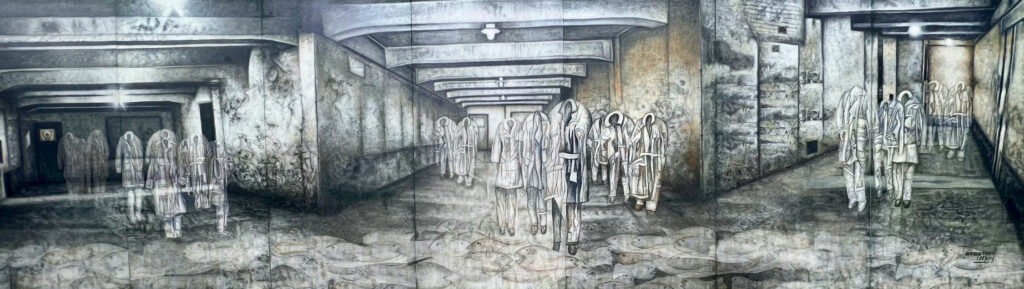
Facing the transfiguration of the Holocaust through painting in contemporary times, after all that has been written and painted about it, is an immense aesthetic, ethical, and even political challenge that Hernán Illescas tackles with the mastery granted by his four decades of continuous artistic production.
The Holocaust is not simply an isolated historical event. Theodor W. Adorno defined it as the extreme manifestations of dehumanization and the instrumentalization of reason that have led to the domination and control of individuals, causing them to lose empathy to the extent that others are treated as mere objects.
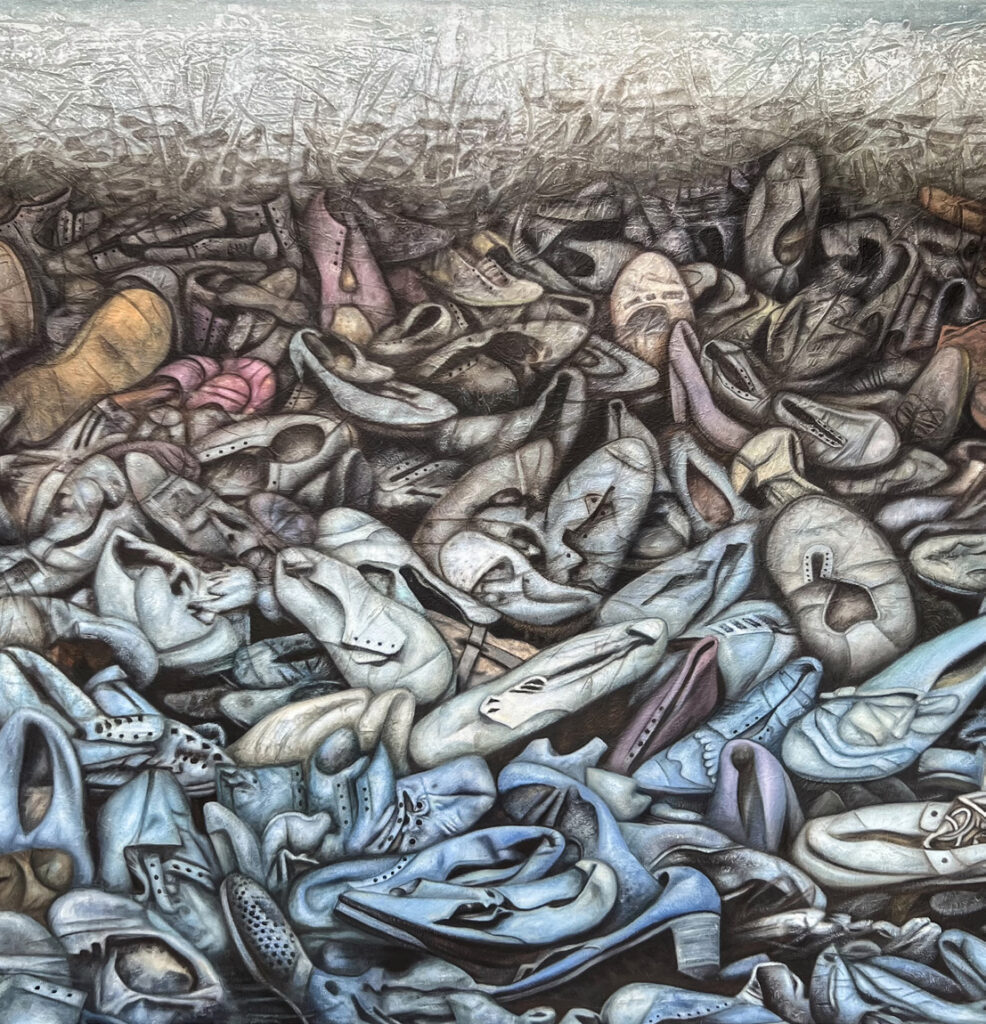
This immense series on the Holocaust that Illescas has created is a successful and radical critique of the origins of the contemporary crisis that has reached the highest levels in the trajectory of the Western Enlightenment project. Illescas’s aesthetic operation does not limit itself to paying homage to the victims.
We believe it is possible to propose another reading of this work, one that discovers its appealing gesture directed at the viewer, inviting them to an emotional and thoughtful experience about the consequences of democratic decisions. For this, it is necessary to remember the origin of the Third Reich and Hitler’s rise to power as products of a democratic election in a scenario of widespread discontent due to the consequences of World War I and devastating inflation, which created a favorable environment for the emergence of extremist movements like the Nazi Party, led by Hitler.
He skillfully exploited this social unrest, presenting himself as the solution to Germany’s problems. His nationalist, xenophobic, and anti-Semitic discourse managed to gain the support of broad sections of the population, especially those who felt marginalized or disillusioned with the established political system. Let us also remember that the Holocaust took the lives of 6 million Jews and millions of other people belonging to marginalized groups, such as Roma, the disabled, homosexuals, and political dissidents. The Holocaust was the result of meticulous planning; it was a systematic extermination, using industrial methods like concentration camps, gas chambers, and crematoria; it was also an implacable racial persecution that expanded with the collaboration and complicity of states and individuals who shared the goals of the Nazi project and undoubtedly has a lasting impact on intergenerational consciousness.
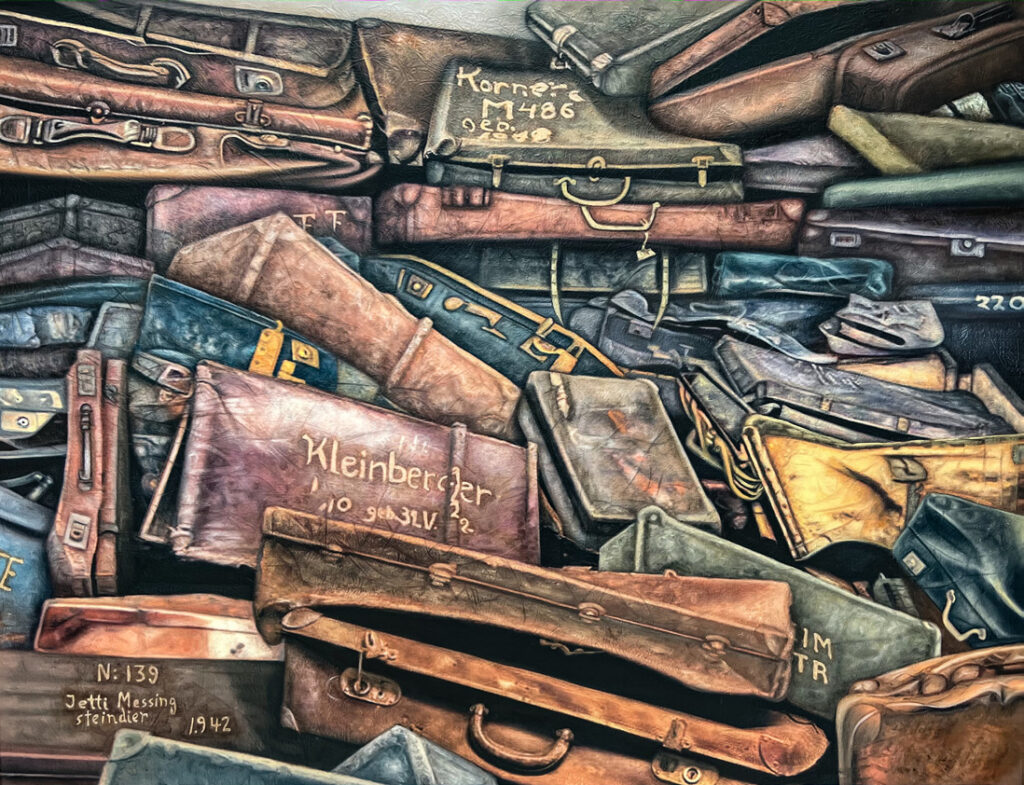
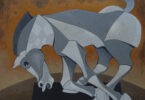
In this context, the aesthetic and extra-aesthetic values of this series of large formats and disturbing neo-figurative or neo-expressionist images move the viewer, thanks to the artist’s conscious renunciation of the decorative and the treatment of a terrifying beauty that leaves no one indifferent. Illescas also demonstrates with this series his great technical mastery, the result of a 40-year career that has allowed him to thoroughly understand the virtues and limits of materials, a diversity of techniques, and a variety of languages with which he has dialogued: painting, ceramics, mural, installation, sculpture.
Illescas owns a unique style characterized by the handling of highly expressive figures whose gazes are unsettling; because he knows and properly handles textures, the semiotics of color, the choice of formats, and, above all, because he has managed to configure powerful symbols that speak of his clear conceptual, ethical, and political stance.
This stance allows spectators to experience a wide and varied range of emotions that oscillate from pain, shame, terror, and sadness to solidarity with the victims who could live the terror of similar policies being repeated anywhere in the world. In this series on the Holocaust, handled with singular mastery, Illescas demonstrates that the emotions produced by great plastic art generate aesthetic knowledge, as important as scientific and philosophical knowledge, thus capable of promoting collective and individual emotions with the potential to transform daily life.
Shoes, suitcases, suits, skins marked with numbers branded with ink are transfigured by the artist until they become symbols of the dehumanization and objectification inflicted on life by Modernity in favor of the arrogance of capital. We are increasingly less human and more numbers and objects without criteria or critical capacity.
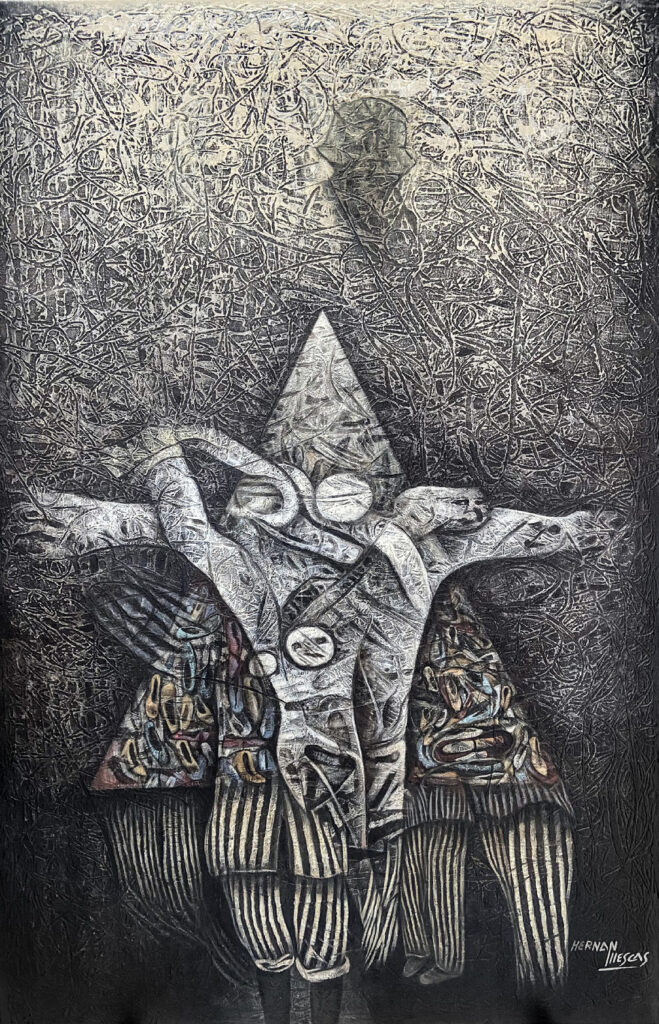
Illescas’s present work also brings to mind the reflections of Hannah Arendt on the banality of evil, analyzing the behavior of seemingly ordinary individuals who participated in the extreme atrocities of the Holocaust, like Adolf Eichmann and other perpetrators of the Nazi regime, who lacked critical thinking, personal responsibility, and moral resistance to blind obedience to authority and social conformity.
Arendt argues that the capacity to commit evil acts is not limited to a few exceptionally evil individuals but can arise in contexts where social and political norms dehumanize certain groups and foster uncritical obedience. However, this in no way justifies the crimes of the Holocaust nor absolves those who participated in them of moral and legal responsibility.
Illescas’s series on the Holocaust allows us to extrapolate the concept of the “banality of the soul” to form an opinion about the behaviors of those seemingly ordinary people who can commit extremely evil acts as a result of their alienation in a system that has no interest in critical thinking. On the contrary, this great art by Illescas triggers what evil does not want to occur: critical thinking, individual responsibility, and moral resistance. G&S
Cecilia Suárez Moreno is Professor Emerita of the University of Cuenca

Leave a Comment